Why in the News ?
Recently, the 11th Review Conference of the States Parties to the Treaty on the Non-Proliferation of Nuclear Weapons (NPT) ended without a unanimous outcome document, re-emerging the challenges of global nuclear disarmament efforts and international consensus-building.
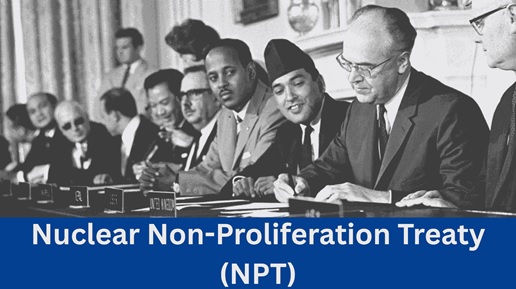
What is the Treaty on the Non-Proliferation of Nuclear Weapons (NPT) ?
- The Treaty on the Non-Proliferation of Nuclear Weapons (NPT) is an international treaty aimed at preventing the spread of nuclear weapons in the world and promoting the peaceful uses of nuclear energy.
- It is considered the cornerstone of global nuclear governance.
Major Objectives of the NPT
- Nuclear Non-Proliferation: Preventing the spread of nuclear weapons and related technology.
- Peaceful Use of Nuclear Energy: Encouraging the peaceful and developmental use of nuclear energy.
- Nuclear Disarmament: Working towards complete nuclear disarmament by reducing nuclear weapons globally.
Key Features
- The treaty establishes safeguards under the supervision of the International Atomic Energy Agency (IAEA).
- The IAEA monitors compliance with the treaty by member states through inspection and verification mechanisms.
- It is a legally binding international treaty.
- Signatures of the treaty began in 1968 and it came into effect in 1970.
States Parties to the NPT
- Currently, there are 191 States Parties to the NPT.
- Five countries are recognized as Nuclear Weapon States:
- United States
- Russia
- China
- United Kingdom
- France
India and the NPT
- India is not a party to the NPT. India believes the treaty is discriminatory because it recognizes only five countries as nuclear weapon states, while imposing restrictions on others.
- India supports universal, non-discriminatory, and verifiable nuclear disarmament.
Importance of the NPT
- The cornerstone of the global nuclear non-proliferation regime.
- The primary means of controlling the nuclear arms race.
- Promoting the peaceful use of nuclear energy.
- Strengthening international security and strategic stability.
- Providing the institutional basis for nuclear disarmament efforts.
Conclusion
- The Treaty on the Non-Proliferation of Nuclear Weapons (NPT) is considered the cornerstone of the global nuclear non-proliferation regime, having played a vital role in limiting the spread of nuclear weapons and promoting the peaceful uses of nuclear energy.
- However, slow progress on nuclear disarmament, geopolitical competition, and differences among member states continue to challenge its effectiveness. A more inclusive, balanced, and universal nuclear disarmament regime is needed to ensure global peace and security.






 Contact Us
  New Batch : 9555124124/ 7428085757
  Tech Support : 9555124124/ 7428085757