
- UPSC Exam
- State PCS
- One Day Exam
- Current Affairs
- PT Quiz
- Downlaods
- About Coaching
- Blog
- Videos

| Prelims: Advanced Medium Combat Aircraft (AMCA) | Rolls-Royce | Reliance Industries | Aero-Engine | Aerospace Gas Turbine | Fighter Jet Propulsion | Strategic Autonomy | Atmanirbhar Bharat | Defence Manufacturing | Technology Transfer Mains: GS Paper III – Defence Technology & Indigenisation | Strategic Autonomy | Defence Manufacturing | Public-Private Partnership | Critical Technologies |
Reliance Industries Limited (RIL) and British aerospace major Rolls-Royce announced, their strategic intent to partner for the design, development, manufacturing and delivery of a sovereign indigenous combat engine for India’s Advanced Medium Combat Aircraft (AMCA) programme.
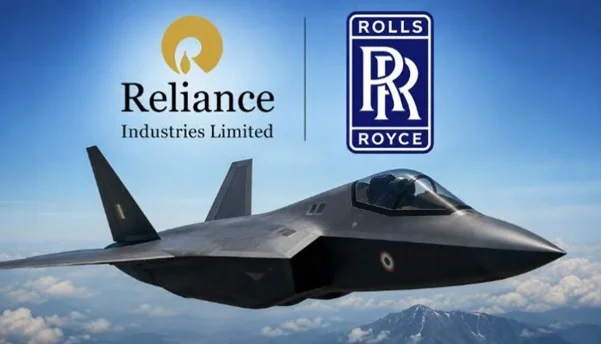
The Advanced Medium Combat Aircraft (AMCA) is India’s proposed twin-engine, stealth-capable, fifth-generation fighter aircraft programme. It is being developed to strengthen the Indian Air Force’s capability in high-end air combat and reduce dependence on foreign combat aircraft and critical technologies.
The engine is arguably one of the most technologically demanding components of the programme because modern fighter engines require advanced materials, high-temperature metallurgy, sophisticated cooling, precision manufacturing and highly reliable propulsion systems.
The proposed collaboration seeks to combine the respective strengths of both companies.
|
Reliance Industries |
Rolls-Royce |
|
Industrial scale |
Advanced propulsion expertise |
|
Manufacturing capabilities |
Century-long aerospace engineering experience |
|
Technology and execution capabilities |
Aero-engine design expertise |
|
Indian industrial ecosystem |
Global engine development experience |
|
Supply-chain and production capabilities |
Power and propulsion technology |
The companies will explore establishing an Aerospace Gas Turbine Complex in India. The proposed complex could eventually create an integrated ecosystem covering:
Design → Development → Manufacturing → Testing → Production → Maintenance & Through-life Support
This end-to-end approach is important because merely assembling foreign-designed engines in India would provide much less strategic autonomy than developing and controlling critical technologies domestically.
A fighter aircraft is only as capable as its propulsion system. Dependence on foreign engines can create strategic vulnerabilities during geopolitical crises, sanctions or supply-chain disruptions. Indigenous engine capability would strengthen India’s strategic autonomy.
India has developed significant capabilities in aircraft design, missiles, radar and space technology, but high-performance fighter aero-engines remain a major technological challenge. The proposed collaboration could help India address this long-standing gap.
The project aligns with India's broader objective of increasing domestic defence manufacturing and reducing dependence on imported military hardware.
A modern fighter engine requires a sophisticated industrial ecosystem involving: Advanced materials, Super alloys, Single-crystal turbine blades, precision machining, Additive manufacturing, Thermal barrier coatings, Digital manufacturing, advanced testing facilities, Maintenance, Repair and Overhaul (MRO). Therefore, the project could generate technological spill overs beyond the AMCA programme.
If India develops competitive aero-engine capabilities, it could eventually participate in the global aerospace supply chain and potentially export components, subsystems and propulsion technologies.
An aero-engine is the propulsion system that generates thrust to propel an aircraft. Modern fighter aircraft generally use gas-turbine engines.
A simplified working sequence is:
Air Intake → Compression → Combustion → Turbine → Exhaust → Thrust
In a turbofan/turbojet-type military engine:
For advanced fighter aircraft, the engine must deliver a difficult combination of:
High thrust + low weight + fuel efficiency + reliability + thermal management + combat survivability
The partnership is significant because it indicates a greater role for private-sector participation in strategic defence technologies. India's defence-industrial ecosystem is increasingly moving from a model dominated by government-owned organisations towards collaboration among:
Government + DRDO/ADA + DPSUs + Private Industry + Global Technology Partners + MSMEs + Start-ups
Such an ecosystem can accelerate innovation, manufacturing capacity and technology absorption.
Despite its potential, developing an indigenous fighter engine will not be easy.
The Reliance–Rolls-Royce proposal should be viewed in the larger context of India's attempt to build sovereign defence capabilities. The most important lesson is that defence self-reliance does not necessarily mean developing every technology in isolation. India can combine:
Foreign technological expertise + Indian manufacturing + domestic R&D + indigenous supply chains
If successfully executed, the proposed Aerospace Gas Turbine Complex could become a major hub for India's future military and civil aerospace propulsion ecosystem.The partnership also has the potential to expand beyond the AMCA engine into defence, civil aerospace and next-generation power and propulsion systems, according to the companies.
UPSC Prelims MCQQ. With reference to the proposed Reliance Industries–Rolls-Royce partnership, consider the following statements:
Which of the statements given above is/are correct? A. 1 and 2 only Mains Practice QuestionQ. “Indigenous aero-engine capability is central to India's strategic autonomy in military aviation.” Discuss the technological, industrial and strategic significance of the proposed Reliance–Rolls-Royce partnership for the AMCA programme. |
1. What is AMCA?Answer: AMCA is India's proposed twin-engine, stealth-capable fifth-generation combat aircraft programme aimed at strengthening the Indian Air Force's advanced air-combat capabilities. 2. What is the Reliance–Rolls-Royce partnership about?Answer: It aims to explore joint design, development, manufacturing and delivery of a sovereign indigenous combat engine for the AMCA programme. 3. What is the proposed Aerospace Gas Turbine Complex?Answer: It is a proposed Indian facility intended to build end-to-end capabilities in aero-engine design, development, manufacturing, testing, production and through-life support. 4. Why is an indigenous fighter engine important for India?Answer: It can reduce dependence on foreign propulsion systems, strengthen strategic autonomy and create a high-end domestic aerospace manufacturing ecosystem. 5. Is the AMCA engine contract finally awarded to Reliance and Rolls-Royce?Answer: No. The August 2026 announcement represents a strategic intent to partner; it is not itself a final government selection or awarded engine contract. |


Our support team will be happy to assist you!

 Contact Us
  New Batch : 9555124124/ 7428085757
  Tech Support : 9555124124/ 7428085757