
New
GS Foundation (P+M) - Delhi : 19th Jan. 2026, 11:30 AM Spring Sale UPTO 75% + 10% Off, Valid Till : 6th Feb., 2026 GS Foundation (P+M) - Prayagraj : 09th Jan. 2026, 11:00 AM Spring Sale UPTO 75% + 10% Off, Valid Till : 6th Feb., 2026 GS Foundation (P+M) - Delhi : 19th Jan. 2026, 11:30 AM GS Foundation (P+M) - Prayagraj : 09th Jan. 2026, 11:00 AM

Capital Punishment in India: Appellate Corrections Expose Deep Trial-Level Failures

Prelims: (Polity & Governance + CA)
Mains: (GS 2 – Governance, Judiciary, Constitution; GS 4 – Ethics in Public Administration)

Why in News ?

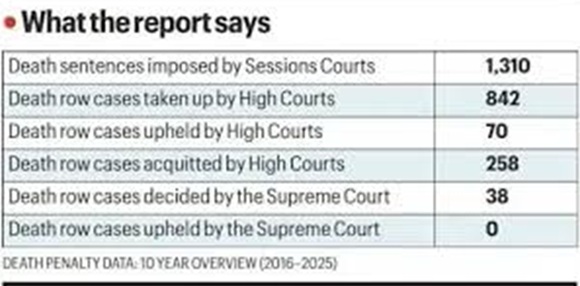
A decade-long study (2016–2025) by the Square Circle Clinic, NALSAR University of Law, reveals systemic flaws in death penalty sentencing in India.
While trial courts frequently impose death sentences, appellate courts (High Courts and the Supreme Court) overturn, commute, or acquit in the overwhelming majority of cases, indicating widespread errors and unjustified convictions at the trial stage.
The findings have major implications for criminal justice reform, due process, Article 21, and capital punishment jurisprudence.

Death Penalty in India

Meaning

  • The death penalty is a legal punishment for the most heinous crimes such as:
    • Murder,
    • Gang rape of minors,
    • Terrorism-related offences.
  • It is constitutionally restricted to the “rarest of rare” cases under the IPC/CrPC framework.

Confirmation and Appellate Review

  • A death sentence passed by a Sessions Court must be confirmed by the High Court.
  • The convict has a right to:
    • Appeal to the Supreme Court,
    • Seek review and curative petitions,
    • Seek executive clemency.

Exceptions

  • Death penalty cannot be imposed on:
    • Individuals who were below 18 years at the time of the offence.
  • Execution is generally avoided for:
    • Pregnant women.

Bharatiya Nyaya Sanhita (BNS), 2023

  • Retains capital punishment for heinous crimes.
  • Continues to restrict its application to the “rarest of rare” cases.

Constitutional and Legal Framework

Constitutional Provisions

  • Article 21:
    • Death penalty is not per se unconstitutional, provided the procedure is fair, just, and reasonable.
  • Articles 14 and 19:
    • Though challenged, capital punishment has been upheld as constitutionally valid.
  • Article 72:
    • Empowers the President to grant pardons, reprieves, respites, or commute sentences, including death sentences.

Judicial Precedents (Key Cases)

  • Jagmohan Singh v. State of UP (1973):
    • Upheld the constitutionality of the death penalty.
  • Bachan Singh v. State of Punjab (1980):
    • Established the “rarest of rare” doctrine.
  • Machhi Singh v. State of Punjab (1983):
    • Laid down guiding categories for applying the doctrine.
  • Mithu v. State of Punjab (1983):
    • Struck down mandatory death penalties (e.g., Section 303 IPC) as unconstitutional.

Judicial Discretion

  • Courts must balance:
    • Aggravating factors: Brutality, premeditation, threat to society.
    • Mitigating factors: Age, mental health, socio-economic background, possibility of reform and rehabilitation.

Key Findings of the Report

1. Stark Disparity Between Trial and Appellate Courts

  • 2025 data:
    • Sessions Courts awarded 128 death sentences in 94 cases.
    • High Courts overturned death sentences in nearly 90% of cases.
    • Supreme Court acquitted the accused in over 50% of cases (10 out of 19).
  • This reflects a systemic pattern, not isolated errors, of wrongful or unjustified convictions.

2. Growing Death Row Population Despite Fewer Confirmations

  • 574 persons on death row as of December 31, 2025 — the highest since 2016.
  • Paradox:
    • Appellate courts show increasing restraint,
    • Yet trial courts continue imposing death sentences at scale.

3. Supreme Court’s Evolving Due Process Jurisprudence

  • 2022 Guidelines:
    • Trial courts must consider:
      • Psychological evaluation reports,
      • Probation officer reports,
      • Prison conduct records,
      • Evidence on potential for reform.
  • Vasanta Sampat Dupare v. Union of India (2025):
    • Sentencing hearings declared an essential part of a fair trial.
    • Non-compliance violates Articles 14 and 21.
    • Allowed reopening of sentencing hearings even after exhaustion of appeals.
    • Reflects a constitutional shift towards mitigation-centric and procedural fairness-based sentencing.

4. Persistent Non-Compliance at the Sessions Court Level

  • In 2025, trial courts failed to comply with Supreme Court guidelines in:
    • 79 out of 83 cases — a 95.18% non-compliance rate.
  • Sentencing often:
    • Occurred on the same day as conviction (18 cases),
    • Within five days in over two-thirds of cases.
  • Such haste prevents:
    • Collection of mental health records,
    • Proper investigation into social background,
    • Effective presentation of mitigating circumstances.

5. Legislative Expansion vs Judicial Retrenchment

  • While higher judiciary shows increasing caution, legislatures have:
    • Expanded the scope of capital punishment through statutory amendments.
  • This reflects a disconnect between legislative intent and judicial constitutionalism.

6. Rise of Life Imprisonment Without Remission

  • Appellate courts increasingly commute death sentences to:
    • Fixed-term imprisonment or whole-life imprisonment without remission.
  • The report flags this as:
    • A poorly regulated and arbitrary sentencing category.
  • Such sentences:
    • Remove the possibility of remission,
    • Deprive prisoners of hope,
    • Undermine human dignity under Article 21.

7. Geographical and Offence-Wise Trends

  • States with highest death row population:
    • Uttar Pradesh (highest),
    • Followed by Gujarat, Haryana, Maharashtra, Kerala, and Karnataka.
  • Women:
    • Constituted 4.18% of death row inmates in 2025.
  • Major offences:
    • Murder simpliciter,
    • Murder involving sexual offences.

Challenges Highlighted and Way Forward

Key Challenges

  • Systemic failure of trial courts to follow constitutional safeguards.
  • High risk of wrongful convictions, especially in capital cases.
  • Arbitrary use of life imprisonment without remission.
  • Gap between evolving constitutional jurisprudence and ground-level judicial practice.
  • Legislative push towards harsher punishments amid judicial caution.

Way Forward

  • Mandatory and enforceable implementation of the Supreme Court’s 2022 sentencing guidelines.
  • Capacity-building and sensitisation of trial judges on mitigation and sentencing hearings.
  • Development of a clear statutory framework governing life imprisonment without remission.
  • Strengthening legal aid, defence representation, and investigative standards in capital cases.
  • Aligning legislative policy with constitutional values of:
    • Fair trial,
    • Proportionality,
    • Human dignity.

FAQs

1. What is the “rarest of rare” doctrine ?

It is a judicial principle that restricts the death penalty to only the most exceptional cases where life imprisonment is inadequate, based on a balance of aggravating and mitigating factors.

2. Why are appellate courts overturning most death sentences ?

Because trial courts frequently fail to follow due process, properly assess mitigating factors, or conduct adequate sentencing hearings, leading to unjust or erroneous convictions.

3. Is the death penalty unconstitutional in India ?

No. The Supreme Court has upheld its constitutionality under Article 21, provided the procedure followed is fair, just, and reasonable.

4. What is life imprisonment without remission, and why is it controversial ?

It is a sentence where the convict is imprisoned for life with no possibility of remission. It is controversial due to lack of statutory regulation and concerns over human dignity and hope for reform.

5. What reforms are needed in India’s death penalty framework ?

Key reforms include strict enforcement of sentencing guidelines, better judicial training, stronger legal aid, statutory regulation of life without remission, and alignment of laws with constitutional values.

Have any Query?

Our support team will be happy to assist you!

OR


