
- UPSC Exam
- State PCS
- One Day Exam
- Current Affairs
- PT Quiz
- Downlaods
- About Coaching
- Blog
- Videos

| Prelims : (Economics + CA) Mains : (GS 3 – Energy Security, Nuclear Energy Policy, Clean Energy Transition) |
The recently proposed SHANTI Act 2025 aims to expand India’s nuclear energy sector by allowing wider participation from public and private players, academia, and industry, while strengthening the regulatory ecosystem.
At the same time, India’s ambitious plan to achieve 100 GWe nuclear power capacity by 2047 faces a major challenge : limited domestic uranium reserves. Achieving this capacity may require 18,000–20,000 tonnes of uranium annually, which would largely depend on imports.
This has renewed policy attention on thorium-based nuclear fuel cycles, where India possesses some of the largest reserves in the world.
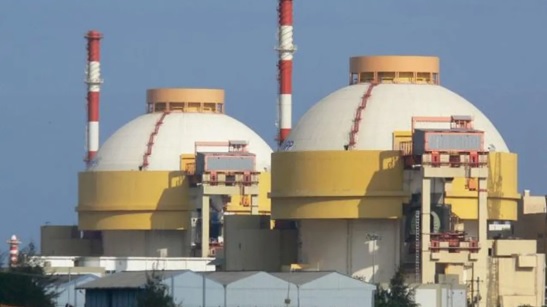
Nuclear power is expected to remain a reliable low-carbon energy source in the coming decades, especially as countries aim to reduce dependence on fossil fuels.
However, conventional nuclear power largely relies on uranium-based fuel cycles, which pose long-term sustainability concerns due to :
In this context, India’s long-standing nuclear strategy—designed by Homi Jehangir Bhabha — focuses on utilising abundant thorium reserves to ensure long-term energy security.
Thorium offers a potential alternative to uranium-based nuclear fuel cycles.
Unlike uranium, thorium itself is not directly fissile, but it can be converted into uranium-233, a fissile material capable of sustaining nuclear reactions.
Advantages of Thorium-Based Fuel
Through nuclear fuel recycling, the energy extracted from nuclear fuel can increase 50–100 times compared to once-through cycles, improving resource efficiency.
India’s nuclear strategy is structured around a three-stage programme designed to gradually transition toward thorium-based energy generation.
The first stage relies on Pressurised Heavy Water Reactor technology.
Fuel : Natural uranium (U-238)
PHWRs currently form the backbone of India’s nuclear power generation.
The second stage involves Fast Breeder Reactor (FBRs).
Fuel : Plutonium-239 and uranium-238.
FBRs breed more fissile material than they consume, generating the fuel inventory needed for the third stage.
India’s 500 MWe Prototype Fast Breeder Reactor (PFBR) is nearing completion and is a crucial step toward scaling this technology.
The final stage aims to fully utilise thorium.
Fuel : Thorium-232 and plutonium-239.
Thorium-232 is converted into uranium-233, which then acts as the fissile fuel for electricity generation.
This stage is designed to enable long-term sustainable nuclear power generation in India.
Fast breeder reactors are essential for producing the fissile materials required for thorium utilisation.
They help :
However, widespread deployment of FBRs is expected only in the coming decades, as the technology is complex and capital-intensive.
India’s immediate nuclear expansion strategy focuses largely on Pressurised Heavy Water Reactors.
These reactors :
At the same time, PHWRs could be used to irradiate thorium, helping generate uranium-233 earlier and accelerating the transition to the third stage.
Another emerging pathway involves combining thorium with High-Assay Low-Enriched Uranium (HALEU).
However, India currently lacks adequate irradiation testing facilities for such advanced fuels. International collaboration could accelerate technology development.
India is also exploring advanced nuclear technologies such as :
Small Modular Reactor (SMRs) offer :
These reactors could also support green hydrogen production, contributing to the clean energy transition.
India is researching Thorium Molten Salt Reactors (TMSRs) that can :
1. Energy Security
Thorium utilisation can significantly reduce dependence on imported uranium, strengthening India’s strategic autonomy.
2. Clean Energy Transition
Nuclear energy provides stable low-carbon power, helping India meet climate commitments.
3. Technological Leadership
India’s expertise in thorium fuel cycles could make it a global leader in advanced nuclear technology.
4. Long-Term Sustainability
Thorium reserves can potentially sustain India’s energy needs for centuries, ensuring long-term power security.
To realise the 100 GWe nuclear power vision by 2047, India needs to :
Such measures can help India move toward energy independence and sustainable nuclear power generation.
FAQs1. Why is thorium important for India’s nuclear programme ? Thorium is abundant in India and can be converted into uranium-233, enabling long-term sustainable nuclear energy generation. 2. What is India’s target for nuclear power capacity ? India aims to achieve 100 GWe of nuclear power capacity by 2047. 3. What are Fast Breeder Reactors (FBRs) ? Fast breeder reactors are nuclear reactors that produce more fissile fuel than they consume, enabling efficient fuel utilisation. 4. What is HALEU fuel ? HALEU (High-Assay Low-Enriched Uranium) is uranium enriched between 5% and 20% U-235, used in advanced nuclear reactors. 5. What is the three-stage nuclear programme of India ? India’s nuclear programme consists of PHWRs using uranium, Fast Breeder Reactors using plutonium, and thorium-based reactors using uranium-233. |



Our support team will be happy to assist you!

 Contact Us
  New Batch : 9555124124/ 7428085757
  Tech Support : 9555124124/ 7428085757