
- UPSC Exam
- State PCS
- One Day Exam
- Current Affairs
- PT Quiz
- Downlaods
- About Coaching
- Blog
- Videos

| Prelims: (Minority Affairs + CA) Mains: (GS-2 – Governance; GS-1 – Society) |
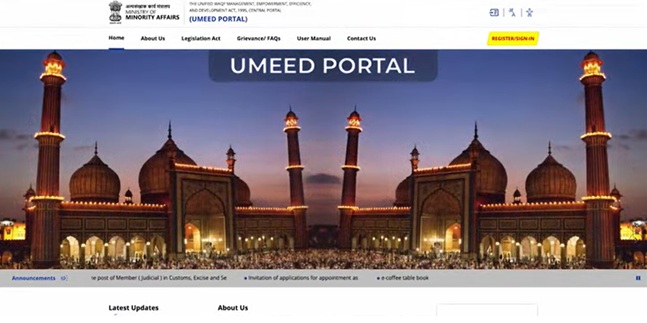
The Union Minister for Minority Affairs announced that the government will not impose penalties or strict action for the next three months on individuals or institutions that have not yet registered Waqf properties on the UMEED Portal, giving stakeholders additional time to complete documentation.
Waqf properties, historically created for charitable, religious, educational, and community welfare purposes, constitute one of the largest public endowment ecosystems in India.
However, for decades, the sector has faced recurring challenges:
An expert committee in 2013 and subsequent audits repeatedly highlighted the need for digitization, central monitoring, and transparent management of Waqf assets.
To address these concerns, the government introduced a framework for unified digital management, culminating in the creation of the UMEED Portal under the Unified Waqf Management, Empowerment, Efficiency and Development Act, 1995.
The portal aims to shift Waqf property governance from manual, fragmented records to centralized, real-time, transparent systems.
The Unified Waqf Management, Empowerment, Efficiency, and Development (UMEED) Portal is a centralized digital platform developed to modernize and streamline the management of Waqf properties across India.
It aims to:
The portal is managed by the Ministry of Minority Affairs, with registration facilitated through respective State Waqf Boards.
Legal Basis
1. Digital Inventory & Geo-Tagging
2. Real-Time Uploading & Verification
3. GIS Mapping Integration
4. Online Grievance Redressal
5. Transparent Leasing & Usage Tracking
6. Public Access to Verified Records
7. Rule on Women-Owned Properties
The Minister clarified that:
This aims to ensure smooth onboarding rather than coercive enforcement.
It marks a major shift from paper-based processes to digital governance.
FAQs1. What is the main purpose of the UMEED Portal ? To create a centralized digital system for registering, monitoring, and managing Waqf properties across India. 2. Why has the government paused penalties for three months ? To give stakeholders additional time to register and verify documentation without fear of punitive action. 3. Who manages the portal ? The Ministry of Minority Affairs, with support from State Waqf Boards. 4. Are women-owned properties considered Waqf ? No. Properties registered in the names of women are not eligible to be classified as Waqf properties. 5. How does geo-tagging help ? It accurately maps property boundaries, prevents illegal occupation, and creates reliable digital records. |



Our support team will be happy to assist you!

 Contact Us
  New Batch : 9555124124/ 7428085757
  Tech Support : 9555124124/ 7428085757