Why in the News?
- The Fifth Plenum of the 20th Central Committee of the Chinese Communist Party (CCP) will be held in Beijing from October 26 to 29.
- It is the last major meeting of more than 300 top leaders before the 21st Party Congress scheduled for 2027. It is expected to shape China’s future political direction and governance framework.
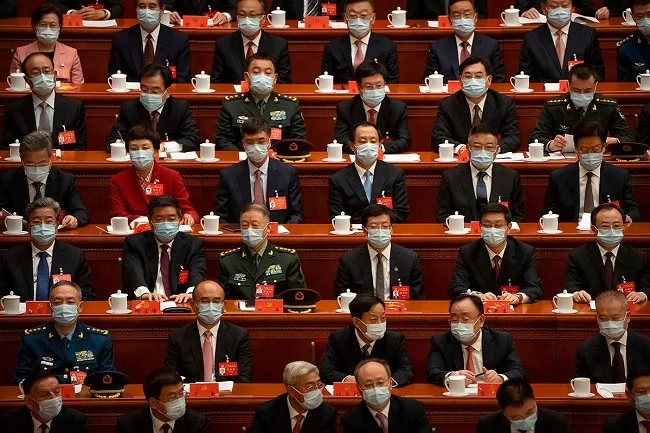
What Is a Plenum?
- A Plenum is a full meeting of the central committee of a political party.
- In China, the ruling Chinese Communist Party (CCP) periodically convenes such meetings to discuss party strategy, economic policy, administrative reforms, security, and leadership-related issues.
China’s System of Governance
- China’s governance system is one of the world’s most distinctive and complex political systems. Unlike Western liberal democracies, China follows a one-party socialist system led by the Communist Party.
- This system is described as “Socialism with Chinese Characteristics.”
Major Features and Structure
1. Supremacy of the Communist Party (CCP)
- The Chinese Communist Party exercises dominant political control over China’s political and governance systems.
- The country’s Constitution recognizes the leadership of the Communist Party.
- The government, legislature, judiciary, and military operate within a political system led by the Party.
2. Democratic Centralism
- Democratic centralism is an organizational principle governing the Party and its functioning.
- It means that lower-level officials and party members may participate in discussions during the policymaking process. However, once the top leadership makes a decision, all members are expected to follow it strictly.
3. Major Positions of Power
General Secretary of the Communist Party
- This is the most powerful political position within the Party and plays a central role in determining China’s ideological and political direction.
President of the People’s Republic of China
- The President is the country’s head of state and represents China in diplomatic and ceremonial functions.
- However, the office also carries constitutional responsibilities, and the actual distribution of power depends on the position-holder’s other leadership roles.
Chairman of the Central Military Commission
- The Chairman exercises the highest leadership authority over the armed forces through the Central Military Commission (CMC).
- In China, the military is considered central to political power. The famous political maxim, “Political power grows out of the barrel of a gun,” is associated with Mao Zedong.
4. Top Decision-Making Bodies
Politburo Standing Committee
- The Politburo Standing Committee is the most powerful regular political leadership body in China.
- It generally consists of seven members who oversee major political, economic, and strategic decisions.
National People’s Congress (NPC)
- The NPC functions as China’s national legislature.
- However, unlike legislatures in competitive multiparty democracies, it does not operate as an independent parliamentary opposition capable of routinely challenging or replacing the ruling leadership.
- It plays a major role in formal legislative approval and constitutional functions within the Party-led political system.
5. Administrative Structure and Local Governance
Provinces and Autonomous Regions - China is divided into provinces andautonomous regions. Tibet and Xinjiang, for example, have the status of autonomous regions.
Counties and Townships
- Counties and townships are important local administrative units responsible for implementing policies and managing local affairs.
- Party cadres supervise governance and policy implementation at these levels.
Presidential Election in China
1. Role of the Ruling Party
- The Chinese Communist Party occupies the dominant position in China’s political system.
- In practice, the person who becomes President is generally selected through the Party’s top-level political process and is usually also the Party’s General Secretary.
- The President is not directly elected by the general public through a competitive nationwide presidential election.
2. The Formal Role of the National People’s Congress (NPC)
- Once the Party’s top leadership has determined its preferred candidate, the presidential election takes place through the National People’s Congress.
- The NPC consists of nearly 3,000 deputies representing different parts of China and various sectors of society.
- The process is not a competitive, direct popular presidential election comparable to those held in multiparty democracies. The Party’s leadership plays the decisive role in determining the political leadership.
3. Other Important Positions Held by the President
In China, the presidency alone does not explain the full extent of political power. The country’s most powerful leader generally holds three key positions simultaneously:
- General Secretary of the CCP: Provides political and ideological leadership.
- Chairman of the Central Military Commission (CMC): Exercises the highest leadership authority over the military.
- President of the People’s Republic of China: Serves as the head of state and represents China internationally.
The combination of these three positions enables the leader to exercise extensive influence over the Party, the military, and the state.
4. Term Limits
- Previously, China’s Constitution limited the President and Vice-President to two consecutive terms.
- In 2018, a constitutional amendment removed the two-consecutive-term limit for the presidency.
- Consequently, Xi Jinping can continue serving as President beyond two terms, provided he is elected again through the constitutional process. The amendment does not itself establish a lifetime presidency or guarantee that he will remain in office indefinitely.
The Main Problem: The Limits of Xi Jinping’s Control and Policy Implementation
- Although Xi Jinping is China’s most powerful leader and has significantly strengthened his control over the Party, military, and government, he continues to face a longstanding governance problem: the substantial gap between orders issued at the top and their implementation at the grassroots level.
1. Reluctance Among Officials
- Xi Jinping often refers to his early experience of hard work and grassroots engagement, including his time in Zhengding County, Hebei Province, beginning in 1982.
- In contrast, some officials today are criticized for focusing on showcase projects and bureaucratic formalities rather than substantive work, primarily to satisfy their superiors.
2. Fear of Making Mistakes
- Strict disciplinary rules and intensive anti-corruption inspections may reduce officials’ willingness to experiment with new or innovative approaches.
- Instead of trying new ideas, officials may adopt a policy of avoiding mistakes and evading responsibility, leading to administrative delays and inertia.
- The number of officials disciplined for disciplinary violations, dereliction of duty, or superficial work has reportedly increased significantly in recent years, with a substantial rise in certain categories of cases between 2023 and 2025.
Xi Jinping’s Tough Anti-Corruption Stance and “Self-Revolution”
- Xi Jinping considers corruption one of the major threats to the long-term survival of the Communist Party and China’s economic development.
- The Central Commission for Discipline Inspection (CCDI) continuously investigates cases involving party discipline, abuse of office, and alleged collusion between government officials and businesses.
- Xi Jinping’s concept of “Self-Revolution” emphasizes centralized authority, ideological alignment, and a disciplined party organization capable of implementing central directives effectively and promptly.
Turmoil in the Military Leadership
- Over the past several years, extensive disciplinary actions and investigations have taken place within the People’s Liberation Army (PLA).
- Several senior generals and defence officials associated with the Central Military Commission (CMC) have been removed from their positions or investigated.
- Apart from Defence Minister Dong Jun and some newer commanders, many previously prominent senior military figures have reportedly been removed or affected by leadership changes.
- Such extensive changes demonstrate the leadership’s ability to intervene in the military hierarchy. At the same time, they raise important organizational questions about continuity of command, military readiness, and operational effectiveness.
The Question of Succession
- Given Xi Jinping’s strong political position, some analysts believe that he may seek a fourth term as President. However, this remains a future political possibility rather than a certainty.
- The dilemma of not choosing a successor
- Like Logan Roy, the central character in the American television series Succession, Xi Jinping can be compared to a leader who seeks to maintain control over a vast political system.
- If he designates a successor, that individual may gradually accumulate political influence that becomes difficult for Xi to control completely.
- If he does not identify a successor, the future of his policies and the political structure he has built may become uncertain after his eventual departure.
Foreign Policy and Domestic Priorities
- Because Xi Jinping is occupied with strengthening the domestic governance system and managing economic challenges, he may seek to avoid unnecessary confrontation with the United States, particularly under the Donald Trump administration.
- This may explain the emphasis on limited negotiations and diplomatic stability with Washington, even as strategic and economic competition between the two countries continues.
Conclusion
- The Fifth Plenum is not merely about tightening administrative controls or imposing stricter rules. It is also a test of whether Xi Jinping’s strict disciplinary system can improve the functioning of the Communist Party or instead intensify fear, administrative inertia, and inefficiency among officials.
Preliminary Examination Question
Question: What does the term Plenum mean?
(a) Joint sitting of Parliament
(b) Full meeting of a Central Committee
(c) Special meeting of the judiciary
(d) Annual conference of the Cabinet
Main Examination Question
Question: “The centralization of political power does not necessarily guarantee good governance and administrative efficiency.” Critically examine this statement in the context of Xi Jinping’s leadership in China.
|
FAQ
Q1. What is a Plenum?
Answer: A Plenum is a full meeting of an organization’s central committee. In the context of the Chinese Communist Party, it discusses party strategy, economic policy, administration, security, and leadership-related issues.
Q2. How can an anti-corruption campaign lead to administrative inaction?
Answer: Fear of strict disciplinary action may discourage officials from taking necessary but risky decisions. Instead of encouraging innovation, officials may focus on avoiding mistakes and satisfying their superiors.
Q3. What is the CCDI?
Answer: The Central Commission for Discipline Inspection is the Chinese Communist Party’s principal internal disciplinary body. Its major responsibilities include investigating violations of party discipline and corruption-related cases.
Q4. What does “Self-Revolution” mean?
Answer: Self-Revolution refers to the Party’s efforts to reform itself by addressing corruption, indiscipline, and organizational weaknesses. Xi Jinping’s political thought places particular emphasis on the Party’s capacity for self-correction and internal discipline.
Q5. What is the difference between the CMC and the PLA?
Answer: The PLA is China’s armed forces, whereas the CMC, or Central Military Commission, is the principal institution through which the Communist Party exercises leadership and control over the military.
|





 Contact Us
 New Batch : 9555124124/ 7428085757
 Tech Support : 9555124124/ 7428085757
