
Prime Minister’s Visit to the Philippines and India–ASEAN Relations

Why in the News?

  • Prime Minister Narendra Modi will visit Philippines, on 16–17 November 2026.
  • During this visit, the Prime Minister will participate in the following two major summits:
    • 23rd India–ASEAN Summit
    • 21st East Asia Summit (EAS)

East Asia Summit (EAS)

  • The East Asia Summit (EAS) is a premier leaders-led forum that discusses major strategic, political, and economic challenges in the Indo-Pacific and East Asian regions.
  • It was established in 2005, and its first summit was held in Kuala Lumpur, Malaysia.
  • It comprises a total of 19 countries:
    • 11 ASEAN member countries.
    • 8 dialogue partner countries: India, China, the United States, Russia, Japan, Australia, New Zealand, and South Korea.
  • The main objective of this forum is to promote peace, security, stability, and economic prosperity in the region.

ASEAN (Association of Southeast Asian Nations)

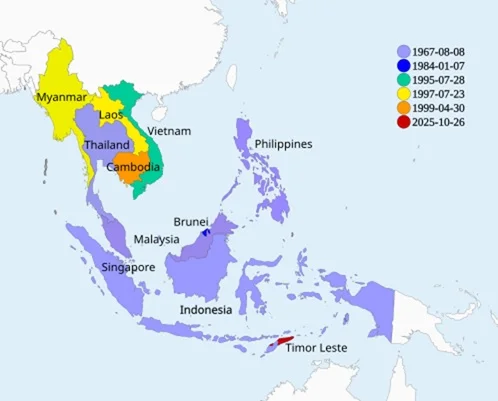
  • ASEAN is a regional organization of Southeast Asian countries.
  • It was established on 8 August 1967.
    • 8 August is celebrated as ASEAN Day.
  • The primary objective of the organization is to promote political, economic, security, and socio-cultural cooperation among Southeast Asian countries.
  • Its motto is "One Vision, One Identity, One Community."
  • Its Secretariat is located in Jakarta, the capital of Indonesia.
    • Currently, ASEAN has 11 member countries:
  • Indonesia, Malaysia, the Philippines, Singapore, Thailand, Brunei, Vietnam, Laos, Myanmar, Timor-Leste, and Cambodia.

India–ASEAN Relations

Significance of ASEAN for India

  • ASEAN (Association of Southeast Asian Nations) is a regional organization comprising 11 countries of Southeast Asia.
  • Its significance for India is not limited to trade; it is also an important component of India's economic security, strategic interests, regional connectivity, and Indo-Pacific strategy.

1. Major Pillar of India's Act East Policy

  • India's Act East Policy aims to strengthen economic, political, cultural, and strategic relations with Southeast Asian countries.
  • ASEAN serves as a major institutional pillar of this policy because it provides India with an organized platform to engage with the entire Southeast Asian region.
  • Through ASEAN, India promotes regional trade, investment, connectivity, maritime security, and defence cooperation.
  • This policy is also important for India's strategy of connecting the Northeastern region with Southeast Asia.

2. Strengthening India's Strategic Presence in the Indo-Pacific Region

  • The Indo-Pacific region is an important centre of global trade, energy supplies, and maritime transportation.
  • Maritime routes in Southeast Asia, including the Strait of Malacca, are extremely important for global trade.
  • Cooperation with ASEAN helps India strengthen strategic connectivity between the Indian Ocean and the Pacific Ocean.
  • It enables India to promote a free, open, inclusive, and rules-based Indo-Pacific order.

3. Economic and Trade Significance

  • ASEAN is one of India's major trading partners.
  • Trade in goods and services, along with investment relations, plays an important role in India–ASEAN relations.
  • ASEAN markets provide opportunities for Indian pharmaceuticals, agricultural products, machinery, information technology, and service sectors.
  • Economic cooperation with ASEAN helps India increase its participation in global supply chains.

4. Balancing China's Growing Influence

  • China's economic, political, and strategic influence in Southeast Asia remains significant.
  • Strong relations with ASEAN countries help India maintain the regional balance of power.
  • Through cooperation with ASEAN countries, India promotes a multipolar regional order rather than excessive dependence on any single power.
  • This is important for India's strategic autonomy and regional interests.

5. Role in the Development of Northeast India

  • The geographical location of India's Northeastern states provides them with significant opportunities to connect with Southeast Asia.
  • Through Myanmar, India can develop road, rail, inland waterway, and maritime connectivity with ASEAN countries.
  • This can promote trade, tourism, employment, and industrial development in Northeast India.
  • Consequently, the Northeast can evolve from merely being a border region into a gateway for India's engagement with Southeast Asia.

6. Regional Peace and Stability

  • ASEAN promotes dialogue, cooperation, and the peaceful resolution of disputes in Southeast Asia.
  • India can cooperate with ASEAN to address challenges such as maritime security, terrorism, piracy, and transnational crimes.
  • Regional stability is essential for protecting India's trade and strategic interests.

Main Examination Question (Mains)

Question: "Analyse the role of ASEAN in achieving the objectives of India's Act East Policy. Also, discuss the challenges facing India–ASEAN relations."

Preliminary Examination Question (Prelims)

Question: Consider the following statements regarding the East Asia Summit (EAS):

  1. It was established in 2005.
  2. Its first summit was held in Kuala Lumpur, Malaysia.
  3. It comprises a total of 19 countries, including 11 ASEAN member countries.
  4. Its Secretariat is located in Jakarta, Indonesia.

Which of the statements given above are correct?

(a) 1 and 2 only
(b) 1, 2 and 3 only
(c) 2, 3 and 4 only
(d) All four

FAQ (Frequently Asked Questions)

Question. When and where was ASEAN established?

Answer:

  • Establishment: 8 August 1967.
  • Place of establishment: Bangkok, Thailand.

Question. How many member countries does ASEAN currently have?

Answer: ASEAN has a total of 11 member countries:

  1. Indonesia
  2. Malaysia
  3. The Philippines
  4. Singapore
  5. Thailand
  6. Brunei
  7. Vietnam
  8. Laos
  9. Myanmar
  10. Cambodia
  11. Timor-Leste

Question. When was the East Asia Summit (EAS) established, and how many countries are its members?

Answer:

  • Established: 2005.
  • First Summit: Kuala Lumpur, Malaysia.
  • Total Member Countries: 19.

Question. What is the difference between India's Act East Policy and Look East Policy?

Answer:

  • Look East Policy: Launched in 1991. Its primary focus was on strengthening economic and trade relations with Southeast Asian countries.
  • Act East Policy: Launched in 2014. Its objective is to strengthen not only economic cooperation but also political, strategic, cultural, and connectivity-related relations.