Prelims: Train Propulsion System, Vande Bharat Express, Make in India, Shinkansen, Indian Railways
Mains: GS Paper II – India-Japan Relations; GS Paper III – Infrastructure, Indigenisation of Technology, Industrial Development and Exports
Keywords: Railway Technology, Electronic Propulsion System, Railway Exports, Atmanirbhar Bharat, India-Japan Cooperation, High-Speed Rail |
Why in News?
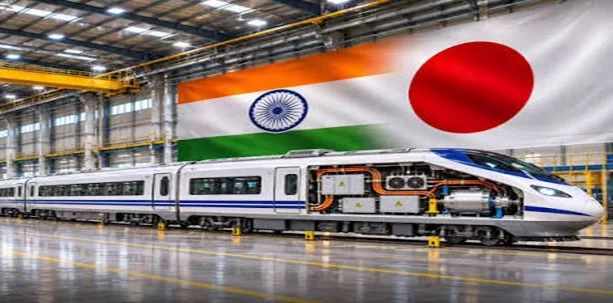
- India has secured its first export order from Japan for indigenously manufactured electronic train propulsion systems, marking a significant achievement in railway manufacturing.
- The development reflects India's growing technological capabilities and ambition to become a global railway manufacturing hub.
Key Highlights
- Export Destination: Japan, a global leader in advanced railway technology and high-speed trains.
- High-Value Technology: Propulsion systems reportedly account for nearly 40% of a train's total value.
- Existing Export Markets: India already exports railway components to Germany, France, Switzerland and the United States.
- Future Target: India aims to export complete indigenously manufactured Vande Bharat trains by 2029–30.
- Government Initiatives: The development supports Make in India and Make for the World initiatives.
What is a Train Propulsion System?
A train propulsion system is a combination of electrical, electronic and mechanical components that generate and control the power required to move a train.
Major Components
|
Component
|
Function
|
|
Traction Motor
|
Converts electrical energy into mechanical energy.
|
|
Power Converter
|
Converts and regulates electrical power.
|
|
Traction Transformer
|
Adjusts the voltage of the electrical supply, where required.
|
|
Control System
|
Regulates train speed, acceleration and braking.
|
|
Regenerative Braking System
|
Recovers electrical energy during braking.
|
How Does It Work?
- The train receives electricity through an overhead power supply or another suitable source.
- Power converters regulate the electricity supplied to traction motors.
- Traction motors convert electrical energy into mechanical energy to move the wheels.
- Electronic control systems manage acceleration, speed and braking.
India's Growing Railway Manufacturing Capabilities
India is gradually expanding its role from a railway technology importer to a manufacturer and exporter of advanced railway equipment.
- Railway Exports: India exports locomotives, coaches, bogies and electronic propulsion systems.
- Manufacturing Ecosystem: Integral Coach Factory (Chennai), Modern Coach Factory (Raebareli) and private manufacturers contribute to railway modernisation.
- Global Integration: Alstom's manufacturing facilities in India have exported over 3,800 bogies and 4,000 flatpack modules, according to a July 2025 government release.
- Technological Advancement: Domestic manufacturing increasingly incorporates advanced power electronics, automated control systems and energy-efficient technologies.
About Vande Bharat Express
- Vande Bharat Express, originally known as Train 18, is an indigenously developed semi-high-speed train.
- It was initially developed by the Integral Coach Factory, Chennai.
- India's first Vande Bharat Express was inaugurated on 15 February 2019 between New Delhi and Varanasi.
- It operates through a distributed traction system instead of a separate locomotive.
- Its major features include regenerative braking, automatic doors, rapid acceleration and modern passenger amenities.
India-Japan Railway Cooperation
India and Japan have established strong cooperation in railway infrastructure, technology and modernisation.
- Mumbai-Ahmedabad High-Speed Rail: India's first bullet train project is being developed with Japanese technical and financial assistance.
- Shinkansen Technology: Japan's high-speed railway technology provides the foundation for India's first bullet train corridor.
- JICA: The Japan International Cooperation Agency provides financial and technical assistance for several Indian infrastructure projects.
- Technology Exports: The latest order reflects India's emerging role as a supplier of advanced railway equipment to Japan.
Significance of the Development
- Technological Self-Reliance: Strengthens India's domestic railway engineering and manufacturing capabilities.
- Export Diversification: Expands India's presence in high-value engineering and technology exports.
- Employment Generation: Encourages skilled employment in electronics, mechanical engineering and manufacturing.
- Global Competitiveness: Provides opportunities for Indian manufacturers to compete in advanced international markets.
- Economic Growth: Supports industrial development, foreign exchange earnings and integration into global supply chains.
- Bilateral Relations: Strengthens economic and technological cooperation between India and Japan.
Major Challenges
- Dependence on imported semiconductor components and specialised electronic materials.
- Compliance with international safety and quality standards.
- Competition from established railway manufacturers in Japan, China and Europe.
- Limited domestic research and development in certain advanced railway technologies.
- Ensuring reliable after-sales services and maintenance in international markets.
Way Forward
- Increase investment in railway research, innovation and indigenous technology development.
- Strengthen domestic semiconductor and power electronics manufacturing.
- Promote collaboration between Indian Railways, private industries and academic institutions.
- Expand international certification and testing facilities.
- Develop export-oriented railway manufacturing clusters.
- Strengthen international partnerships for technology development and market access.
Conclusion
Japan's first order for Indian-made electronic train propulsion systems represents an important milestone in India's railway manufacturing journey. Strengthening domestic innovation, international competitiveness and technological self-reliance can help India emerge as a major global supplier of advanced railway systems.
Prelims Practice Question
Q. With reference to electronic train propulsion systems, consider the following statements:
- Traction motors convert electrical energy into mechanical energy.
- Regenerative braking enables the recovery of energy during braking.
- Vande Bharat Express necessarily requires a separate locomotive for propulsion.
Which of the statements given above are correct?
(a) 1 and 2 only
(b) 2 and 3 only
(c) 1 and 3 only
(d) 1, 2 and 3
Mains Practice Question
Q. Discuss the significance of India's growing railway technology exports in achieving technological self-reliance and strengthening India's position in global manufacturing supply chains.
|
FAQs
Q1. Which country placed its first order for Indian train propulsion systems?
Japan placed its first order for Indian-made systems.
Q2. What is the function of a train propulsion system?
It generates and controls power for train movement.
Q3. What is the role of regenerative braking?
It recovers electrical energy during the braking process.
Q4. When does India aim to export Vande Bharat trains?
India aims to begin exports by 2029–30.
Q5. What is Shinkansen?
It is Japan's advanced high-speed passenger railway system.
|