Why in news?
Jharkhand celebrates its Foundation Day on 15 November every year, commemorating its formation as a separate state on 15 November 2000.
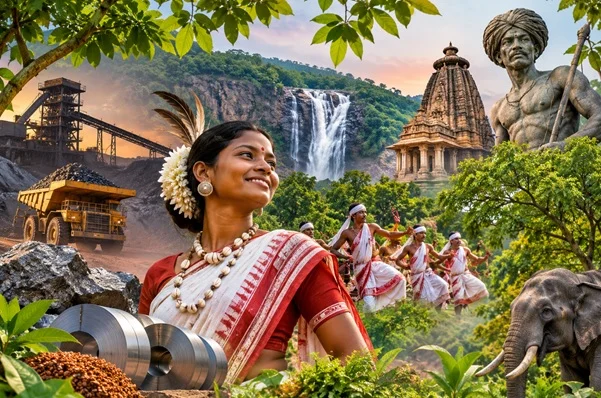
Key Facts
|
Particular
|
Details
|
|
Foundation Day
|
15 November
|
|
Year of Formation
|
2000
|
|
Statehood Legislation
|
Bihar Reorganisation Act, 2000
|
|
Parent State
|
Bihar
|
|
Capital
|
Ranchi
|
|
Sub-capital
|
Dumka
|
|
First Chief Minister
|
Babulal Marandi
|
|
First Governor
|
Prabhat Kumar
|
|
Number of Districts
|
24
|
|
Major Languages
|
Hindi, Santali, Nagpuri, Khortha, Kurukh and Mundari
|
|
High Court
|
Jharkhand High Court, Ranchi
|
|
State Animal
|
Indian Elephant
|
|
State Bird
|
Asian Koel
|
|
State Tree
|
Sal
|
|
State Flower
|
Palash
|
|
Major Rivers
|
Damodar, Subarnarekha, Koel and Barakar
|
|
Important Mineral Resources
|
Coal, iron ore, copper, bauxite and uranium
|
Historical Background
- The Demand for a Separate Jharkhand State
- The term Jharkhand literally means the 'Land of Forests'.
- The region has historically been inhabited by several tribal communities, including Santhal, Munda, Oraon, Ho and Kharia.
- Before independence, the region formed part of the Chota Nagpur Plateau and Santhal Pargana areas under the Bengal Presidency and later Bihar.
- The tribal population gradually demanded a separate administrative identity to protect its land, forests, culture, language and traditional rights.
- The demand for a separate Jharkhand state became stronger because of concerns over economic exploitation, displacement and inadequate regional development.
- Early Tribal Revolts and Resistance Movements
|
Movement
|
Year
|
Important Leaders / Significance
|
|
Kol Rebellion
|
1831-32
|
Led by tribal communities against British interference, exploitation and oppressive land policies
|
|
Santhal Rebellion (Santhal Hul)
|
1855-56
|
Led by Sidhu and Kanhu Murmu, along with Chand and Bhairav
|
|
Birsa Munda Movement (Ulgulan)
|
1899-1900
|
Led by Birsa Munda against British rule, exploitation and the loss of tribal land rights
|
|
Tana Bhagat Movement
|
1914
|
Initiated by Jatra Oraon; focused on social and religious reform and resistance to colonial exploitation
|
- Birsa Munda and the Ulgulan Movement
- Birsa Munda (1875-1900) was a prominent tribal freedom fighter, religious reformer and leader of the Munda community.
- He was born on 15 November 1875 at Ulihatu village in the present-day Khunti district of Jharkhand.
- He led the famous Ulgulan (Great Tumult) movement against British colonial rule, moneylenders, landlords and exploitative systems.
- The movement aimed to restore tribal rights over ancestral land and protect the traditional social and cultural identity of tribal communities.
- Birsa Munda was arrested by the British in 1900 and died in Ranchi Jail on 9 June 1900.
- Development of the Jharkhand Statehood Movement
- The demand for a separate Jharkhand state continued during the colonial period and after independence.
- In 1915, the Chota Nagpur Unnati Samaj emerged as an organisation representing regional interests.
- In 1938, the Adivasi Mahasabha was established under the leadership of Jaipal Singh Munda.
- In 1949, the Jharkhand Party was formed under Jaipal Singh Munda, which strongly advocated a separate state.
- The movement gained political momentum through demands for regional autonomy, protection of tribal identity, land rights and control over natural resources.
- Formation of Jharkhand: 15 November 2000
- After decades of political mobilisation and public demands, the movement for a separate Jharkhand state gained national attention.
- Parliament passed the Bihar Reorganisation Bill, 2000, which provided the legal framework for the creation of Jharkhand.
- The Bihar Reorganisation Act, 2000, was enacted on 25 August 2000.
- On 15 November 2000, Jharkhand was officially carved out of southern Bihar and became the 28th state of the Indian Union.
- Ranchi was designated as the capital of the newly formed state.
- Babulal Marandi became the first Chief Minister of Jharkhand, while Prabhat Kumar became its first Governor.
Constitutional and Legislative Framework
|
Constitutional / Legislative Provision
|
Year
|
Significance
|
|
Article 3
|
1950
|
Empowers Parliament to create new states and alter existing state boundaries
|
|
Bihar Reorganisation Act
|
2000
|
Provided for the creation of Jharkhand from Bihar
|
|
Bihar Reorganisation Act, Section 3
|
2000
|
Specifically provided for the formation of Jharkhand State
|
Geographical Significance
|
Geographical Feature
|
Details
|
|
Location
|
Eastern India
|
|
Total Area
|
Approximately 79,714 sq. km
|
|
Capital
|
Ranchi
|
|
Sub-capital
|
Dumka
|
|
Major Plateau
|
Chota Nagpur Plateau
|
|
Major Rivers
|
Damodar, Subarnarekha, North Koel, South Koel and Barakar
|
|
Highest Peak
|
Parasnath Hill
|
|
Major Waterfalls
|
Hundru, Dassam, Jonha and Lodh
|
|
Neighbouring States
|
Bihar, West Bengal, Odisha, Chhattisgarh and Uttar Pradesh
|
Major River Systems
- Damodar River: An important river system associated with the industrial and coal-producing belt of Jharkhand and West Bengal.
- Subarnarekha River: Originates near Ranchi and flows through Jharkhand, West Bengal and Odisha.
- North Koel River: An important tributary of the Son River.
- Barakar River: An important tributary of the Damodar River.
Cultural and Historical Heritage
- Tribal Culture and Communities
- Jharkhand has a rich tribal heritage and is home to several indigenous communities.
- Major tribal communities include Santhal, Munda, Oraon, Ho, Kharia, Bhumij and Birhor.
- Their traditional lifestyles, languages, festivals, music, dance and art form an important part of the state's cultural identity.
- Major Festivals
- Sarhul: Celebrates nature, trees and the Sal tree; an important festival among tribal communities
- Karma: Associated with the worship of the Karam tree and agricultural prosperity
- Sohrai: Harvest festival associated with cattle, agriculture and traditional wall paintings
- Tusu Parab: A harvest-related folk festival celebrated mainly by women and young girls
- Mage Parab: An important traditional festival of the Ho community
- Traditional Dance and Art Forms
- Chhau Dance: A traditional masked dance form associated with the Seraikella region of Jharkhand.
- Paika Dance: A traditional martial dance performed by men.
- Jhumar: A popular folk dance associated with celebrations and community gatherings.
- Sohrai Painting: A traditional tribal art form depicting animals, nature and geometric patterns.
Important Historical and Religious Places
|
Place
|
Historical / Cultural Significance
|
|
Baidyanath Dham
|
One of the twelve Jyotirlingas of Lord Shiva, located in Deoghar
|
|
Parasnath Hill
|
An important Jain pilgrimage centre
|
|
Rajrappa
|
Famous for the Chhinnamasta Temple
|
|
Maluti Temples
|
Known for their historic terracotta temple architecture
|
|
Jagannath Temple, Ranchi
|
An important religious and cultural landmark
|
|
Netarhat
|
Famous for its scenic natural beauty and sunrise views
|
Economic Significance
|
Mineral
|
Important Areas
|
|
Coal
|
Dhanbad, Bokaro, Ramgarh and Hazaribagh
|
|
Iron Ore
|
Noamundi, Gua and Kiriburu
|
|
Copper
|
Singhbhum region, especially Ghatsila
|
|
Uranium
|
Jaduguda
|
|
Bauxite
|
Lohardaga and Gumla
|
|
Mica
|
Koderma and Giridih
|
- Industrial Development
- Jharkhand is an important centre of India's iron, steel, mining and heavy engineering industries.
- Jamshedpur is famous for the Tata Steel industry and its industrial development.
- Bokaro is known for the Bokaro Steel Plant.
- Dhanbad is widely known as the Coal Capital of India because of its extensive coal-mining activities.
- Ranchi is an important industrial and administrative centre.
- Agriculture and Forest Resources
- Agriculture remains an important source of livelihood for a large section of the state's population.
- Major crops include rice, maize, pulses, wheat and oilseeds.
- Forest resources support biodiversity, minor forest produce and the livelihoods of tribal communities.
- Lac production, tasar silk and forest-based industries also contribute to the rural economy.
Environmental Significance
- Jharkhand has extensive forest cover and rich biodiversity.
- Important forest regions include Palamau, Saranda and Hazaribagh.
- Betla National Park is one of the important wildlife conservation areas in the state.
- Palamau Tiger Reserve is among India's original nine tiger reserves established under Project Tiger in 1973.
- The state is home to elephants, tigers, leopards, deer and several other wildlife species.
Significance of Jharkhand Foundation Day
- Tribal Identity: Recognises the historical struggles and contributions of tribal communities.
- Regional Development: Marks the achievement of a long-standing demand for a separate administrative identity.
- Cultural Preservation: Highlights the importance of tribal languages, traditions, festivals and indigenous knowledge.
- Natural Resource Management: Draws attention to the sustainable utilisation of forests, minerals and other natural resources.
- National Integration: Recognises the contribution of tribal freedom fighters to India's independence movement.
Prelims MCQs
Q. Jharkhand was formed as a separate state under which of the following Acts?
(a) States Reorganisation Act, 1956
(b) Bihar Reorganisation Act, 2000
(c) Bihar Land Reforms Act, 1950
(d) Government of India Act, 1935
Mains Practice Question
Q. Jharkhand's formation was the outcome of a long struggle for tribal identity, regional autonomy and equitable development. Discuss
|
FAQs
When is Jharkhand Foundation Day celebrated?
15 November every year.
When was Jharkhand formed?
15 November 2000.
Which Act provided for the formation of Jharkhand?
The Bihar Reorganisation Act, 2000.
Who was the first Chief Minister of Jharkhand?
Babulal Marandi.
Which plateau covers a major part of Jharkhand?
The Chota Nagpur Plateau.
|