
- UPSC Exam
- State PCS
- One Day Exam
- Current Affairs
- PT Quiz
- Downlaods
- About Coaching
- Blog
- Videos

| Prelims: (Science & Technology + CA) Mains: (GS 3 – Security, Defence Technology, Emerging Technologies; GS 2 – International Relations) |
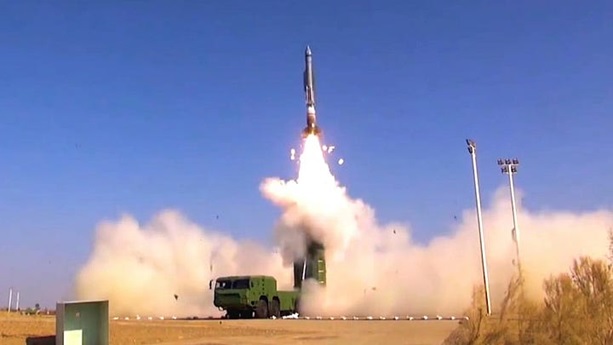
China recently showcased the CJ-1000, a land-based scramjet-powered hypersonic missile, during a military parade in Beijing. The unveiling has drawn global attention due to its reported operational status and advanced propulsion technology.
The missile is being described as a major leap in hypersonic cruise missile capability.
Rise of Hypersonic Weapons
Hypersonic weapons, capable of travelling at speeds above Mach 5, are increasingly central to modern military competition. Major powers including the United States, China, and Russia are investing heavily in such systems.
China’s Hypersonic Ambitions
China has previously demonstrated hypersonic glide vehicles. The CJ-1000 represents a shift toward scramjet-powered hypersonic cruise missile technology.
Platform Mobility
The CJ-1000 is reportedly mounted on a road-mobile transporter-erector-launcher (TEL), enhancing survivability and rapid deployment capability.
Strategic Deterrence: Long-range hypersonic missiles complicate adversary defence planning and strengthen second-strike credibility.
Reduced Detection Window: Low-altitude flight profiles make interception more difficult.
Technological Leap: Scramjet propulsion indicates advanced aerospace engineering capability.
Regional Security Implications: Extended range potentially alters the balance of power in the Indo-Pacific region.
Arms Race Dynamics: Development of operational scramjet systems may intensify hypersonic weapons competition globally.
The CJ-1000 is a road-mobile hypersonic cruise missile developed by China.
It is described as the world’s first operational land-based scramjet-powered hypersonic missile.
Estimated Range
The missile is estimated to have a range of at least 2,500 km.
Launch Platform
It is mounted on a diesel-electric hybrid transporter-erector-launcher (TEL), enabling mobility and rapid repositioning.
What is a Scramjet?
A scramjet (Supersonic Combustion Ramjet) engine allows combustion of fuel in a supersonic airflow.
Unlike traditional rocket engines, scramjets use atmospheric oxygen for combustion, reducing onboard oxidiser requirements.
Sustained Hypersonic Flight
The scramjet engine operates throughout cruise and terminal phases, sustaining hypersonic speed.
Flight Altitude
Lower altitude reduces radar detection range.
Propulsion
Manoeuvrability
Powered propulsion allows scramjet missiles greater mid-course corrections and terminal manoeuvres.
Reduced Detection Time: Lower flight altitude limits early radar tracking.
Continuous Propulsion: Active engine operation enhances speed retention and manoeuvrability.
Higher Accuracy: Sustained propulsion improves terminal guidance capability.
Interception Difficulty: Air defence systems have limited reaction time against fast, low-altitude threats.
Indo-Pacific Security
With an estimated range of 2,500 km, the missile potentially covers significant strategic areas in Asia.
Missile Defence Challenges
Traditional ballistic missile defence systems are optimised for high-altitude ballistic arcs, not low-altitude hypersonic cruise profiles.
Technological Signalling
Showcasing the missile during a parade signals operational readiness and deterrence posture.
Acceleration of Hypersonic Arms Race: Operational deployment may prompt counter-developments.
Pressure on Missile Defence Systems: Countries may need to invest in advanced tracking and interception technologies.
Shift in Warfare Doctrine: Hypersonic weapons blur the line between conventional and strategic deterrence.
Increased Strategic Instability Risks: Reduced response times may heighten miscalculation risks during crises.
Develop Advanced Detection Systems: Invest in space-based and over-the-horizon radar capabilities.
Strengthen Missile Defence Research: Focus on layered defence mechanisms.
Promote Arms Control Dialogue: Encourage international frameworks addressing hypersonic weapons.
Enhance Crisis Communication Channels: Prevent escalation due to compressed decision timelines.
Invest in Indigenous Capabilities: Strengthen domestic research in propulsion and hypersonic technology.
FAQs1. What is the CJ-1000 missile? It is a Chinese road-mobile, land-based hypersonic cruise missile powered by a scramjet engine. 2. What makes scramjet propulsion significant? It enables sustained hypersonic flight using atmospheric oxygen, improving efficiency and manoeuvrability. 3. How does it differ from hypersonic glide vehicles? Scramjet missiles maintain powered flight at lower altitudes, while glide vehicles rely on inertia after rocket boost. 4. Why are scramjet missiles harder to intercept? Their low-altitude trajectory and high manoeuvrability reduce radar detection time and complicate interception. 5. What are the broader security implications? They intensify global hypersonic competition and challenge existing missile defence architectures. |



Our support team will be happy to assist you!

 Contact Us
  New Batch : 9555124124/ 7428085757
  Tech Support : 9555124124/ 7428085757