| (Prelims Exam: General Studies Paper 1, Current Affairs: Reports and Index) |
Why in News?
Recently, the 'Climate Risk Index' (CRI), 2025 was released by environmental think tank 'Germanwatch'.
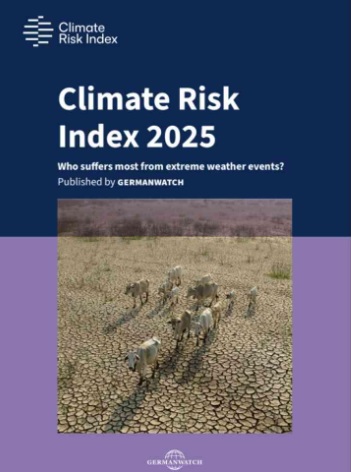
About Climate Risk Index:
- Introduction: This index ranks countries by assessing the economic impact and risks of climate-related extreme weather events on countries.
- The most affected country is given the highest rank in the index.
- Start: Since the year 2006
- Countries included: 171 countries have been included in the index for the year 2025.
- Some countries have not been included due to lack of data.
- Risk Categories: The Index analyses the impacts of extreme weather events through three risk categories:
- Hydrology
- Meteorology
- Climatology
- Measurement Period: The Index reflects the impact of extreme events on countries in the two years prior to publication and over the past 30 years.
- Data Source: The report’s findings are based on extreme weather event data from the International Disaster Database and socio-economic data from the International Monetary Fund.
- Key Indicators: The Index considers absolute and relative impacts using the following indicators:
- Economic Losses
- Mortality
- People Affected
- Recommendations: The latest edition highlights the growing losses and the urgent need for stronger climate resilience and action.
Key findings of the Index
- Top countries most affected in 2022:
- Most affected countries in the period 1993 to 2022:
- The most affected countries during the same period are also divided into two groups -
- Countries most affected by very rare extreme events: Dominica, Honduras, Myanmar, Vanuatu
- Countries affected by frequent extreme events: China, India, Philippines.
- From 1993 to 2022, more than 765,000 people died worldwide and direct losses amounted to approximately US$4.2 trillion.
- Extreme events such as floods, storms, heatwaves and droughts had the most prominent impacts from short-term and long-term perspectives.
- According to the Index, human-induced climate change affects the frequency and intensity of extreme weather events and leads to widespread adverse climate impacts.
- New Collective Quantified Goals (NCQG): According to the Index, the COP-29 conference failed to deliver ambitious New Collective Quantified Goals (NCQG) on climate finance.
- According to the Index, due to lack of ambition and action towards mitigation, even high-income countries are likely to be severely affected.
India's position:
- India is among the 10 countries most affected by extreme weather events between 1993 and 2022.
- India contributed 10% of global deaths and 4.3% of economic losses due to such events.
- During the same period, India was most affected by floods, heatwaves and cyclones.
Key recommendations:
- High-income and high-emitting countries need to step up mitigation action, including the implementation of higher climate targets and actions with new Nationally Determined Contributions (NDCs) to limit temperature rise to below 1.5℃ and contain impacts to a manageable level.
- There is an urgent need for increased financial support from the international community to the most vulnerable countries to prevent the severe consequences of climate impacts.
- In times of geopolitical turmoil and diminishing commitments, developed countries must step up to their responsibilities and provide the necessary support to ensure a more resilient and sustainable future.
|
Germanwatch:
- Introduction: It is an independent development, environment and human rights organization.
- Founded: 1991 by Christoph Bals
- Headquarters: Bonn (Germany)
- Major functions: Collects a variety of economic and social data to prepare status reports in partnership with other NGOs
- Major areas of work:
- Climate mitigation and adaptation
- Loss and damage
- Corporate responsibility
- Global food, land use and trade
- Sustainable and democratic digitalization
- Education for sustainable development
- Sustainable finance
- Climate and human rights
- Major publications:
- Climate Change Performance Index
- Climate Risk Index
|






 Contact Us
  New Batch : 9555124124/ 7428085757
  Tech Support : 9555124124/ 7428085757