| Keywords: India's Green Cover, Climate Trends Report 2026, Green Cover Loss, Rising Summer Temperatures, MODIS, ERA5-Land, Climate Adaptation, Urban Heat Island Effect, Vegetation Conservation, UPSC Environment |
Why in News?
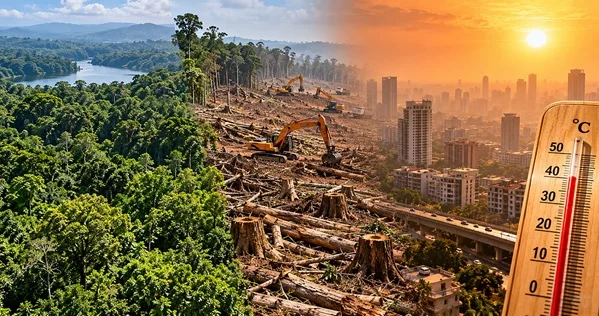
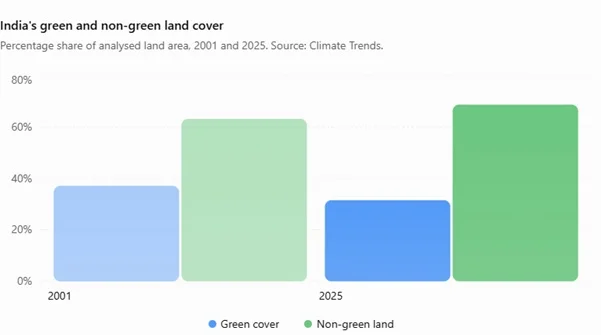
- India's green cover decreased from 36.95% in 2001 to 31.35% in 2025.
- Non-green land increased from 63.05% to 68.65% during the same period.
- Green-covered areas recorded summer temperatures approximately 1°C to 2.5°C lower than non-green areas.
- Regions experiencing green-cover loss showed an average summer temperature increase of 0.26°C.
Key Findings of the Climate Trends Report 2026
1. Decline in India's Green Cover
2. Increase in Summer Temperatures
- Non-green landscapes were consistently warmer than vegetation-covered areas.
- The average temperature difference ranged between 1°C and 2.5°C.
- Areas that lost green cover experienced an average summer temperature increase of 0.26°C.
- Both green and non-green areas experienced warming, indicating the influence of broader climate change.
3. Regional Variation in Green Cover
|
Regions
|
Major Observations
|
|
Western India
|
Significant green-cover loss
|
|
Indo-Gangetic Plain
|
Decline in vegetation coverage
|
|
Central and Peninsular India
|
Green-cover reduction in several areas
|
|
Northeastern India
|
Localised gains in green cover
|
|
Himalayan Foothills
|
Vegetation gains in some areas
|
|
Southern and Eastern India
|
Mixed changes, including localised improvements
|
Summer warming was particularly prominent in northern and northwestern India. Some parts of central and southern India experienced localised cooling.
How Does Green Cover Reduce Temperatures?
Vegetation moderates temperatures through several natural processes.
- Evapotranspiration: Plants absorb water through their roots and release water vapour through their leaves. This process uses heat energy and helps cool the surrounding environment.
- Shading: Trees prevent direct solar radiation from reaching the ground, reducing surface heating.
- Moisture Retention: Vegetated soils generally retain more moisture than exposed, dry surfaces, helping moderate local temperatures.
- Carbon Sequestration: Plants absorb atmospheric carbon dioxide through photosynthesis, contributing to long-term climate change mitigation.
Technology Used in the Study
|
Technology
|
Purpose
|
|
MODIS (Moderate Resolution Imaging Spectroradiometer)
|
Satellite-based observation of land cover and vegetation
|
|
ERA5-Land Reanalysis Data
|
Provides historical information about land-surface and climate conditions
|
|
Remote Sensing
|
Helps identify changes in vegetation and land use over time
|
|
Geospatial Analysis
|
Supports the comparison of land-cover changes with temperature patterns
|
MODIS instruments operate aboard NASA's Terra and Aqua satellites. ERA5-Land is a land-focused reanalysis dataset produced through the Copernicus Climate Change Service.
Significance of Green Cover for India
- Climate Change Adaptation: Green cover provides natural protection against extreme temperatures and helps reduce local heat stress. Protecting existing vegetation can strengthen India's resilience to climate change.
- Biodiversity Conservation: Forests and other vegetated habitats support wildlife, maintain ecological balance and provide essential ecosystem services.
- Public Health: Green spaces can reduce exposure to extreme heat, particularly for elderly people, children and outdoor workers.
- Agricultural Sustainability: Vegetation helps maintain soil moisture, limits erosion and supports water conservation, which are important for agricultural productivity.
- Economic Significance: Rising temperatures can reduce labour productivity, increase electricity demand and affect economic activity.
Major Challenges
- Urbanisation: Expansion of built-up areas can reduce natural vegetation and increase heat absorption.
- Deforestation and Land Degradation: Loss of natural vegetation weakens ecological resilience.
- Climate Change: Rising temperatures and changing rainfall patterns increase pressure on ecosystems.
- Water Scarcity: Reduced soil moisture and water availability can affect vegetation growth.
- Inadequate Urban Planning: Limited green spaces and excessive concrete surfaces can intensify the Urban Heat Island Effect.
- Restoration Challenges: Planting trees without considering native species, water availability and local ecology may reduce restoration effectiveness.
Government Initiatives Related to Green Cover
|
Initiative
|
Objective
|
|
Green India Mission
|
Protect, restore and enhance forest cover and ecosystem services
|
|
National Afforestation Programme
|
Support afforestation and ecological restoration
|
|
CAMPA
|
Utilise compensatory afforestation funds for forest-related activities
|
|
Nagar Van Yojana
|
Develop and improve urban forests and green spaces
|
|
National Action Plan on Climate Change
|
Strengthen India's response to climate change through various missions
|
|
MISHTI
|
Restore and promote mangrove ecosystems along coastal regions
|
Way Forward
- Protect existing vegetation: Conservation of established forests and natural ecosystems should receive priority, particularly in regions facing vegetation loss and extreme heat.
- Promote native species: Ecological restoration should focus on locally suitable trees, shrubs, grasslands and other vegetation.
- Strengthen urban green infrastructure: Cities should incorporate urban forests, green corridors, parks and shaded public spaces into development plans.
- Use satellite-based monitoring: MODIS and other geospatial technologies can help identify vegetation loss and guide targeted restoration.
- Integrate vegetation into Heat Action Plans: Local authorities should prioritise vegetation restoration in areas exposed to severe heat stress.
Conclusion
- The Climate Trends Report 2026 highlights a close relationship between declining green cover and rising summer temperatures across India. The reduction of green-covered land by 5.6 percentage points between 2001 and 2025 underlines the need for stronger vegetation conservation and ecological restoration.
- India must recognise green cover not only as a biodiversity resource but also as essential natural climate-adaptation infrastructure. Protecting existing vegetation, restoring degraded landscapes and improving urban planning can help reduce heat stress and strengthen long-term environmental sustainability.
UPSC Prelims Practice Questions
Q. Which of the following processes directly contributes to the cooling effect of vegetation?
A. Thermal inversion
B. Evapotranspiration
C. Ozone depletion
D. Radioactive decay
UPSC Mains Practice Question
"Declining green cover can intensify local heat stress and increase India's vulnerability to climate change." Discuss the relationship between vegetation loss and rising temperatures.
|
FAQs
Q1. What is the Climate Trends Report 2026?
It is a study examining changes in India's green cover and their relationship with summer temperatures between 2001 and 2025.
Q2. How much green cover did India lose between 2001 and 2025?
According to the study, green cover declined from 36.95% to 31.35% of the analysed land area, a reduction of 5.6 percentage points.
Q3. How does vegetation help reduce rising temperatures?
Vegetation reduces heat through evapotranspiration, shade and soil moisture retention, keeping green-covered landscapes relatively cooler.
Q4. Which regions experienced significant green-cover loss?
The study identified western India, the Indo-Gangetic Plain, parts of central India and several peninsular regions as major areas of vegetation loss.
Q5. Can increasing green cover stop global warming?
No.
|