| Prelims: (Economy + CA) Mains: (GS 2: Government Policies & Interventions, Health Governance; GS 3: Indian Economy, Taxation) |
India has notified a new taxation regime for tobacco and related sin goods, effective 1 February, following legislative changes approved by Parliament. The reform restructures GST slabs, excise duties, and cess mechanisms for tobacco products, marking a significant shift in India’s approach to public health-oriented taxation.

Sin goods such as tobacco, pan masala, and alcohol are taxed heavily in India due to their adverse public health and social impacts. Tobacco taxation serves a dual policy objective:
Despite being placed in the highest GST slabs since 2017, tobacco products—particularly cigarettes—remained relatively affordable over the past decade due to stagnation in effective excise duties. This weakened tobacco control efforts even as incomes rose.
Globally, institutions such as the World Health Organization (WHO) recommend that tobacco prices should rise faster than income growth to reduce affordability and consumption. India’s latest reforms seek to address this gap.
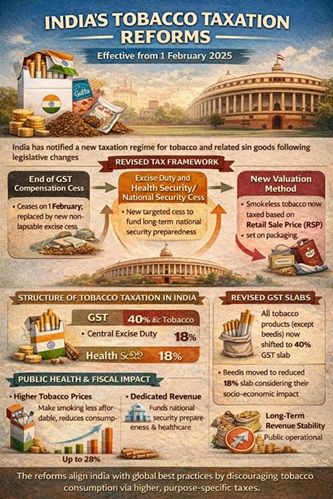
India follows a multi-layered taxation framework for tobacco products, involving:
Under GST, tobacco products have consistently been treated as demerit goods, attracting the highest tax incidence. However, complexity in valuation and cess structures led to uneven enforcement and revenue leakage.
The GST Compensation Cess on tobacco products will cease from 1 February, as its original purpose—compensating States for GST-related revenue losses—has largely been fulfilled.
Key Points:
Significance: Marks the closure of a temporary, transition-phase tax instrument under GST.
To replace the compensation cess, the government has introduced:
Significance: Reflects a shift from compensation-based cess to purpose-specific fiscal instruments.
The reform introduces major rationalisation in GST rates:
For smokeless tobacco products such as:
GST valuation will now be based on the Retail Sale Price (RSP) declared on packaging.
FAQsQ1. Why are tobacco products taxed heavily in India ? Due to their adverse health and social impacts and to discourage consumption while generating public revenue. Q2. What replaces the GST Compensation Cess on tobacco ? Revised excise duties and a new purpose-specific cess under the Health Security-cum-National Security Act, 2025. Q3. Why is the RSP-based valuation important ? It reduces tax evasion and ensures higher compliance in smokeless tobacco products. Q4. Why was the GST slab for beedis reduced to 18% while other tobacco products were raised ? Beedis are largely consumed by lower-income groups and produced in the informal sector. The differentiated GST treatment aims to balance public health objectives with socio-economic considerations, while higher-risk and more organised tobacco products face higher effective taxation. Q5. How do India’s tobacco taxation reforms align with global best practices ? The reforms move India closer to WHO recommendations by increasing real tobacco prices, reducing affordability, strengthening valuation mechanisms, and shifting towards predictable, purpose-specific revenue instruments rather than temporary cess-based taxation. |
| (Preliminary Exam: Current Events of National Importance, Economic and Social Development, General Science) (Main Exam, General Studies Papers 2 and 3: Government policies and interventions for development in various sectors and issues arising from their design and implementation; changes in industrial policy and their impact on industrial development; awareness regarding issues related to intellectual property rights) |
The National Technology Readiness Assessment Framework (NTRAF) was unveiled on December 29, 2025, to standardize innovation assessment in India.

Technology readiness should run parallel to market validation, especially beyond TRL 4. Also, a pilot phase can be adopted before implementing it on the ground.
| (Prelims: Economic and Social Development) (Mains, General Studies Paper 3: Bilateral, regional, and global groupings and agreements related to and/or affecting India's interests, Indian economy and planning, resource mobilization, growth, development, and employment) |

| Prelims: (Polity + CA) Mains: (GS 2: Government Policies & Interventions, Constitution; GS 3: Digital Economy) |
The Consumer Protection Act, 2019 came into force on 20 July 2020, replacing the Consumer Protection Act, 1986. The new law aims to empower consumers, strengthen grievance redressal mechanisms, and address emerging challenges such as e-commerce, misleading advertisements, and product liability, making consumer justice faster and more effective.
The Consumer Protection Act, 1986 was enacted at a time when consumer markets were relatively simple and dominated by physical transactions. Over the decades, the rapid expansion of:
exposed significant limitations in the older law. The 1986 Act relied on single-point access to justice, resulting in prolonged litigation and delays.
To address these gaps, the Consumer Protection Act, 2019 was enacted to provide a consumer-centric, technology-enabled, and time-bound dispute resolution framework, aligned with the realities of a modern digital economy.
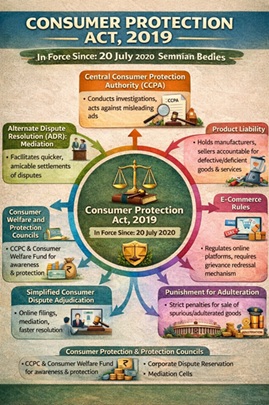
The Act establishes the Central Consumer Protection Authority (CCPA) to promote, protect, and enforce consumer rights.
Significance: CCPA acts as a proactive regulatory body, shifting consumer protection from a purely grievance-driven system to preventive enforcement.
For the first time, the Act introduces product liability, making manufacturers, sellers, and service providers accountable for defective goods and deficient services.
Significance: This ensures consumer safety, strengthens corporate accountability, and discourages negligent business practices.
The Consumer Protection (E-commerce) Rules, 2020 were notified under the Act to regulate digital marketplaces.
Significance: The rules ensure fair competition, transparency, and consumer trust in online markets.
The Act introduces stringent penalties to deter harmful trade practices.
Significance: Protects consumers from health and safety hazards and strengthens deterrence against unethical manufacturing.
The Act introduces mediation as an alternative dispute resolution mechanism.
Significance: Promotes speedy, cost-effective, and amicable dispute resolution.
The Act modernises and simplifies adjudication procedures.
Significance: Enhances access to justice and reduces procedural delays.
The Act provides for the constitution of the Central Consumer Protection Council.
Significance: Facilitates cooperative federalism and participatory policymaking in consumer protection.
FAQsQ1. How is the Consumer Protection Act, 2019 different from the 1986 Act ? It introduces CCPA, product liability, e-commerce regulation, mediation, and technology-enabled dispute resolution. Q2. Why are the e-commerce rules significant ? They ensure transparency, accountability, and fair practices in online marketplaces. Q3. What is product liability under the Act ? It makes manufacturers, sellers, and service providers legally responsible for harm caused by defective goods or deficient services. |
| Prelims: (Environment & Ecology + Current Affairs) Mains: (GS 1: Geography; GS 2: Judiciary, Governance, Policy Making; GS 3: Environment Protection, Mining Regulation, Sustainable Development) |
In December 2025, the Supreme Court of India kept its earlier November 2025 judgment on the definition of the Aravalli Hills in abeyance, citing serious environmental and regulatory concerns. The Court proposed a re-examination of the issue through a high-powered expert committee and imposed restrictions on mining and irreversible administrative actions in the Aravalli region until further review.

The Aravalli Hills are among the oldest surviving fold mountain systems in the world, with geological origins dating back nearly 1.5 billion years. Stretching over 690 km from Gujarat through Rajasthan and Haryana to Delhi, the range forms a critical ecological barrier in north-western India.
Over decades, the Aravallis have faced severe degradation due to:
Unlike many ecologically sensitive regions, protection of the Aravallis has evolved primarily through judicial intervention, rather than a single comprehensive legislation. Persistent ambiguity over the legal and scientific definition of the Aravalli range has remained the core challenge undermining conservation efforts.
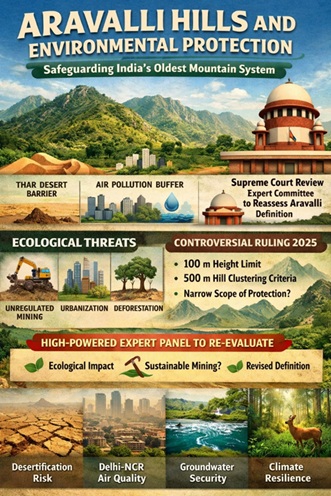
The Aravalli range plays a crucial environmental role by:
Despite their low elevation compared to the Himalayas, the Aravallis function as a keystone ecological system for north-west India.
Environmental protection of the Aravallis has largely relied on:
However, the absence of a scientifically precise and uniform definition of what constitutes the Aravalli Hills has led to regulatory disputes and inconsistent enforcement across states.
November 2025 Supreme Court Judgment
In November 2025, the Supreme Court upheld a government-appointed expert panel’s definition, which restricted the Aravallis to:
This significantly narrowed the geographical scope of the protected Aravalli region.
In response to widespread environmental concerns, the Supreme Court placed its own earlier judgment in abeyance.
The Supreme Court proposed constituting an expert committee to:
The Court emphasised that any final definition must be grounded in exhaustive scientific, geological, and ecological assessment.
FAQsQ1. Why are the Aravalli Hills ecologically important ? They prevent desertification, regulate climate, recharge groundwater, and act as a pollution buffer for north-west India. Q2. What was controversial about the November 2025 Supreme Court definition ? The 100-metre elevation and 500-metre clustering criteria potentially excluded many ecologically significant hill systems. Q3. Why did the Supreme Court pause its own judgment ? Due to concerns that the restrictive definition could create regulatory gaps, enabling environmental degradation through mining. |
| Prelims: (Science & Technology + CA) Mains: (GS Paper 2 – Governance, Public Policy; GS Paper 3 – Science & Technology, Economy, Inclusive Growth) |
The Government of India has highlighted the scale and impact of the IndiaAI Mission, backed by an investment of over ₹10,300 crore and deployment of 38,000 Graphics Processing Units (GPUs), positioning Artificial Intelligence (AI) as a key driver of inclusive growth, innovation, and digital governance.

Artificial Intelligence is emerging as a foundational technology reshaping economies, governance systems, and societies worldwide. For India, AI represents not only a tool for economic expansion but also a means to address long-standing development challenges in healthcare, agriculture, education, urban governance, and climate resilience.
India’s AI strategy emphasises:
This approach aligns with India’s long-term vision of Viksit Bharat @2047.
Artificial Intelligence refers to the ability of machines to perform tasks that typically require human intelligence, such as:
AI systems rely on:
Over time, AI systems improve autonomously, enabling applications such as chatbots, image recognition, predictive analytics, and large language models (LLMs).
According to Stanford University’s 2025 Global AI Vibrancy Tool:
India is also:
Vision: “Making AI in India and Making AI Work for India”

As per NITI Aayog’s 2025 report, AI can empower:
FAQs1. What is the IndiaAI Mission ? A national mission to build computing capacity, talent, datasets, and responsible AI systems. 2. Why are GPUs critical for AI ? They enable high-speed processing required for training large AI models. 3. How does India ensure inclusive AI growth ? Through subsidised compute access, regional labs, multilingual AI, and public-sector use cases. 4. What is India’s global rank in AI competitiveness ? India ranks 3rd globally as per Stanford’s 2025 AI index. 5. How does AI support Viksit Bharat 2047 ? By driving productivity, inclusion, innovation, and efficient governance. |
| Prelims: (Economy + CA) Mains: (GS 2: Governance, Policy Reforms, Federalism, Welfare Schemes; GS 3: Indian Economy, Inclusive Growth, Government Budgeting, Employment, Infrastructure) |
In 2025, the Government of India undertook a wide-ranging set of economic reforms aimed at simplifying governance, reducing compliance burden, and strengthening inclusive growth. These reforms span income tax restructuring, labour codes, GST 2.0, rural employment guarantees, MSME support, export promotion, and ease of doing business measures—marking a decisive shift towards outcome-driven and citizen-centric economic governance.

India’s economic reforms in 2025 represent a transition from regulatory expansion to delivery-focused governance. Building on structural reforms of the past decade—such as GST, Insolvency and Bankruptcy Code (IBC), and Digital Public Infrastructure—the focus in 2025 moved towards:
The reform agenda aligns with the long-term national vision of Viksit Bharat @2047, emphasizing productivity-led growth, inclusivity, and resilience.
Replacing the Income-tax Act, 1961, the new law is guided by three principles:
Significance: The Act reduces litigation, enhances clarity, and modernizes India’s direct tax architecture for a digital economy.
The Government consolidated 29 labour laws into four Labour Codes, covering over 50 crore workers:
Impact
Viksit Bharat – Guarantee for Rozgar and Ajeevika Mission (Gramin) Act, 2025
Replacing MGNREGA, the new framework integrates employment with rural development.
Significance: Enhances livelihood security while strengthening rural infrastructure and agricultural productivity.
Quality Control Orders (QCOs)
To protect MSMEs from compliance shocks:
|
Category |
Investment Limit |
Turnover Limit |
|---|---|---|
|
Micro |
₹2.5 crore |
₹10 crore |
|
Small |
₹25 crore |
₹100 crore |
|
Medium |
₹125 crore |
₹500 crore |
Significance: Strengthens GST as a citizen-centric, growth-oriented tax system.
Outlay: ₹25,060 crore (2025–26 to 2030–31)
FAQsQ1. How are 2025 reforms different from earlier reforms ? They focus on delivery, simplification, and outcomes rather than expanding regulation. Q2. Why is GST 2.0 significant ? It simplifies taxation, reduces disputes, and broadens the tax base while lowering costs. Q3. How do labour reforms help gig workers ? They extend social security, health, and insurance benefits to previously uncovered workers. |

Our support team will be happy to assist you!


 Contact Us
  New Batch : 9555124124/ 7428085757
  Tech Support : 9555124124/ 7428085757