New
GS Foundation (P+M) - Delhi : 19th Jan. 2026, 11:30 AM Spring Sale UPTO 75% + 10% Off, Valid Till : 6th Feb., 2026 GS Foundation (P+M) - Prayagraj : 09th Jan. 2026, 11:00 AM Spring Sale UPTO 75% + 10% Off, Valid Till : 6th Feb., 2026 GS Foundation (P+M) - Delhi : 19th Jan. 2026, 11:30 AM GS Foundation (P+M) - Prayagraj : 09th Jan. 2026, 11:00 AM

Current Affairs for 08 January 2026

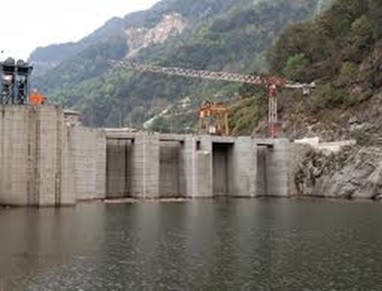
Wangchu Hydroelectric Project

Recently, the Adani Group launched the 570 MW Wangchu Hydroelectric Project in Bhutan. This project is considered an important step towards further strengthening India-Bhutan energy cooperation.

Key Facts about the Wangchu Hydroelectric Project

  • Location: The project is being developed on the Wangchu River (called the Raidak River in India) in the Chukha district of Bhutan.
  • River System: The Wangchu River is a major tributary of the Brahmaputra River.
  • Project Type: It is a run-of-the-river hydroelectric project that generates power with minimal dependence on water storage.
  • Developer Agency: The project is being developed by Wangchu Hydroelectric Power Limited (WHPL), a joint venture company.
  • Joint Venture Structure: Druk Green Power Corporation Limited (DGPC), Bhutan – 51% stake (controlling partner) and Adani Power Limited (APL), India – 49% stake
    • This joint venture was formed following a shareholders' agreement in September 2025.
  • Investment and Implementation Model: The total investment is approximately ₹6,000 crore and the project will be implemented on the BOO₹ (Build, Own, Operate and Transfer) model.
  • Technical Features: The project will operate as a peaking run-of-river plant, helping Bhutan offset seasonal fluctuations in hydropower generation. It will have a total of four turbines.
  • Estimated annual power generation: approximately 2,478.93 gigawatt-hours (GWh)

Energy Use:

  • Winter: The project will help meet Bhutan's domestic power demand, when hydropower production typically decreases.
  • Summer: Excess power generated will be exported to India.

Significance

  • Strengthening the India-Bhutan Strategic Energy Partnership
  • Promoting renewable energy and clean energy cooperation
  • Strengthening the central role of the hydropower sector in Bhutan's economy
  • Contributing to India's energy security and regional energy integration

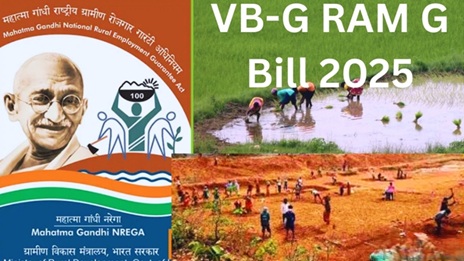
The Vikasit Bharat – Guarantee for Rozgar and Ajeevika Mission (Gramin): VB – G Ram G

(Preliminary Examination: Current events of national importance, Indian polity and governance – Constitution, Panchayati Raj, public policy, economic and social development – ​​sustainable development, poverty, inclusion, demography, social sector initiatives, etc.)
(Mains Examination, General Studies Papers 2 and 3: Government policies and interventions for development in various sectors and issues arising out of their design and implementation, Indian economy and planning, issues related to resource mobilization, growth, development, and employment, inclusive development and issues arising out of it)

Context

  • The Vikasit Bharat – Guarantee for Rozgar and Ajeevika Mission (Gramin): VB – G Ram G (Viksit Bharat – G Ram G) Bill, 2025 was introduced in the Lok Sabha on December 16, 2025 by the Union Minister of Rural Development. 
  • The President has given assent to the Vikasit Bharat-Employment and Livelihood Guarantee Mission (Gramin): VB-G Ram Ji (Vikasit Bharat-G Ram Ji) Bill, 2025 on December 21, 2025, which is a significant change in rural employment policy.

Rationale for the New Statutory Framework

  • MNREGA was implemented in 2005, but rural India is now transforming. Poverty levels have declined from 27.1% in 2011-12 to 5.3% in 2022-23, supported by rising consumption, improved financial access, and enhanced welfare coverage.

  • As rural livelihoods become more diversified and digitally integrated, MNREGA's extensive and demand-driven structure no longer fully matches the reality of today's villages.
  • Developed India – The Ramji Act, 2025 responds to this context by modernizing the rural employment guarantee, strengthening accountability, and linking job creation with long-term infrastructure and climate resilience goals.

Key Points

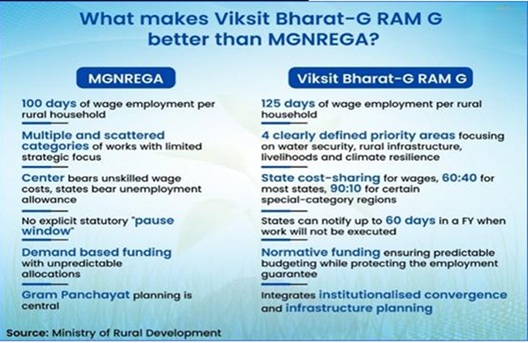
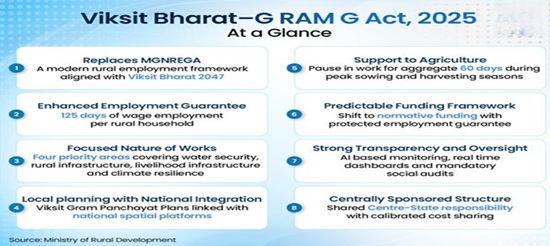
  • The Developed India - Shri Ram Ji Bill, 2025 replaces MNREGA with a new statutory framework aligned with Developed India 2047.
  • The employment guarantee has been increased to 125 days per rural household, strengthening income security.
  • Links wage employment with sustainable rural infrastructure in four priority sectors.
  • Developed India strengthens decentralized planning through nationally integrated and enhanced Gram Panchayat schemes through the National Rural Infrastructure Stack.
  • The shift to benchmark-linked funding and a centrally sponsored structure improves predictability, accountability, and Centre-State partnerships.

Key Objectives

  • The Act extends the statutory guarantee of wage employment to 125 days per financial year for rural households and seeks to advance empowerment, inclusive growth, convergence of schemes, and service delivery in a holistic manner, thereby strengthening the foundation of a prosperous, capable, and self-reliant rural India.

  • Earlier, Parliament passed the Vikas Bharat - Employment and Livelihood Guarantee Mission (Rural) Bill, 2025, which paved the way for a decisive reform of India's rural employment and development framework.
  • This Act replaces the Mahatma Gandhi National Rural Employment Guarantee Act, 2005 (Mahatma Gandhi NREGA) and provides a modern statutory framework to strengthen livelihood security.
  • The Act elevates rural employment from a mere welfare scheme to an integrated vehicle for development, based on the principles of empowerment, development, convergence, and saturation.
  • It strengthens the income security of rural households, modernises governance and accountability and links wage employment with the creation of durable and productive rural assets, thereby laying the foundation for a prosperous and resilient rural India.

Key Features of the Act

Increase in Statutory Guarantee of Employment

  • The Act provides a statutory guarantee of at least 125 days of wage employment to every rural household in each financial year, provided that adult members of the household are willing to do unskilled manual work. (Section 5(1))
  • This increase, compared to the previously available 100 days of employment, provides livelihood security to rural households, makes work more predictable, and provides more stable income.

Balanced Provisions Between Agricultural and Rural Labor

  • The Act empowers states to notify a consolidated rest period of up to 60 days in a financial year to facilitate the availability of agricultural labor for agriculture-related activities during the sowing and harvesting seasons. (Section 6)
  • The workers' entitlement to a total of 125 days of employment will remain unchanged and will be provided for the remaining period, ensuring a balanced balance between agricultural productivity and protection of workers' interests.

Timely Wage Payment

  • The Act mandates payment of wages on a weekly basis or, in any case, within fifteen days of completion of work (Section 5(3)).
  • However, in case of delay beyond the prescribed period, compensation for delay will be payable as per the provisions mentioned in Schedule II, thereby strengthening wage security and protecting workers from delays.

Employment Linked to Sustainable and Useful Rural Infrastructure

  • The Act explicitly links wage employment to the creation of durable public assets in four priority thematic areas (Section 4(2)):
  • Water security and water-related works
  • Core rural infrastructure works
  • Livelihood-related infrastructure works
  • Works to mitigate the impact of extreme weather events
  • All works are proposed from the village level using a bottom-up approach, and all assets created are integrated into the Develop India National Rural Infrastructure Stack. This ensures convergence of public resources, avoids fragmentation, and results-based planning based on saturation targets to create essential rural infrastructure as per local needs.

Decentralized Planning with National Convergence

  • All actions begin with "Developed Gram Panchayat Plans," which are prepared through participatory processes at the Gram Panchayat level and approved by the Gram Sabha. (Sections 4(1) to 4(3))
  • These plans are digitally and spatially integrated with national platforms, including PM Gati Shakti, to enable convergence of all plan-related activities under government oversight, while maintaining decentralized decision-making at the local level.
  • This integrated planning framework will enable ministries and departments to plan and implement activities more effectively, while avoiding duplication and wastage of public resources.

Financial Structure

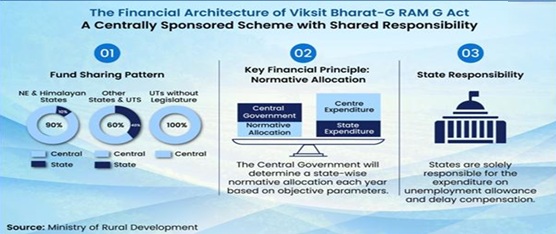
  • The Act will be implemented as a Centrally Sponsored Scheme, which will be notified and implemented by the states in accordance with the provisions of the Act.
  • The expenditure-sharing pattern under the Act is
  • 60:40 between the Centre and the States,
  • 90:10 for the North-Eastern and Himalayan States, and
  • 100% Central funding for Union Territories without Legislative Assemblies.

  • Funds will be provided through state-wise standardized allocations based on objective parameters specified in the rules (Sections 4(5) and 22(4)) to ensure predictability, financial discipline, and sound planning.

Strengthening Administrative Capacity

  • The maximum limit for administrative expenditure under the Act has been increased from 6% to 9%.
  • This strengthens human resource availability, training, technical capacity, and field support, strengthening the ability of institutions to effectively deliver results.
  • The Developing India – Employment and Livelihood Guarantee Mission (Rural) Act, 2025 represents a decisive step towards revamping and strengthening India's rural employment system.
  • It integrates transparent, rules-based financing, accountable mechanisms, technology-enabled inclusion, and convergence-based development so that rural employment not only provides income security but also contributes to sustainable livelihoods, strong assets, and long-term rural prosperity.

Employment Guarantee and the Right to Demand Employment

  • The Act does not weaken the right to demand employment. In contrast, Section 5(1) imposes a clear statutory obligation on the government to provide at least 125 days of guaranteed wage employment to eligible rural households.
  • This increase in guaranteed days, combined with strengthened accountability and grievance redressal mechanisms, further strengthens the enforceability of this right.

Normative Financing and Employment Provision

  • The shift to normative allocations relates to budgeting and fund flow arrangements and does not adversely impact the legal right to employment.
  • Sections 4(5) and 22(4) ensure rule-based and predictable allocation, while the statutory obligation to provide employment or unemployment allowance remains unchanged.

Decentralization and the Role of Panchayats

  • The Act does not centralize planning or implementation. Sections 16 to 19 vest planning, implementation, and monitoring powers at appropriate levels in Panchayats, program officers, and district authorities. National visibility, convergence, and coordination will be provided, but local decision-making will not be taken away.

Employment and Asset Creation

  • The Act not only establishes a statutory guarantee of 125 days of enhanced livelihoods, but also ensures that employment contributes to the creation of productive, sustainable, and climate-resilient assets.
  • Employment creation and asset creation are envisioned as complementary objectives that support long-term rural development and adaptation (Section 4(2) and Schedule I).

Technology and Inclusion

  • Under the Act, technology is envisioned as an enabling tool, not a hindrance.
  • Sections 23 and 24 of the Act provide for technology-enabled transparency through biometric authentication, geo-tagging, and real-time dashboards, while Section 20 strengthens social audits by Gram Sabhas, ensuring community monitoring, transparency, and inclusion.

Unemployment Allowance

The Act removes the previous disqualifying provisions regarding unemployment allowance and restores it as a meaningful statutory safeguard. Where employment is not provided within the stipulated period, unemployment allowance becomes payable after fifteen days.

Potential Impact of VB-G RAM G on the Rural Economy

  • According to the government, this new law will play a significant role in increasing employment opportunities, stabilizing incomes, and strengthening infrastructure in rural areas.
  • By prioritizing water conservation projects, rural roads, local markets, and climate-resilient assets, the scheme aims to increase agricultural productivity and reduce forced migration.
  • Furthermore, the scheme's digital planning, payment, and monitoring system is expected to bring greater efficiency, transparency, and timeliness to implementation.

Its significance for farmers

  • Allowing states to suspend public works for a maximum of 60 days will improve the availability of agricultural labor during the busy sowing and harvesting seasons.
  • Wage rates are expected to be reduced during critical agricultural stages.
  • Improvements in water management and irrigation facilities will increase the climate resilience of crops.
  • Improved rural connectivity, storage, and transportation facilities will reduce post-harvest losses.

Expected benefits for rural workers

  • 25% increase in employment guarantee days, now 125 days of work opportunity instead of 100.
  • Digital wage payments and Aadhaar-based verification will prevent problems such as payment delays and wage cuts.
  • Workers will receive mandatory unemployment allowance if work is not provided within the stipulated period.
  • Roads, water structures, and other durable community assets will be constructed.
  • Panchayat-led planning systems will enable advance assessment of employment availability.

Strengthening Accountability and Monitoring

To address past shortcomings, the Bill includes robust monitoring and accountability provisions:

  • Artificial Intelligence (AI)-based fraud detection system
  • Monitoring of works using GPS and mobile technology
  • Weekly public publication of scheme-related data
  • Biannual social audits at the Gram Panchayat level
  • Establishment of dedicated monitoring committees at the central and state levels

Conclusion

  • The passage of the Developing India – Employment and Livelihood Guarantee Mission (Rural) Act, 2025 represents a significant transformation of India's rural employment guarantee system.
  • By expanding statutory employment to 125 days, embedding decentralized and participatory planning, strengthening accountability, and institutionalizing convergence and saturation-based development, the Act reestablishes rural employment as a strategic tool for empowerment, inclusive growth, and building a prosperous and capable rural India.

Acid Violence in India: Gaps Between Law, Justice and Survivor Rehabilitation

Prelims: (Social Issues + CA)
Mains: (GS 2: Issues Related to Women, Government Policies & Interventions)

Why in News ?

The acquittal of the accused in the 2009 Shaheen Malik acid attack case, after a prolonged 16-year legal battle, has reignited concerns over India’s response to acid violence. The case exposed systemic failures in police investigation, prosecution, judicial sensitivity, and survivor rehabilitation, despite the existence of strong laws and Supreme Court directives.

Background and Context: Acid Violence in India

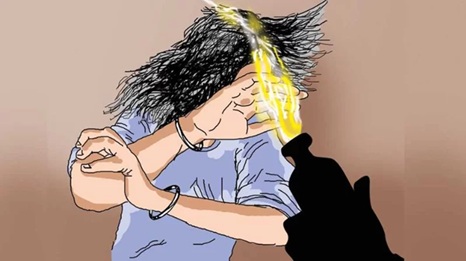
Acid attacks represent one of the most brutal forms of gender-based violence, aimed not merely at harming but at permanently disfiguring, disabling, and socially isolating the victim.
In India, such attacks are deeply embedded in patriarchal notions of control, revenge, and punishment, often linked to rejection of marriage proposals, dowry disputes, or perceived dishonour.

Although India criminalised acid attacks as a distinct offence and introduced victim-centric safeguards following judicial interventions, implementation remains weak, allowing impunity to persist.

What is an Acid Attack ?

Definition: An acid attack involves the intentional throwing or administering of corrosive substances—such as sulphuric, hydrochloric, or nitric acid—causing severe burns, permanent disfigurement, blindness, or disability.

Beyond Physical Harm:

  • Long-term psychological trauma
  • Social ostracisation and stigma
  • Loss of livelihood and economic dependency
  • Prolonged legal battles for justice and compensation

The Law Commission of India (226th Report, 2009) recognised acid attacks as crimes causing irreversible physical and psychological damage, calling for special penal provisions and rehabilitation measures.

Scale and Pattern of Acid Attacks in India

  • NCRB Data (2023):
    • 207 acid attacks reported
    • 65 attempted attacks
  • Underreporting: Independent estimates suggest ~1,000 attacks annually, due to fear, stigma, and family pressure.
  • Worst-Affected States: West Bengal, Uttar Pradesh, Gujarat
    • Higher incidence linked to easy availability of acid and weak enforcement.

Victim–Perpetrator Profile:

  • Victims: Predominantly women and young girls
  • Perpetrators: Mostly men
  • Motives: Personal relationship conflicts, dowry disputes, domestic violence

Legal Framework Against Acid Attacks

1. Bharatiya Nyaya Sanhita (BNS), 2023

  • Section 124:
    • Minimum 10 years imprisonment, extendable to life
    • Fine to cover medical expenses
  • Attempted Acid Attack: 5–7 years imprisonment
  • Mandatory free medical treatment in all hospitals

2. Supreme Court Interventions

  • Laxmi vs Union of India (2013):
    • Recognised acid attack as a distinct offence
    • Minimum compensation of ₹3 lakh
    • Regulated acid sale through identity verification
  • Parivartan Kendra Case (2015):
    • Flagged poor enforcement of acid sale rules

3. Acid Sale Regulation

  • Model Poisons Possession and Sale Rules, 2013
    • Framed under the Poisons Act, 1919
    • States responsible for enforcement
    • Implementation remains patchy and ineffective

4. Legal Aid

  • NALSA Scheme (2016):
    • Priority legal services to acid attack survivors

Judicial Trends and Structural Gaps

  • Low Conviction Rates:
    • 2023: Only 16 convictions against 703 pending cases
  • Delayed Trials:
    • Survivors often wait over a decade for verdicts
  • Victim-Blaming & Insensitivity:
    • Intrusive questioning
    • Character assassination in court

The Shaheen Malik case exemplifies how procedural delays erode faith in justice, turning legal pursuit into a second form of victimisation.

Challenges Faced by Survivors

  • Weak and delayed police investigations
  • Failure to trace source of acid
  • Poor forensic evidence collection
  • Pressure for out-of-court settlements
  • Delayed and inadequate compensation
  • Limited psychological and livelihood support

Way Forward: Preventing Acid Attacks and Supporting Survivors

1. Prevention

  • Strict regulation or ban on retail acid sale
  • Administrative accountability for enforcement
  • Learn from Bangladesh, which reduced attacks from 494 (2002) to 13 (2024)

2. Justice Delivery

  • Fast-track courts for acid attack cases
  • Mandatory gender-sensitisation of judges and prosecutors
  • Penalise unreasonable judicial delays

3. Survivor-Centric Rehabilitation

  • Time-bound compensation
  • Functional disability-based assessment
  • Lifelong medical, psychological, and livelihood support

4. Institutional Reforms

  • National survivor fund (Justice Verma Committee recommendation)
  • Integrated coordination between police, hospitals, courts, and legal services

FAQs

1. Why are acid attacks considered a gender-based crime ?

Because the majority of victims are women and motives are rooted in patriarchal control, rejection, and honour-based violence.

2. What is the punishment for acid attacks under current law ?

Under BNS, a minimum of 10 years imprisonment, extendable to life, along with compensation for medical expenses.

3. Why are conviction rates so low in acid attack cases ?

Due to poor investigation, weak evidence, prolonged trials, and victim intimidation.

4. How does Bangladesh’s model help reduce acid attacks ?

Through strict regulation of acid sale, quick sealing of illegal shops, and awareness campaigns.

5. What is the biggest challenge faced by survivors post-attack ?

Delayed justice and compensation, coupled with lifelong medical, psychological, and social rehabilitation needs.

SHINE Initiative: Empowering Women at the Heart of India’s Quality Movement

Prelims: (Social Issues + CA)
Mains: (GS 2 - Government Policies & Interventions, Women Empowerment; GS 3 - Consumer Protection, Standardisation, Inclusive Growth)

Why in News ?

At the 79th Foundation Day of the Bureau of Indian Standards (BIS), the Union Minister for Consumer Affairs launched the SHINE Scheme (Standards Help Inform & Nurture Empowered Women) in New Delhi. The initiative marks a strategic shift towards placing women at the centre of India’s quality and standardisation ecosystem.

Background and Context: Quality, Households and Women

Quality standards in India have traditionally been associated with industry, manufacturing, and exports. However, a large proportion of unsafe products, substandard practices, and consumer harm originate at the household and community level, particularly in food safety, electrical goods, construction materials, and everyday consumer products.

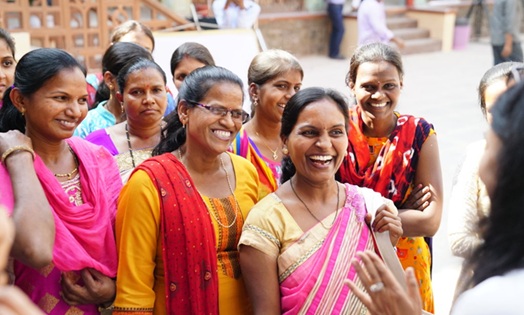
Women, especially in rural and semi-urban India, play a central role as consumers, caregivers, micro-entrepreneurs, and SHG members, yet often lack awareness of safety standards and quality benchmarks. Recognising this gap, BIS has begun repositioning itself from a regulatory authority to a facilitative institution, with SHINE emerging as a flagship women-centric intervention.

What is the SHINE Scheme ?

SHINE (Standards Help Inform & Nurture Empowered Women) is a newly launched initiative of the Bureau of Indian Standards aimed at empowering women through standards literacy, safety awareness, and quality consciousness.

The scheme places women at the grassroots level of India’s quality journey, recognising their role in safeguarding families, communities, and livelihoods.

Key Objectives of the SHINE Scheme

  • Empower women with knowledge of safety, quality, and standardisation
  • Integrate standards awareness into households, SHGs, and community networks
  • Enable women to become agents of consumer protection and quality compliance
  • Strengthen livelihoods by linking quality standards with local entrepreneurship

Key Features and Implementation Strategy

1. Structured Training Programmes

  • Capacity-building modules on product safety, quality marks, and consumer rights
  • Focus on everyday goods such as food items, electrical appliances, and construction materials

2. Grassroots Partnerships

  • Collaboration with NGOs, Self-Help Groups (SHGs), and community organisations
  • Decentralised delivery to ensure last-mile reach

3. Community-Centric Approach

  • Awareness campaigns conducted at the local and household level
  • Women trained to act as quality ambassadors within their communities

4. Livelihood and Safety Linkages

  • Promotes adoption of BIS standards among women-led micro-enterprises
  • Enhances market credibility and income opportunities

5. Shift from Regulation to Facilitation

  • Reflects BIS’s evolving role from enforcing compliance to enabling informed participation

Key Facts about the Bureau of Indian Standards (BIS)

  • National Standards Body of India, established under the BIS Act, 2016
  • Successor to the Indian Standards Institution (ISI) founded in 1947
  • Mandate: Harmonious development of standardisation, marking, and quality certification
  • Represents India in ISO and IEC
  • Nodal Ministry: Ministry of Consumer Affairs, Food & Public Distribution
  • Headquarters: New Delhi, with regional and branch offices nationwide

Significance of SHINE Scheme

  • Women-Centric Governance: Aligns with women-led development and grassroots empowerment
  • Consumer Safety: Reduces risks from substandard products at the household level
  • Inclusive Quality Infrastructure: Extends standardisation beyond industries to communities
  • Economic Empowerment: Strengthens women-led enterprises through quality compliance
  • Behavioural Change: Builds long-term quality consciousness within society

FAQs

1. What does SHINE stand for ?

SHINE stands for Standards Help Inform & Nurture Empowered Women.

2. Which organisation launched the SHINE Scheme ?

The scheme was launched by the Bureau of Indian Standards (BIS).

3. Why is the SHINE Scheme significant for women ?

It empowers women with knowledge of safety, quality standards, and consumer protection, enhancing both household safety and livelihoods.

4. How does SHINE differ from traditional BIS activities ?

Unlike industry-focused regulation, SHINE adopts grassroots, community-based, and facilitative approach.

5. Which ministry oversees BIS ?

BIS functions under the Ministry of Consumer Affairs, Food and Public Distribution.

Bio-Based Materials: India’s Next Green Manufacturing Leap

Prelims: (Science and Technology + CA)
Mains: (GS Paper 3 – Environment, Industrial Development, Climate Change, Sustainable Manufacturing)

Why in News ? 

Biomaterials are drawing renewed policy and industry attention as India and other countries search for low-carbon alternatives to fossil-based materials amid climate commitments, plastic bans, and tightening global sustainability standards.
Background & Context: Why Biomaterials Are Gaining Momentum

Global manufacturing has long relied on petroleum-based plastics and materials, which are carbon-intensive, non-biodegradable, and environmentally damaging. Rising climate risks, plastic pollution, and stricter environmental regulations have exposed the limitations of this model.

India faces a dual challenge:

  • Reducing emissions and plastic waste
  • Sustaining industrial growth and employment

Biomaterials emerge at this intersection—offering a pathway that combines climate action, industrial competitiveness, and rural value creation. Their growing relevance aligns with India’s commitments under the Paris Agreement, its ban on single-use plastics, and the broader push for a circular economy.

Understanding Biomaterials

What Are Biomaterials ?

Biomaterials are materials derived wholly or partly from biological sources, or engineered using biological processes, to replace or complement conventional fossil-based materials.

Unlike petroleum-based materials, biomaterials aim to:

  • Lower greenhouse gas emissions
  • Reduce dependence on finite fossil resources
  • Enable sustainable and circular production systems

Major Types of Biomaterials

  1. Drop-in Biomaterials
    • Chemically identical to conventional plastics
    • Can be used in existing infrastructure
    • Example: Bio-PET in packaging
  2. Drop-out Biomaterials
    • Chemically different and require new processing or disposal systems
    • Example: Polylactic Acid (PLA), which needs industrial composting
  3. Novel Biomaterials
    • Offer entirely new functionalities
    • Include self-healing materials, bioactive medical implants, and advanced composites

These materials are increasingly used in packaging, textiles, construction, automotive components, and healthcare.

Why Biomaterials Are Strategically Important for India

Biomaterials serve multiple national objectives simultaneously:

Environmental Sustainability

  • Reduce fossil-fuel dependence
  • Lower emissions from manufacturing
  • Address plastic waste and pollution

Economic & Industrial Opportunity

  • Build domestic capacity in advanced materials
  • Reduce reliance on imported polymers and technologies
  • Enable India to capture value in future green supply chains

Agricultural Advantage

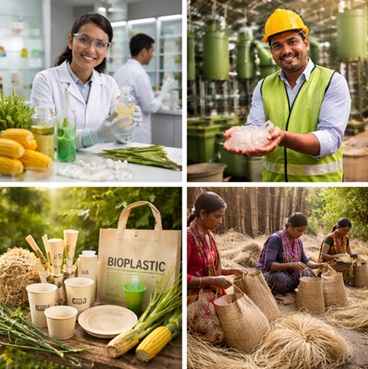
India’s large agricultural base provides abundant feedstocks:

  • Sugarcane
  • Maize
  • Crop residues and agri-waste

This creates new income streams for farmers, linking agriculture with industrial value chains and strengthening rural livelihoods.

Trade and Global Competitiveness

As export markets increasingly demand low-carbon and sustainable products, biomaterials help Indian manufacturers:

  • Meet international standards
  • Avoid carbon-related trade barriers
  • Retain competitiveness in global markets

Current Status of Biomaterials in India

India’s biomaterials sector is nascent but expanding.

  • The bioplastics market was valued at around USD 500 million in 2024
  • Growth is driven by plastic bans, ESG pressures, and private investment

Key Developments

  • Planned PLA manufacturing plants, such as the Balrampur Chini Mills project in Uttar Pradesh
  • Start-ups converting agricultural and floral waste into biodegradable materials
  • Early adoption in packaging and consumer goods

Key Limitation

Despite strong feedstock availability, India remains dependent on foreign technology, especially in:

  • Biomass conversion processes
  • Advanced material engineering
  • Scaling from pilot to commercial production

Global Developments in Biomaterials

Other regions are moving faster:

  • European Union: Binding rules under the Packaging and Packaging Waste Regulation promote compostable and recyclable materials
  • United States: Government procurement policies favour bio-based products
  • UAE and East Asia: Large-scale investments in PLA and bio-manufacturing hubs

These trends highlight the competitive urgency for India to scale its biomaterials ecosystem.

Challenges and the Way Forward

Key Challenges

  • Risk of competition with food crops for feedstock
  • Water stress and soil degradation from intensive agriculture
  • Weak composting and waste-segregation infrastructure
  • Fragmented governance across agriculture, industry, and environment ministries
  • Lack of clear standards, labelling norms, and end-of-life frameworks

Way Forward

  • Invest in biomanufacturing infrastructure and pilot-to-scale facilities
  • Improve feedstock productivity using precision agriculture and biotechnology
  • Strengthen R&D and technology transfer
  • Establish clear regulatory definitions and certification standards
  • Use government procurement and time-bound incentives to de-risk early investments
  • Align biomaterials policy with waste-management and climate strategies

FAQs

1. How are biomaterials different from biodegradable plastics ?

All biodegradable plastics are biomaterials, but not all biomaterials are biodegradable. Some are chemically identical to conventional plastics.

2. Why is PLA important for India’s biomaterials sector ?

PLA is a commercially viable bioplastic that can be produced from agricultural feedstocks like sugarcane and maize.

3. Can biomaterials threaten food security ?

If poorly managed, yes. Hence, policy must prioritise crop residues and non-food biomass.

4. Which sectors can benefit most from biomaterials in India ?

Packaging, textiles, construction, healthcare, and automotive manufacturing.

5. How do biomaterials support India’s climate goals ?

They reduce emissions, cut plastic pollution, and enable circular production systems aligned with climate commitments.

Melghat Emerges as a Vulture Conservation Hub

Prelims: (Environment + CA)
Mains: (GS 3 – Environment, Biodiversity Conservation, Wildlife Protection)

Why in News ?

The Bombay Natural History Society (BNHS) has successfully released 15 critically endangered Indian vultures into the Melghat Tiger Reserve in Maharashtra. This marks a significant step in India’s efforts to restore vulture populations, which suffered catastrophic declines due to veterinary drug toxicity and habitat stress.

Background: India’s Vulture Crisis and Revival Efforts

India once hosted over 99% of the world’s vulture population, but numbers crashed by more than 95% since the 1990s.
The primary cause was the veterinary drug diclofenac, lethal to vultures feeding on treated cattle carcasses.

In response:

  • Diclofenac was banned for veterinary use in 2006.
  • Conservation breeding centres were established by BNHS.
  • Phased reintroduction into safe habitats became the next step.

The Melghat release represents a transition from captive breeding to wild restoration, a crucial milestone in species recovery.

Why Melghat Tiger Reserve Was Selected

Melghat offers an ideal ecological and social landscape for vulture revival:

  • Low use of toxic veterinary drugs due to awareness campaigns
  • Abundant natural prey and livestock carcasses
  • Large, undisturbed forest tracts
  • Presence of tribal communities with traditional coexistence practices
  • Strong institutional support from forest authorities and BNHS

This makes Melghat a “vulture-safe zone” within Central India.

About Melghat Tiger Reserve

Location & Geography

  • Situated in Maharashtra, along the Gavilgarh Hill (southern offshoot of the Satpura Range)
  • First notified tiger reserve in Maharashtra
  • “Melghat” literally means confluence of valleys, reflecting its rugged terrain
  • Bounded by the Tapti River and Gawilgadh ridge

Vegetation

  • Dominated by tropical dry deciduous forests
  • Teak is the primary species, along with bamboo and mixed hardwoods

River System

  • Catchment area for five tributaries of the Tapti:
    • Khandu, Khapra, Sipna, Gadga, and Dolar

Tribal Communities

  • Korkus form the largest tribal group
  • Other communities include Gond and Gawli
  • Traditional forest dependence and coexistence shape conservation outcomes

Biodiversity

  • Fauna: Tiger, leopard, sloth bear, Indian gaur, sambar, nilgai, dhole, hyena
  • Avifauna: A stronghold of the critically endangered forest owlet
  • Now emerging as a vulture conservation landscape

Ecological Importance of Vultures

Vultures are nature’s sanitation workers:

  • Rapidly dispose of carcasses, preventing disease spread
  • Reduce populations of feral dogs and rats
  • Lower risks of rabies and zoonotic outbreaks
  • Maintain ecological balance and nutrient cycling

Their decline previously contributed to public health crises, underlining their importance beyond wildlife conservation.

Conservation Challenges and Way Forward

Key Challenges

  • Illegal use of toxic veterinary drugs
  • Habitat fragmentation
  • Power-line collisions
  • Low reproductive rates of vultures

Way Forward

  • Expansion of Vulture Safe Zones
  • Monitoring of released birds through tagging
  • Community engagement with livestock owners
  • Strict enforcement of drug bans
  • Integration of vulture conservation into tiger landscape management

Melghat’s success could serve as a replicable model for other reserves.

FAQs

1. Why are Indian vultures critically endangered ?

Due to poisoning from veterinary drugs like diclofenac, habitat loss, and low breeding rates.

2. What role does BNHS play in vulture conservation ?

BNHS leads captive breeding, research, awareness campaigns, and reintroduction programmes.

3. Why is Melghat ecologically suitable for vultures ?

It offers undisturbed forests, safe food availability, low drug toxicity, and strong institutional protection.

4. How do vultures contribute to human health ?

By rapidly removing carcasses, they prevent disease spread and control scavenger populations.

5. What is the significance of this release for India’s conservation efforts ?

It signals a shift from species survival in captivity to restoration in the wild, strengthening ecosystem-based conservation.

Madras HC on Thiruparankundram: Balancing Faith, Heritage and Public Order

Prelims: (History & Culture + CA)
Mains: (GS 1 - Indian Culture, History; GS 2 - Judiciary, State–Religion Relations, Constitution)

Why in News ?

The Madras High Court allowed the lighting of the Karthigai Deepam lamp at Thiruparankundram hill near Madurai, while rejecting the Tamil Nadu government’s apprehensions of communal unrest as speculative. However, the court barred public participation, permitting the ritual to be performed only by a limited temple team under official supervision.

Background and Context of the Thiruparankundram Dispute

Thiruparankundram hill, rising around 1,050 feet on the outskirts of Madurai, is a site of layered religious and cultural history. At its foothills stands the ancient Arulmigu Subramanian Swamy Cave Temple, one of the six abodes (Arupadai Veedu) of Lord Murugan. Over centuries, the hill also developed Jain associations, evidenced by rock beds and inscriptions.

Sufi Dargah at the Summit

At the summit lies the burial site of the Sufi saint Sikkandar Badhusha, around which a dargah evolved. This has given the hill multiple identities—Thiruparankundram, Samanar Hill, and Sikkandar Hillmaking it a shared sacred landscape. Due to this overlapping religious significance, the site has historically required tight administrative regulation, especially during festivals.

Early Legal Settlement (1920–1923)

  • In 1920, the temple Devasthanam filed a civil suit claiming ownership of the hill.
  • In 1923, the trial court ruled that:
    • Most of the hill and pilgrim pathways belonged to the temple.
    • The topmost peak, mosque area, Nellithope, and access steps belonged to the Muslim community.

This judgment continues to form the legal foundation for managing competing religious claims.

Earlier Disputes at Thiruparankundram

Recurring Litigation

Disputes over ritual practices, access, and structures have surfaced repeatedly, reflecting the sensitive coexistence at the site.

Key Controversies

  • 2021: Dispute over replacing a wooden flagstaff at the dargah with an iron one.
  • 2025: Litigation over animal sacrifice at the summit, which was prohibited by a three-judge Bench, citing the hill’s status as a protected monument under ASI rules.

Lamp-Lighting Restrictions

  • Historical records show that authorities restricted lamp-lighting near the summit even in the 19th century, citing lack of established custom.
  • In 1996, the Madras High Court permitted Karthigai Deepam lighting only at the Uchipillaiyar Temple mandapam, or at alternative sites at least 15 metres away from the dargah and its access routes.

Trigger for the 2025 Thiruparankundram Dispute

Petition for Lighting the Deepam

In November 2025, worshippers sought permission to light the Karthigai Deepam on December 3 at a stone pillar known locally as the “Deepathoon” near the summit.

Single Judge’s Order

  • Allowed the ritual, treating it as restoration of a religious practice.
  • Directed the temple authorities to perform the ritual with police protection.
  • Initiated contempt proceedings when officials cited law-and-order concerns.

State Government’s Objections

  • Argued that disputes over custom and usage should be adjudicated under the HR&CE Act, not writ jurisdiction.
  • Claimed the Deepathoon might be a survey marker or Jain relic, not a ritual structure.
  • Imposed prohibitory orders citing potential communal tension, preventing the ritual on the festival day.

Appeals Filed

The State government, HR&CE Department, and representatives of the dargah challenged the Single Judge’s order before a Division Bench.

What Did the Madras High Court Division Bench Rule ?

Recognition of Deepathoon

The Bench held that the structure was indeed a Deepathoon, noting the carved cavity designed to hold oil and wicks, rejecting the State’s alternative explanations.

Rejection of Security Concerns

The court termed the State’s apprehensions an “imaginary ghost”, observing that:

  • A small, regulated ritual once a year was administratively manageable.
  • Any disturbance would arise only if “sponsored by the State itself.”

Restricted Performance of the Ritual

  • Allowed lighting of the Karthigai Deepam.
  • Barred public access, limiting the ritual to a small Devasthanam team.

Administrative and Heritage Safeguards

  • Directed the District Collector to coordinate the process.
  • Mandated strict compliance with Archaeological Survey of India (ASI) conditions to protect the monument.

Governance and Constitutional Significance

  • Reinforces Article 25 (freedom of religion), subject to public order and heritage protection.
  • Clarifies the judiciary’s role in balancing religious rights with administrative authority.
  • Emphasises that law-and-order concerns must be evidence-based, not speculative.
  • Highlights challenges in governing shared sacred spaces in a plural society.

FAQs

1. Why is Thiruparankundram considered sensitive ?

Because it is a shared religious site with Hindu, Jain, and Islamic associations, making ritual practices and access politically and socially sensitive.

2. What is Karthigai Deepam ?

It is a Tamil festival of lights symbolising spiritual illumination, traditionally marked by lighting lamps, often on hills or temple premises.

3. Why did the State oppose the ritual ?

The government cited potential communal unrest, questioned the religious significance of the Deepathoon, and argued procedural issues under the HR&CE Act.

4. How did the High Court balance competing interests ?

By allowing the ritual while restricting public participation and ensuring ASI and administrative safeguards.

5. What is the broader constitutional implication ?

The judgment reinforces that religious freedom cannot be curtailed on vague security fears and must be balanced with heritage conservation and public order.

« »
  • SUN
  • MON
  • TUE
  • WED
  • THU
  • FRI
  • SAT
Have any Query?

Our support team will be happy to assist you!

OR
X