New
Hindi Medium: (Delhi) - GS Foundation (P+M) : 6th July 2026, 6:00 PM Hindi Medium: (Prayagraj) - GS Foundation (P+M) : 5th July 2026, 8:00 AM English Medium: (Delhi) - GS Foundation (P+M) : 20th July 2026 English Medium: (Prayagraj) - GS Foundation (P+M) : 15th July 2026, 8:00 AM Hindi Medium: (Delhi) - GS Foundation (P+M) : 6th July 2026, 6:00 PM Hindi Medium: (Prayagraj) - GS Foundation (P+M) : 5th July 2026, 8:00 AM English Medium: (Delhi) - GS Foundation (P+M) : 20th July 2026 English Medium: (Prayagraj) - GS Foundation (P+M) : 15th July 2026, 8:00 AM

Current Affairs for 09 July 2026

National Highways Logistics Management Limited (NHLML): Objectives, Functions and Recent Update

Why Is It in the News ?

Recently, Union Minister for Road Transport and Highways Nitin Gadkari reviewed the major infrastructure projects being implemented by the National Highways Logistics Management Limited (NHLML) and directed officials to ensure their timely execution.

What is the National Highways Logistics Management Limited (NHLML) ?

  • National Highways Logistics Management Limited (NHLML) is a 100% wholly-owned company of the National Highways Authority of India (NHAI)
  • It functions under the guidance of the Ministry of Road Transport and Highways (MoRTH)
  • It was formerly known as Cochin Port Road Company Limited (CPRCL)
  • Its primary objective is to promote logistics infrastructure, transport connectivity, and asset monetization

Major Functions of NHLML

  • Development of Multi-Modal Logistics Parks (MMLPs)
  • Construction and development of ropeway projects
  • Development of Optical Fiber Cable (OFC) networks along National Highways. 
  • Establishment of Wayside Amenities (WSAs)
  • Construction of Port Connectivity Roads
  • Development of Warehousing Zones
  • Modernization of Passenger Transport Terminals
  • Solarization of National Highways
  • Development of other supporting infrastructure projects. 

Key Highlights of the Review

  • Progress of Multi-Modal Logistics Parks (MMLPs), ropeways, intermodal stations, and wayside amenities was reviewed. 
  • Directions were issued to remove project-related bottlenecks on a priority basis. 
  • Emphasis was laid on completing all projects within the stipulated timelines. 

Significance

  • It will strengthen multi-modal connectivity across the country. 
  • It will help reduce logistics costs and transportation expenses
  • It will promote balanced regional development and investment
  • It will provide world-class facilities for travelers
  • It will accelerate the vision of Viksit Bharat (Developed India) and Atmanirbhar Bharat (Self-Reliant India).

Question: Consider the following statements regarding National Highway Logistics Management Limited (NHLML):

1. It is a 100% owned company of the National Highways Authority of India (NHAI).

2. Its primary function is to construct national highways.

3. It also works in the development of multimodal logistics parks, ropeways, and wayside amenities.

Select the correct answer using the code given below:

(a) 1 and 2 only

(b) 1 and 3 only

(c) 2 and 3 only

(d) 1, 2, and 3

FAQs: National Highways Logistics Management Limited (NHLML)

Q1. What is NHLML ?

Answer : National Highways Logistics Management Limited (NHLML) is a 100% wholly-owned company of the National Highways Authority of India (NHAI) that develops logistics and transport infrastructure across India.

Q2. Under which ministry does NHLML function ?

Answer : NHLML functions under the guidance of the Ministry of Road Transport and Highways (MoRTH).

Q3. What was the previous name of NHLML ?

Answer : It was formerly known as Cochin Port Road Company Limited (CPRCL).

Q4. What is the primary objective of NHLML ?

Answer : Its primary objective is to promote logistics infrastructure, improve transport connectivity, and facilitate asset monetization.

Q5. What are Multi-Modal Logistics Parks (MMLPs) ?

Answer : MMLPs are integrated logistics hubs that combine road, rail, and other transport modes to reduce logistics costs and improve freight movement.

Q6. What are the major functions of NHLML ?

Answer : NHLML develops Multi-Modal Logistics Parks, ropeways, optical fiber cable networks, wayside amenities, port connectivity roads, warehousing zones, passenger transport terminals, and solar infrastructure on National Highways.

Q7. Why did NHLML recently come into the news ?

Answer : Union Minister Nitin Gadkari reviewed NHLML's major infrastructure projects and directed officials to ensure their timely completion by removing project bottlenecks.

Q8. Why are NHLML projects important for India ?

Answer : These projects improve multimodal connectivity, reduce logistics costs, promote regional development, attract investment, and enhance passenger facilities.

Q9. How do NHLML projects support the Indian economy ?

Answer : They improve supply chain efficiency, lower transportation costs, strengthen trade infrastructure, and boost economic growth.

Q10. How do NHLML projects contribute to the vision of Viksit Bharat ?

Answer : By developing world-class logistics and transport infrastructure, NHLML supports faster economic development and contributes to the goals of Viksit Bharat and Atmanirbhar Bharat.

Pinaka Long Range Guided Rocket (LRGR): Features, Range, DRDO Tests & Strategic Significance

Prelims

Science & Technology | Defence | Current Affairs

Mains

GS Paper III – Defence Technology, Internal Security, Indigenisation of Technology

Why Is This in the News ?

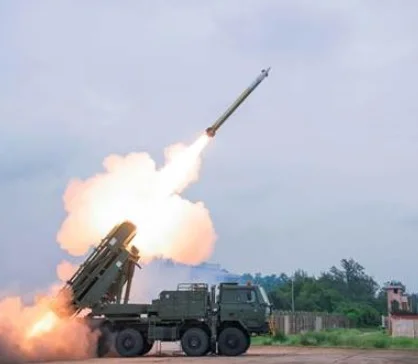
  • DRDO recently conducted successful flight-tests of the Pinaka Long Range Guided Rocket.
  • These successful trials validate the performance of the indigenous guided rocket system and mark another important step in the modernization of India’s artillery forces.

What Is the Pinaka Long Range Guided Rocket (LRGR) ?

  • The Pinaka Long Range Guided Rocket is an advanced guided variant of the Pinaka rocket family. The LRGR combines the mobility and rapid-fire capability of the Pinaka launcher with improved precision.
  • Major Characteristics are that it provides extended range compared with earlier Pinaka rockets, incorporates guidance and control features, offers improved accuracy against designated targets, and enhances the Indian Army’s long-range strike capability.

What Is the Pinaka Rocket System ?

  • The Pinaka is an indigenous Multi-Barrel Rocket Launcher (MBRL) developed to provide rapid and intense artillery support to the Indian Army. The system enables artillery units to deliver powerful strikes while maintaining mobility and operational flexibility.
  • Important features are that it is indigenous in design and developed by DRDO, mounted on highly mobile vehicles for quick deployment, capable of launching multiple rockets within a short duration, provides heavy firepower against enemy positions, and suitable for operations across diverse terrains.
  • Components of a Typical Pinaka System are launcher vehicle, loader-cum-replenishment vehicle, command post vehicle, fire control system, and rocket ammunition.

Evolution of the Pinaka System

  • The Pinaka system was developed by DRDO, primarily through the Armament Research & Development Establishment (ARDE), Pune, to provide an indigenous alternative to imported multi-barrel rocket systems.
  • Following successful trials and its performance during the 1999 Kargil conflict, the Pinaka system was inducted into the Indian Army in the early 2000s. The original variant (Pinaka Mk-I) was designed mainly for area saturation and had an operational range of about 37–40 km.
  • DRDO later developed the Enhanced Range Pinaka, which extended the range to approximately 75 km while improving reliability and overall performance.
  • The latest evolution is the Long Range Guided Rocket (LRGR-120), designed to engage designated targets at ranges up to 120 km. Its maiden test at the maximum range was conducted in December 2025, followed by a successful minimum-range user trial of 60 km from the Integrated Test Range (ITR), Chandipur, in July 2026.

Guided vs Unguided Rockets

The Pinaka LRGR belongs to the guided category and reflects the global shift toward precision-guided munitions.

FEATURES

UNGUIDED ROCKET

GUIDED ROCKET

Flight Control

Ballistic after launch

Guidance during flight

Accuracy

Lower

Higher 

Primary Role

Area saturation 

Precision engagement

Target Type 

Broader target area 

Designated target 

Strategic Significance

  • Enhanced Long-Range Strike Capability : Modern battlefields require the ability to engage targets from significant distances. The LRGR strengthens the Indian Army’s capability to strike important targets while maintaining stand-off distance.
  • Improved Precision : Guidance features improve the accuracy of artillery operations and enhance the effectiveness of target engagement.
  • High Mobility: The vehicle-mounted launcher allows forces to deploy quickly, fire rapidly, and relocate before enemy counter-fire arrives.
  • Strengthening Indigenous Capability : The successful development of the LRGR demonstrates India’s growing expertise in advanced rocket technologies and supports strategic autonomy in defence production.
  • Strengthening Deterrence : A capable indigenous artillery system contributes to military preparedness and enhances India’s overall deterrence posture.

Importance for the Indian Army

As warfare becomes increasingly technology-driven, such systems are essential for maintaining operational readiness.

ADVANTAGE 

BENEFIT

Longer Reach

Ability to engage distant targets

Better Accuracy

Higher probability of successful target engagement

Rapid Firepower

Multiple rockets can be launched quickly

High Mobility 

Fast deployment and relocation

Indigenous support

Easier maintenance and upgrades through domestic production

Role of DRDO and Indian Industry

This collaboration strengthens India’s domestic defence manufacturing ecosystem and advances the goal of Atmanirbhar Bharat.

  • DRDO's Contribution includes Research and development, System design, Technology development, Testing and evaluation and Integration of various subsystems.
  • Contribution of Indian Industry includes Manufacturing components, Producing launchers and support vehicles, System integration and supporting production and supply chains.

Challenges Ahead

  • Continuous technological upgradation is necessary to keep pace with evolving warfare.
  • Integration with modern surveillance and targeting systems is important.
  • Ensuring efficient large-scale production and maintenance remains essential.
  • Future conflicts will demand greater precision, networking, and rapid response capabilities.

Way Forward

  • Continue indigenous development of advanced artillery systems.
  • Strengthen collaboration between DRDO, the armed forces, and industry.
  • Enhance research in guidance, navigation, and precision-strike technologies.
  • Promote self-reliance in critical defence manufacturing and supply chains.

PRELIMINARY MCQ

Q. Consider the following statements:

  1. Pinaka is a missile defence system designed to intercept incoming ballistic missiles.

  2. Pinaka is an indigenous rocket artillery system developed by DRDO.

  3. The Long Range Guided Rocket is intended to improve precision in target engagement.

Which of the statements given above are correct?

(a) 1 and 2 only

(b) 2 and 3 only

(c) 1 and 3 only

(d) 1, 2 and 3

MAINS PRACTICE QUESTION

Q. Discuss the significance of the successful flight-test of the Pinaka Long Range Guided Rocket for India’s indigenous defence capabilities and military preparedness.

FAQs

1. What is the Pinaka Long Range Guided Rocket ?

It is an indigenously developed guided rocket belonging to the Pinaka rocket family and is designed to enhance the Indian Army's long-range precision strike capability.

2. Where was the recent flight-test conducted ?

The recent successful flight-test was conducted at the Integrated Test Range (ITR), Chandipur, Odisha.

3. What is the Pinaka weapon system ?

Pinaka is an indigenous Multi-Barrel Rocket Launcher (MBRL) designed to provide rapid and powerful artillery fire support to the Indian Army.

4 .How does the Pinaka LRGR support Aatmanirbhar Bharat ?

It strengthens indigenous defence research, development, manufacturing, and technological self-reliance.

5. What is the primary role of the Indian Army in the Pinaka programme ?

The Indian Army is the primary user of the Pinaka system and employs it for artillery fire support and battlefield operations.

3.1 billion-year-old Australian rocks reveal evidence of Earth's ancient water cycle

Preliminary Exam

 Plate tectonics, subduction, the mantle, the deep water cycle, and Earth's evolution.

Mains Exam

GS Paper I: (Geography and Geology) - Earth's internal structure, plate tectonics, continental evolution, volcanic activity, and Earth's geological evolution.
GS Paper III: (Science and Technology) - Recent research in Earth sciences, geological discoveries, and contemporary scientific studies related to natural processes.

Why in the news ?

  • Scientists have discovered evidence of Earth's early deep water cycle by studying 3.1 billion-year-old rocks found in Australia's Pilbara Craton.
  • This study has been published in the prestigious journal Nature Communications. The research indicates that surface water was reaching the Earth's interior even before plate tectonics developed.

Key findings of the study

  • The deep water cycle was active even 3.1 billion years ago
  • Till now it was believed that recycling of water within the Earth was possible only due to plate tectonics.
  • The new study shows that 3.1 billion years ago, when modern plate tectonics did not exist, surface water was still reaching the Earth's interior.
  • Importance of Pilbara Craton
  • The Pilbara Craton of Western Australia is one of the oldest rocks on Earth.
  • The rocks here have remained almost unchanged for billions of years, so they are extremely important for the study of the early Earth.
  • Evidence of 'boninite' lava
  • Scientists found water-rich lava called Boninite here.
  • Today, this lava is mainly formed in subduction zones.
  • This indicates that even at that time there was sufficient amount of water present inside the earth.

What is the Deep Water Cycle?

  • In the normal water cycle, water circulates through evaporation, precipitation, and rivers.
  • But in the deep water cycle, ocean water enters sea rocks.
  • This water becomes chemically bound within minerals.
  • This water later reaches the Earth's interior (mantle).
  • This water returns to the surface through volcanic eruptions.
  • This process plays an important role in maintaining the balance of Earth's oceans, continents, and volcanic activity.

What is 'Dripduction'?

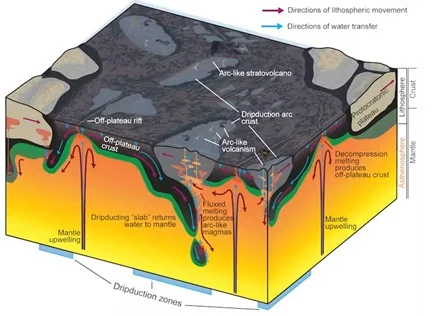
  • In the study, scientists have presented a new concept called 'Dripduction'.
  • According to this, the crust of the early Earth was not divided into rigid plates as it is today.
  • Some parts of the hot and soft crust gradually sank into the mantle.
  • Surface water also reached the Earth's interior through this process.
  • That is, dripduction was a possible mechanism for water recycling before plate tectonics.

Plate Tectonics and Subduction

  • Plate Tectonics - The Earth's outer layer is divided into several rigid plates. These plates are constantly in motion.
  • Subduction - When one tectonic plate sinks beneath another, it is called subduction. This process is how water and other materials reach the Earth's interior.

Significance of the Study

  • It will help understand the early evolution of the Earth.
  • It will provide new insights into the formation of oceans and continents.
  • It will provide new perspectives on Earth's geological processes before the origin of plate tectonics.
  • It will provide a better understanding of the history of the water cycle, essential for the development of life on Earth.

Conclusion

This study shows that Earth's deep water cycle was active approximately 3.1 billion years ago, even before modern plate tectonics had developed. According to the researchers, surface water reached Earth's mantle through a process called dripduction. This discovery is considered a significant advance in understanding Earth's early geological evolution, the formation of the oceans, and the evolution of the water cycle.

Preliminary Exam Questions

Q: Consider the following statements regarding the Deep Water Cycle:

  1. Seawater is chemically bound to rock minerals.
  2. This water can reach the mantle through processes such as subduction.
  3. It is limited only by evaporation and precipitation.

Which of the above statements are correct?

  1. 1 and 2 only

  2. 2 and 3 only

  3. 1 and 3 only

  4. 1, 2, and 3

Mains Question

Explain the concept of the 'Deep Water Cycle' in the context of recent research. How is it important in the Earth's evolution and the formation of continents?

FAQs: 3.1 Billion-Year-Old Australian Rocks and Earth's Ancient Water Cycle

1. Where were the 3.1 billion-year-old rocks recently in the news found?

Answer: These rocks were found in the Pilbara Craton in Western Australia, one of Earth's oldest rock formations.

2. What is the main conclusion of this study?

Answer: According to the study, the deep water cycle was active on Earth even before the development of plate tectonics.

3. What is the deep water cycle?

Answer: It is the process by which surface water reaches Earth's mantle through rocks and later returns to the surface through volcanic activity.

4. What is 'dripduction'?

Answer: Drip-induction is a proposed process in which some of the soft crust of the early Earth sank into the mantle, carrying water with it.

5. What is boninite?

Answer: Boninite is a water-rich volcanic lava found primarily in subduction zones. Its presence suggests a deep water cycle in the early Earth.

Prambanan Temple, Indonesia: History, Architecture & India–Indonesia Civilizational Relations

Keywords: Prambanan Temple 2026, Narendra Modi Prambanan Temple Visit, Prambanan Temple Indonesia, Largest Hindu Temple in Indonesia, UNESCO World Heritage Site, Sanjaya Dynasty, Mataram Kingdom, Nagara Temple Architecture, Trimurti Temple, India–Indonesia Cultural Relations, Cultural Diplomacy, UPSC Current Affairs 2026

Focus Areas: GS Paper I (Indian Heritage & Culture, Ancient History, Temple Architecture) GS Paper II (India–Indonesia Relations, Cultural Diplomacy, Act East Policy)   

Why in News?

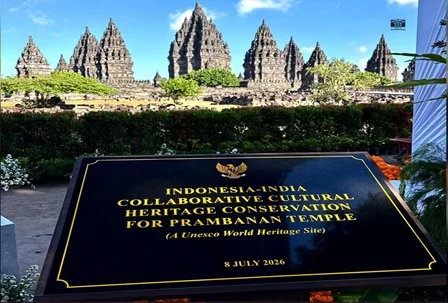
During the recent visit of Narendra Modi to Indonesia, his visit to Prambanan Temple drew significant attention. The visit highlighted the deep civilizational, cultural, and historical ties between India and Southeast Asia, making the temple.
Prambanan Temple: Historical Background 

1. Origin of the Temple

  • Prambanan Temple was constructed during the 9th century CE by the Sanjaya Dynasty of the Mataram Kingdom in Central Java.
  • The temple symbolizes the revival of Hinduism after the Buddhist dominance under the Sailendra Dynasty, which had earlier built the famous Borobudur Buddhist monument.

Thus, Prambanan represents the political and religious shift from Buddhist rule to Hindu rule in Java.

2. Which King Built It?

  • Historians generally attribute its construction to Rakai Pikatan, a ruler of the Sanjaya Dynasty.
  • Later kings, especially Balitung, expanded the complex significantly.
  • Construction continued over several decades.

3. Why Was It Built? There are three major historical reasons:

(A) To Celebrate Hindu Revival

  • The temple was built after the Sanjaya ruler’s regained political power.
  • It became a symbol of the restoration of Hindu traditions in Java.

(B) Royal Temple

  • Prambanan served as the royal state temple of the Mataram Kingdom.
  • It was used for royal ceremonies and major religious festivals.

(C) Political Legitimacy

  • Like many Indian kings, Javanese rulers used magnificent temples to demonstrate divine authority.
  • Building grand temples strengthened the legitimacy of the monarchy.

Religious Importance

Prambanan is dedicated to the Trimurti:

  • Lord Shiva (Main Temple)
  • Lord Vishnu
  • Lord Brahma

Among these,

The Shiva Temple is the tallest and most important. Inside the Shiva temple are statues of:

  • Shiva Mahadeva
  • Durga Mahishasuramardini
  • Ganesha
  • Agastya Rishi

This reflects the strong influence of Shaivism in ancient Java.

About Architecture

Prambanan is one of the finest examples of Nagara Style Hindu architecture outside India.

Key Features

  • Built entirely from volcanic stone.
  • Main Shiva Temple is approximately 47 metres high.
  • Originally consisted of 240 temples.
  • Central courtyard surrounded by concentric temple complexes.
  • Rich carvings depicting Hindu mythology.
  • Highly symmetrical temple layout.

Unlike South Indian Dravidian temples, Prambanan has tall, vertical spires resembling North Indian Nagara temples.

Temple Layout

The complex consists of three zones:

Zone

Description

Outer Zone

Open area

Middle Zone

Hundreds of small temples

Inner Zone

Main temples

Temple

Vehicle

Importance

Shiva

Nandi

Largest

Vishnu

Garuda

Preservation

Brahma

Hamsa

Creation

Ramayana Connection

One of the most significant features is the extensive Ramayana relief panels carved on the walls.

These carvings narrate the story from:

  • Rama's exile
  • Sita's abduction
  • Hanuman's journey
  • Battle with Ravana

The carvings demonstrate how Indian epics spread across Southeast Asia through trade, religion, and cultural exchange. Today, the famous Ramayana Ballet is performed near the temple, blending dance, drama, and music while preserving this shared heritage.

Decline of the Temple

Around the 10th century CE, the political capital shifted from Central Java to East Java. Gradually, Prambanan was abandoned. Subsequent volcanic eruptions and earthquakes caused severe damage. For centuries, the temple remained buried under volcanic debris and jungle vegetation.

Rediscovery

The ruins attracted attention during the colonial period. Large-scale archaeological restoration began in the early 20th century. The restoration continues even today, as not all of the original temples have been fully reconstructed.

UNESCO World Heritage Status

Prambanan was declared a UNESCO World Heritage Site in 1991 because of:

  • Outstanding Hindu architecture
  • Exceptional artistic carvings
  • Historical significance
  • Representation of cultural exchanges between India and Southeast Asia

Role of the Archaeological Survey of India (ASI) in Prambanan Temple

The Archaeological Survey of India (ASI) has recently become an important part of the conservation of Prambanan Temple, marking a new chapter in India–Indonesia cultural cooperation. Although Indonesia has been restoring the temple for decades, India officially joined the conservation efforts in 2026 following an agreement between the two countries.

Timeline of ASI's Association with Prambanan

Year

Development

Before 2025

No direct role of ASI in Prambanan Temple conservation.

2025

India and Indonesia agreed to explore India's assistance in restoring Prambanan during bilateral discussions.

2026

PM Narendra Modi and President Prabowo Subianto inaugurated the ASI-led conservation project.

2026 onwards

ASI began scientific documentation, restoration planning, structural assessment, and conservation work in collaboration with Indonesian authorities

Prambanan and Ancient India's Influence on Southeast Asia

Prambanan is one of the strongest examples of Indianization in Southeast Asia.

Indian influence reached Indonesia mainly 

  • Maritime trade
  • Hindu and Buddhist monks
  • Sanskrit Language
  • Brahmin scholars
  • Royal marriages
  • Cultural exchanges

Indian influence can still be seen

  • Sanskrit inscriptions
  • Temple architecture
  • Hindu epics
  • Traditional dance
  • Shadow puppetry (Wayang)
  • Names of kings
  • Ritual practices

India–Indonesia Cultural Relations

  • Prambanan symbolizes the centuries-old civilizational relationship between India and Indonesia.
  • Despite Indonesia being the world's largest Muslim-majority country, it has carefully preserved its Hindu-Buddhist heritage.
  • This reflects Indonesia's cultural philosophy of embracing its diverse historical roots.

Prime Minister Narendra Modi's visit reinforced:

  • Shared civilizational heritage
  • Cultural diplomacy
  • India’s Act East Policy
  • People-to-people ties
  • Soft power cooperation
  • Tourism and heritage collaboration

Quick Facts

Feature

Details

Country

Indonesia

Location

Near Yogyakarta, Central Java

Built

9th Century CE

Dynasty

Sanjaya Dynasty

Kingdom

Mataram Kingdom

Religion

Hinduism

Dedicated To

Trimurti (Shiva, Vishnu, Brahma)

Main Temple Height

47 metres (About 154 Feet)

Original Temples

Around 240

Architecture

Nagara Style

UNESCO Status

1991

Famous For

Ramayana Reliefs & Ramayana Ballet

Conclusion

The Prambanan Temple is not only the largest Hindu temple complex in Indonesia but also a powerful symbol of the centuries-old civilizational ties between India and Indonesia. Its rich history, Nagara-style architecture, Ramayana reliefs, and UNESCO World Heritage status make it highly relevant for UPSC Prelims (Art & Culture) and GS Paper I & II (History and International Relations). Prime Minister Narendra Modi's visit has further highlighted its role in India's cultural diplomacy and Act East Policy. For UPSC aspirants, understanding Prambanan Temple, India–Indonesia cultural relations, and the spread of Indian civilization in Southeast Asia is essential from both examination and contemporary affairs perspectives.

Prelims MCQ

Q. Consider the following statements regarding Prambanan Temple:

  1. It is the largest Hindu temple complex in Indonesia.

  2. It was built during the Sanjaya Dynasty in the 9th century CE.

  3. It is dedicated exclusively to Lord Vishnu.

Which of the statements given above is/are correct?

(a) 1 and 2 only
(b) 2 and 3 only
(c) 1 only
(d) 1, 2 and 3

Mains Practice Question

"Prambanan Temple is not merely a religious monument but a symbol of India's enduring civilizational influence in Southeast Asia." Discuss its historical significance and explain how it strengthens contemporary India–Indonesia cultural diplomacy.

Essay Practice Question

"Prambanan Temple stands as a symbol of India's enduring civilizational influence and cultural diplomacy in Southeast Asia." Discuss in the context of India's soft power and India–Indonesia relations.

FAQs

1. Why is Prambanan Temple important for UPSC aspirants?

Answer: Prambanan Temple is important because it covers Ancient History, Art & Culture, UNESCO World Heritage Sites, and India–Indonesia cultural relations, making it relevant for both Prelims and Mains.

2. What makes Prambanan Temple important for UPSC preparation?

Answer: It showcases the spread of Indian culture, Hindu temple architecture (Nagara style), and the Ramayana tradition in Southeast Asia, which are frequently asked UPSC themes.

3. Why should UPSC aspirants study Prambanan Temple?

Answer: The temple highlights India's historical cultural influence abroad and supports topics like cultural diplomacy, soft power, and the Act East Policy.

4. How is Prambanan Temple relevant for UPSC Prelims and Mains?

Answer: For Prelims, it is important for UNESCO sites, temple architecture, and history. For Mains, it relates to Indian culture and India–Indonesia relations.

5. What is the significance of Prambanan Temple in India–Indonesia cultural relations?

Answer: Prambanan symbolizes the centuries-old civilizational ties between India and Indonesia and strengthens bilateral relations through cultural diplomacy and shared heritage

India–Australia Relations 2026: CECA, ECTA, Trade, Defence & Strategic Partnership

Why in news ?

  • On 9 July 2026, Prime Minister Narendra Modi addressed the Australia–India CEO Forum and the Economic Roadmap Business Event in Melbourne, Australia, where he invited Australian companies to make long-term investments in India.
  • He also urged both countries to expedite the conclusion of the proposed Comprehensive Economic Cooperation Agreement (CECA).
  • Australian Prime Minister Anthony Albanese was also present at the event. More than 200 leading business leaders, investors, and trade representatives from both countries participated in the programme.

India–Australia Historical ties and missions: 

  • Australia–India relations date back to pre-Independence times. India opened a trade office (later Consulate-General) in Sydney in 1941, and in March 1944 Australia appointed its first High Commissioner to India. 
  • Today Australia has five missions in India: a High Commission in New Delhi and Consulates-General in Bengaluru, Chennai, Kolkata and Mumbai. (In 2024 Australia also opened a new Consulate-General in Bengaluru.) 
  • India’s diplomatic presence in Australia includes a High Commission in Canberra and Consulates in major cities.

Comprehensive Strategic Partnership (CSP): 

  • In June 2020 India and Australia elevated their bilateral relationship to a Comprehensive Strategic Partnership. 
  • This reflects a shared vision of a free, open and prosperous Indo-Pacific, grounded in common democratic values, mutual trust and people-to-people ties. 
  • The CSP covers cooperation in areas such as science & technology, maritime security, trade and investment, defence, agriculture, education and tourism.

High-level dialogues and summits: 

  • A notable sign of close ties is the annual leader-level summit, one of only three such regular summits India holds with any country. 
  • The first Australia–India Annual Summit was held on 10 March 2023 in New Delhi (during PM Albanese’s visit), and the second on 19 November 2024 on the sidelines of the G20 Summit in Rio de Janeiro. 
  • Foreign and Defence Ministers meet biennially in a “2+2” format, and Foreign Ministers hold an annual Framework Dialogue. 
  • Since 1989, Trade Ministers meet via a Joint Ministerial Commission to advance economic ties. Both countries also engage closely in multilateral forums like the Quad, G20, and East Asia Summit.

India–Australia People-to-people links: 

  • The Indian diaspora in Australia now numbers nearly one million. According to the 2021 Australian Census, 976,000 Australians reported Indian heritage (2.6% of the population), including 673,000 Indian-born people. 
  • The Indian-Australian community is Australia’s second-largest and fastest-growing overseas-born group, forming a “living bridge” between the countries. 
  • Punjabi is the fastest-growing language in Australia; Hindi is also among the top 10 spoken languages. 
  • India became Australia’s largest source of skilled migrants and (since 2017) its second-largest source of international students. 
  • In May 2023, the two Prime Ministers signed a Migration and Mobility Partnership Arrangement to facilitate two-way mobility for students and professionals and enhance cooperation on irregular migration.

People-to-people institutions: 

  • Australia launched the Centre for Australia–India Relations (in Parramatta, Sydney) in May 2023 to deepen cultural and commercial links. 
  • The Centre runs scholarships, fellowships and grants (the “Maitri” programs) and promotes engagement via programs like the Australia–India Leadership Dialogue and Australia–India Youth Dialogue. 
  • In March 2025 the Australian Parliament appointed Chair and CEO for the Centre. 
  • These initiatives aim to leverage the Indian-Australian diaspora, boost cultural exchanges, and help Australian businesses access Indian markets.

India–Australia Economic and Trade Relations

Complementary economies: 

  • Australia and India are highly complementary. Australia supplies raw materials and expertise (minerals, energy, technologies) that India needs, while India provides a vast market and STEM-skilled talent. India is now the world’s fastest-growing major economy, offering diversification of trade and supply chains for Australia.

Economic Cooperation & Trade Agreement (ECTA, 2022): 

  • The landmark India–Australia ECTA entered into force on 29 December 2022.
  • Under ECTA, 90% of Australian goods exports to India (by value) are now tariff-free, and 100% of imports from India to Australia enjoy zero tariffs. 
  • This was India’s first free trade deal with a developed country in a decade. By end-2024, merchandise trade had more than doubled compared to pre-ECTA levels (from US$12.2 billion in 2020–21 to US$26 billion in 2022–23). 
  • The Australian High Commission reports two-way trade at about US$49 billion in 2023, likely counting services. From April–Nov 2024 bilateral goods trade totaled US$16.3 billion.

Trade diversification: 

  • ECTA has boosted sectors like textiles, chemicals, agriculture and opened new lines (e.g. gold jewellery, turbojets). 
  • It eased imports of key inputs for India’s industry (iron ore, cotton, wood). Australia’s exports to India (2022–23) were about A$32.4 billion, while imports from India were A$12.6 billion. (India was Australia’s 4th-largest export market and 5th-largest overall trading partner in 2023.) 
  • Australia’s investment stock in India is A$17.6 billion; Indian investment in Australia is A$34.5 billion.

Ongoing negotiations – CECA: 

  • Both governments are negotiating an ambitious Comprehensive Economic Cooperation Agreement (CECA) to build on ECTA.
  • CECA talks began in 2011 but were stalled in 2016; they resumed in 2021 and have now completed ten formal rounds (with inter-sessional talks). 
  • Officials in Dec 2024 held a joint “stocktake” in New Delhi to chart progress. The 2023 Australia–India Summit urged officials to “swiftly progress” CECA and conclude it early to unlock the full potential of the trade relationship. 
  • Both countries target bilateral trade of AUD 100 billion by 2030.

Sectoral cooperation – resources & energy: 

  • India’s rapid growth and carbon-reduction goals create huge demand for minerals and clean energy.
  • Australia and India have launched partnerships in critical minerals and renewable energy. 
  • In November 2024 the two PMs unveiled an Australia–India Renewable Energy Partnership, committing joint work in eight areas (solar PV, green hydrogen, energy storage, recycling, two-way investment, skills, etc.). 
  • This builds on a Solar Taskforce and Green Hydrogen Task Force already active in 2023. 
  • The Green Steel Partnership helps meet India’s steel needs sustainably. The Critical Minerals Investment Partnership fosters new supply chains for minerals (lithium, rare earths) vital to EVs and battery industries. Joint initiatives like the India–Australia Minerals Scholar Network train talent for green industries.

Agriculture & market access: 

  • Both sides have ongoing efforts to expand agri-trade. Market access is being negotiated bilaterally; for example, Australia gained access for Hass avocados (Dec 2022) and India granted market access for Australian pomegranates (Sep 2020) and avocados. 
  • Vice versa, India now exports more horticulture to Australia (e.g. okra). The leaders encourage collaboration on climate-smart agriculture and food security in Indo-Pacific fora.

Investment & business links: 

  • Australia encourages investment in India (and vice versa). High-level forums include the Australia–India CEO Forum (revived 2023) and five Joint Working Groups (on sectors like mining, education, etc.) whose reports have guided policy. 
  • In 2024 Australia launched a New Roadmap for Australia’s Economic Engagement with India (Feb 2025), focusing on clean energy, education & skills, agribusiness, technology and tourism. 
  • This builds on the 2018 “India Economic Strategy to 2035” report, aiming to translate private-sector plans into state-level and institutional partnerships. 
  • The leaders also extended the Australia–India Business Exchange (AIBX) program, which supports SMEs and startups to collaborate.

India–Australia Science, Technology and Innovation 

India–Australia Education ties: 

  • Education is a major pillar. Australia’s education exports to India were about A$4.4 billion in 2022. 
  • Indian students are the second-largest foreign student group in Australia (about 120,000 in Feb 2024, 17% of all international students). 
  • In Nov 2023, both countries launched an Education Strategy for India, aiming to expand university collaborations, joint degrees and mobility under the Australia–India Education and Skills Council (AIESC). 
  • In March 2023 they signed a Mutual Recognition of Qualifications arrangement (easier credit transfer and recognition of degrees). 
  • Notably, Deakin University and University of Wollongong received approval to open campuses in India (in GIFT City, Gujarat), making them the first Australian universities with overseas teaching campuses.

Science & research: 

  • Australia and India have shared research initiatives. Since 2005 the India–Australia Strategic Research Fund (AISRF) has supported joint projects; by 2023 they were inviting applications for the 16th round (A$10 million per round). 
  • In the 2023 summit, the leaders also inaugurated joint innovation challenges (e.g. a circular-economy hackathon, the RISE accelerator for cleantech SMEs). 
  • Indian and Australian innovation agencies (NITI Aayog’s Atal Innovation Mission and CSIRO) signed an MoU in 2023 to deepen tech collaboration.

Space cooperation: 

  • The space partnership has grown rapidly. In Jan 2022 ISRO and Australia’s Space Agency formalized cooperation (including support for India’s Gaganyaan human spaceflight). 
  • In 2023 Australia conducted a telemetry site survey at Cocos Islands (for ISRO) and announced funding of A$18 million for joint space projects under an International Space Investment program. 
  • A space agency MoU was signed in Nov 2024 covering crew-return support for Gaganyaan.
  • Indian NewSpace firms (like Skyroot) are launching satellites for Australian customers; e.g. an Australian satellite is scheduled for launch on an Indian rocket in 2026. 
  • Both sides co-promoted space industry cooperation at international forums (e.g. Australia was Innovation Country at India’s Space Expo 2024 and an Indian delegation attended Australia’s Space Forum).

Defence and Security Cooperation

  • Mutual Logistics Support : In 2020 India and Australia became Comprehensive Strategic Partners, and in 2021 they signed a Mutual Logistics Support Agreement (MLSA). 
  • MLSA provides reciprocal access to military bases and supplies (fuel, food) and has greatly enhanced interoperability.

Defence exercises and dialogues: 

  • Defence engagement has intensified. Australia hosted the multinational Exercise Malabar (naval) for the first time in 2023 (with US, Japan and India). 
  • In 2024 Australia participated in India-led La Pérouse and observed Malabar. 
  • India’s Navy visited Australia’s Cocos Islands in 2023 (the first such Indian port-call). Indian Navy and Air Force regularly participate in Australian exercises (e.g. Kakadu naval exercise, Pitch Black air exercise, Exercise Southern Jackaroo).
  • The first all-services tri-service exercise “AUSTRAHIND” was held in Nov 2023 (Army, Navy, Air), and again in Nov 2024. 
  • Australia participates in India’s biennial land exercise Yudh Abhyas and observer in Talisman Sabre. Both countries’ Chief of Defence Staff and service chiefs have made reciprocal visits.

2+2 and ministerial talks: 

  • India–Australia hold a 2+2 Dialogue (Foreign and Defence Ministers) every two years. 
  • The first 2+2 meeting was in 2021, and subsequent ones in 2023 (Canberra) and 2025. 
  • The leaders have announced plans to renew the Joint Declaration on Defence and Security Cooperation in 2025 to reflect deepening ties. 
  • At the Nov 2023 2+2, the Ministers committed to expanding cooperation in 2024 on maritime awareness, joint exercises, S&T collaboration and information-sharing. 
  • In 2024 India’s Defence Minister held talks with his Australian counterpart on the sidelines of ASEAN and AUKMIN meetings.

Other security links: 

  • Both countries are Quad members and often align on Indo-Pacific security issues (e.g. South China Sea tensions). 
  • They conduct trilateral naval exercises with Indonesia (e.g. Exercise Samudra Shakti) and dialogue with France (INDO-PACOM). 
  • They signed Mutual Legal Assistance and Extradition Treaties (entered force 2011), a Social Security Agreement (2016), and an MOU on cyber cooperation (2023). 
  • In March 2025 the two countries, along with Indonesia, held their second maritime security workshop.

Means

Question: Explain how Australia and India collaborate on renewable energy and critical minerals.

FAQs (Frequently Asked Questions)

1. What is ECTA ?

Answer : The Economic Cooperation and Trade Agreement (ECTA) is a Free Trade Agreement (FTA) between India and Australia. It was signed on 2 April 2022 and came into force on 29 December 2022. Its primary objective is to enhance bilateral trade, investment, and overall economic cooperation between the two countries.

2. What is CECA ?

Answer : The Comprehensive Economic Cooperation Agreement (CECA) is a proposed comprehensive trade agreement between India and Australia that aims to build upon the existing ECTA. It is expected to cover a broader range of areas, including trade in goods and services, investment, digital trade, intellectual property, and other sectors, thereby deepening economic integration between the two countries.

3. What is the most important foundation of India–Australia relations ?

Answer : India–Australia relations are founded on shared democratic values, a rules-based international order, a common vision for a free, open and inclusive Indo-Pacific, economic complementarities, and strong people-to-people ties.

4. On which multilateral platforms do India and Australia cooperate ?

Answer : India and Australia cooperate on several multilateral platforms, including the Quad, G20, East Asia Summit (EAS), Indian Ocean regional initiatives, and various trilateral dialogue mechanisms.

5. What is Australia's greatest strategic importance for India ?

Answer: Australia is a key strategic partner for India in the areas of critical minerals (such as lithium, cobalt, and nickel), clean energy, maritime security, Indo-Pacific cooperation, and defence collaboration. These areas are crucial for India's energy transition, supply chain resilience, and strategic security.

4. India and Australia work together on which of the following multilateral forums ?

  1. Quad
  2. G20
  3. East Asia Summit (EAS)

Code:

(a) 1 and 2 only

(b) 2 and 3 only

(c) 1 and 3 only

(d) 1, 2, and 3

upsc english
« »
  • SUN
  • MON
  • TUE
  • WED
  • THU
  • FRI
  • SAT
Have any Query?

Our support team will be happy to assist you!

OR