Preliminary Exam
Plate tectonics, subduction, the mantle, the deep water cycle, and Earth's evolution.
Mains Exam
GS Paper I: (Geography and Geology) - Earth's internal structure, plate tectonics, continental evolution, volcanic activity, and Earth's geological evolution.
GS Paper III: (Science and Technology) - Recent research in Earth sciences, geological discoveries, and contemporary scientific studies related to natural processes.
|
Why in the news ?
- Scientists have discovered evidence of Earth's early deep water cycle by studying 3.1 billion-year-old rocks found in Australia's Pilbara Craton.
- This study has been published in the prestigious journal Nature Communications. The research indicates that surface water was reaching the Earth's interior even before plate tectonics developed.
Key findings of the study
- The deep water cycle was active even 3.1 billion years ago
- Till now it was believed that recycling of water within the Earth was possible only due to plate tectonics.
- The new study shows that 3.1 billion years ago, when modern plate tectonics did not exist, surface water was still reaching the Earth's interior.
- Importance of Pilbara Craton
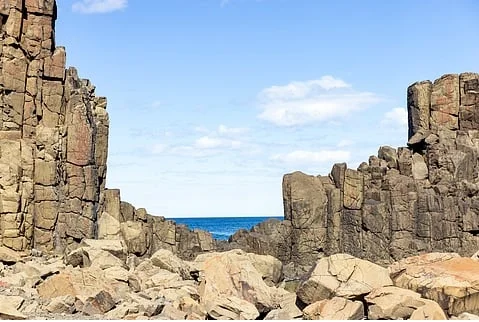
- The Pilbara Craton of Western Australia is one of the oldest rocks on Earth.
- The rocks here have remained almost unchanged for billions of years, so they are extremely important for the study of the early Earth.
- Evidence of 'boninite' lava
- Scientists found water-rich lava called Boninite here.
- Today, this lava is mainly formed in subduction zones.
- This indicates that even at that time there was sufficient amount of water present inside the earth.
What is the Deep Water Cycle?
- In the normal water cycle, water circulates through evaporation, precipitation, and rivers.
- But in the deep water cycle, ocean water enters sea rocks.
- This water becomes chemically bound within minerals.
- This water later reaches the Earth's interior (mantle).
- This water returns to the surface through volcanic eruptions.
- This process plays an important role in maintaining the balance of Earth's oceans, continents, and volcanic activity.
What is 'Dripduction'?
- In the study, scientists have presented a new concept called 'Dripduction'.
- According to this, the crust of the early Earth was not divided into rigid plates as it is today.
- Some parts of the hot and soft crust gradually sank into the mantle.
- Surface water also reached the Earth's interior through this process.
- That is, dripduction was a possible mechanism for water recycling before plate tectonics.
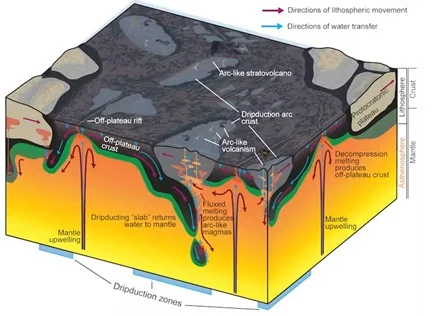
Plate Tectonics and Subduction
- Plate Tectonics - The Earth's outer layer is divided into several rigid plates. These plates are constantly in motion.
- Subduction - When one tectonic plate sinks beneath another, it is called subduction. This process is how water and other materials reach the Earth's interior.
Significance of the Study
- It will help understand the early evolution of the Earth.
- It will provide new insights into the formation of oceans and continents.
- It will provide new perspectives on Earth's geological processes before the origin of plate tectonics.
- It will provide a better understanding of the history of the water cycle, essential for the development of life on Earth.
Conclusion
This study shows that Earth's deep water cycle was active approximately 3.1 billion years ago, even before modern plate tectonics had developed. According to the researchers, surface water reached Earth's mantle through a process called dripduction. This discovery is considered a significant advance in understanding Earth's early geological evolution, the formation of the oceans, and the evolution of the water cycle.
Preliminary Exam Questions
Q: Consider the following statements regarding the Deep Water Cycle:
- Seawater is chemically bound to rock minerals.
- This water can reach the mantle through processes such as subduction.
- It is limited only by evaporation and precipitation.
Which of the above statements are correct?
-
1 and 2 only
-
2 and 3 only
-
1 and 3 only
-
1, 2, and 3
Mains Question
Explain the concept of the 'Deep Water Cycle' in the context of recent research. How is it important in the Earth's evolution and the formation of continents?
|
FAQs: 3.1 Billion-Year-Old Australian Rocks and Earth's Ancient Water Cycle
1. Where were the 3.1 billion-year-old rocks recently in the news found?
Answer: These rocks were found in the Pilbara Craton in Western Australia, one of Earth's oldest rock formations.
2. What is the main conclusion of this study?
Answer: According to the study, the deep water cycle was active on Earth even before the development of plate tectonics.
3. What is the deep water cycle?
Answer: It is the process by which surface water reaches Earth's mantle through rocks and later returns to the surface through volcanic activity.
4. What is 'dripduction'?
Answer: Drip-induction is a proposed process in which some of the soft crust of the early Earth sank into the mantle, carrying water with it.
5. What is boninite?
Answer: Boninite is a water-rich volcanic lava found primarily in subduction zones. Its presence suggests a deep water cycle in the early Earth.
|







 Contact Us
  New Batch : 9555124124/ 7428085757
  Tech Support : 9555124124/ 7428085757