
- UPSC Exam
- State PCS
- One Day Exam
- Current Affairs
- PT Quiz
- Downlaods
- About Coaching
- Blog
- Videos

| Prelims: Hara Mangroves, Qeshm Island, Strait of Hormuz, Avicennia marina, UNESCO Biosphere Reserve, Persian Gulf, Blue Carbon, Ramsar Site, Mangrove Ecosystem Mains: GS Paper I – Geography & Environment, GS Paper III – Environment, Biodiversity & Disaster Management, Marine Pollution, Coastal Ecosystems, Blue Carbon, and India’s Mangrove Conservation Keywords: Hara Biosphere Reserve, Qeshm Island, Mangrove Forest, Oil Spill, Minoan Pioneer, Avicennia marina, Strait of Hormuz, Persian Gulf, Blue Carbon, Coastal Protection, Marine Biodiversity |
A major oil-spill incident in the Persian Gulf is threatening the ecologically important Hara mangrove forests around Qeshm Island, Iran.
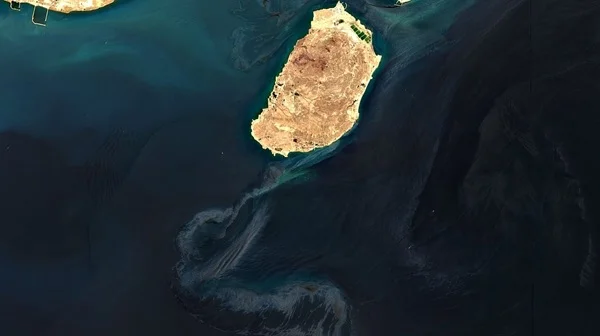
The ecosystem consists primarily of the grey mangrove, scientifically known as Avicennia marina.
Mangroves survive in environments where ordinary terrestrial plants cannot. Avicennia marina possesses specialised mechanisms for dealing with salt. Its roots and leaves help regulate salt and water balance, allowing the species to survive in highly saline coastal environments. This makes Hara an excellent example of halophytic vegetation.
Mangrove roots bind sediments and reduce the energy of waves and tidal currents. Therefore, they help protect coastal communities from:
This function becomes particularly important for low-lying islands such as Qeshm.
Mangroves are among the world's important Blue Carbon ecosystems. They capture atmospheric carbon dioxide and store carbon in:
Hara's complex network of tidal channels provides shelter and breeding habitat for marine organisms. It supports: Fish, Shrimp, Crabs, Molluscs, Other aquatic organisms
Hara is also an important habitat for migratory and wetland birds. UNESCO records species and habitats associated with the reserve, including the great white pelican (Pelecanus crispus), while the wider ecosystem supports numerous waterbirds and herons. The mangrove canopy and surrounding mudflats provide:
The immediate concern is an oil spill following damage to the Minoan Pioneer, a Liberia-flagged dry bulk carrier. According to maritime reports, the vessel was struck by an unidentified projectile while travelling near Oman's side of the Strait of Hormuz. The projectile reportedly hit the engine room, and the crew abandoned the vessel; one seafarer was reported missing. Subsequent satellite observations detected oil slicks near Qeshm.
Oil pollution can be particularly damaging to mangrove ecosystems because mangroves occupy shallow coastal waters and intertidal mudflats.
Oil-spill response in mangrove ecosystems is complicated. Aggressive mechanical cleanup can itself:
Therefore, response agencies have to balance oil removal with ecosystem protection. The current geopolitical situation further complicates emergency response and access to affected areas. Reuters reported that clean up and salvage operations have faced delays linked to the wider regional tensions.
|
Category |
Examples |
|
Dominant mangrove |
Avicennia marina |
|
Birds |
Pelicans, herons, migratory shorebirds |
|
Reptiles |
Green turtle, hawksbill turtle, sea snakes |
|
Marine organisms |
Fish, shrimp, crabs |
|
Habitat |
Tidal mudflats, shallow coves, mangrove channels |
|
Important wetland |
Strait of Khuran |
|
Conservation status |
UNESCO Biosphere Reserve |
UNESCO also records the presence of the critically endangered hawksbill turtle and green turtle-associated feeding habitat in the reserve.
The Hara incident is highly relevant for India because India also possesses extensive mangrove ecosystems along its eastern and western coasts and in the Andaman & Nicobar Islands.
Major Indian mangrove regions include:
Located in the Ganga-Brahmaputra-Meghna delta, the Sundarbans are India's most extensive mangrove ecosystem.
It is globally significant for:
The Sundarbans are also a UNESCO World Heritage Site.
Located in the deltaic region of the Brahmani and Baitarani rivers, Bhitarkanika is one of India's most important mangrove ecosystems.
It is particularly famous for:
The Gulf of Kutch contains extensive mangrove habitats on India's western coast.
Its ecological importance is linked with:
The Gujarat mangrove system is ecologically distinctive because it occurs in a relatively arid environment compared with India's humid eastern mangrove regions.
Mangroves are also present around the Gulf of Khambhat, where strong tidal conditions influence coastal ecosystems.
Pichavaram is one of India's well-known mangrove ecosystems and lies between the Vellar and Coleroon estuaries.
It is important for:
Muthupet lies in the southern Cauvery delta region.
Avicennia marina is particularly important here, demonstrating that the same dominant mangrove species found in Hara also occurs prominently in parts of India's coast.
The Godavari and Krishna delta systems support important mangrove ecosystems.
Coringa Mangroves, near Kakinada, are among India's major mangrove habitats.
The islands possess highly diverse mangrove communities because of their tropical island environment. They also form part of India's important coastal and marine biodiversity network.
|
Feature |
Hara Mangroves |
Indian Mangroves |
|
Country |
Iran |
India |
|
Major region |
Persian Gulf |
Arabian Sea, Bay of Bengal, Indian Ocean |
|
Key location |
Qeshm–Strait of Khuran |
Sundarbans, Odisha, Gujarat, Tamil Nadu, A&N |
|
Major species |
Avicennia marina |
Avicennia, Rhizophora, Bruguiera, etc. |
|
Major function |
Coastal protection & marine nursery |
Coastal protection, fisheries & biodiversity |
|
Carbon role |
Blue Carbon |
Blue Carbon |
|
Major threat |
Oil pollution, coastal pressure |
Pollution, reclamation, aquaculture, erosion, cyclones |
|
Conservation |
UNESCO Biosphere Reserve |
Multiple protected areas & conservation programmes |
India has recognised mangrove restoration as an important component of climate and coastal resilience. The MISHTI – Mangrove Initiative for Shoreline Habitats & Tangible Incomes programme focuses on mangrove restoration and conservation.
Its broader objectives include:
Thus, the Hara oil-spill incident provides a useful international case study for understanding why India's mangroves require protection from oil pollution, industrialisation, coastal development and climate change.
India has a long coastline and several major ports, oil terminals and shipping corridors. Important areas at risk include:
Prelims MCQQ. With reference to the Hara Mangrove Forests, consider the following statements:
Which of the statements given above are correct? A. 1, 2 and 3 only Mains Practice QuestionQ. “Mangroves are natural infrastructure for coastal resilience.” Discuss with reference to the ecological functions of Hara Mangroves and India's major mangrove ecosystems. Also examine the threats posed by oil pollution and suggest suitable conservation measures. |
Q1. Where are the Hara Mangrove Forests located?Answer: They are located in southern Iran, around Qeshm Island and the Strait of Khuran.They form an important Avicennia marina mangrove ecosystem in the Persian Gulf. Q2. What is the UNESCO status of Hara Mangroves?Answer: Hara is recognised as a UNESCO Biosphere Reserve.It is important for biodiversity, marine life and local livelihoods. Q3. Which is the major mangrove species found in Hara?Answer: The dominant species is the Grey Mangrove (Avicennia marina).It is adapted to survive in highly saline coastal environments. Q4. Why are Hara Mangroves in the news?Answer: A major oil spill near Qeshm Island is threatening the Hara mangrove ecosystem.The pollution can damage mangrove roots, marine life, fisheries and coastal biodiversity. Q5. Why are Hara Mangroves important for UPSC?Answer: They link Mangroves, Blue Carbon, Marine Pollution, Strait of Hormuz and Coastal Ecosystems.They can be compared with India’s Sundarbans, Bhitarkanika and Gulf of Kutch. |


Our support team will be happy to assist you!

 Contact Us
  New Batch : 9555124124/ 7428085757
  Tech Support : 9555124124/ 7428085757