
- UPSC Exam
- State PCS
- One Day Exam
- Current Affairs
- PT Quiz
- Downlaods
- About Coaching
- Blog
- Videos

|
Keywords: Prambanan Temple 2026, Narendra Modi Prambanan Temple Visit, Prambanan Temple Indonesia, Largest Hindu Temple in Indonesia, UNESCO World Heritage Site, Sanjaya Dynasty, Mataram Kingdom, Nagara Temple Architecture, Trimurti Temple, India–Indonesia Cultural Relations, Cultural Diplomacy, UPSC Current Affairs 2026 Focus Areas: GS Paper I (Indian Heritage & Culture, Ancient History, Temple Architecture) GS Paper II (India–Indonesia Relations, Cultural Diplomacy, Act East Policy) |
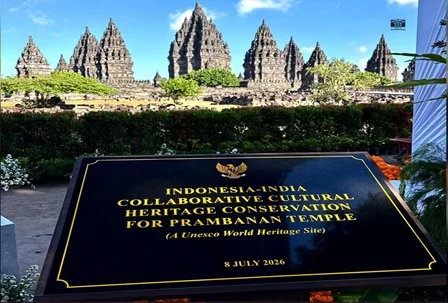
During the recent visit of Narendra Modi to Indonesia, his visit to Prambanan Temple drew significant attention. The visit highlighted the deep civilizational, cultural, and historical ties between India and Southeast Asia, making the temple.
Thus, Prambanan represents the political and religious shift from Buddhist rule to Hindu rule in Java.
(A) To Celebrate Hindu Revival
(B) Royal Temple
(C) Political Legitimacy
Prambanan is dedicated to the Trimurti:
Among these,
The Shiva Temple is the tallest and most important. Inside the Shiva temple are statues of:
This reflects the strong influence of Shaivism in ancient Java.
Prambanan is one of the finest examples of Nagara Style Hindu architecture outside India.
Unlike South Indian Dravidian temples, Prambanan has tall, vertical spires resembling North Indian Nagara temples.
The complex consists of three zones:
|
Zone |
Description |
|---|---|
|
Outer Zone |
Open area |
|
Middle Zone |
Hundreds of small temples |
|
Inner Zone |
Main temples |
|
Temple |
Vehicle |
Importance |
|---|---|---|
|
Shiva |
Nandi |
Largest |
|
Vishnu |
Garuda |
Preservation |
|
Brahma |
Hamsa |
Creation |
One of the most significant features is the extensive Ramayana relief panels carved on the walls.
These carvings narrate the story from:
The carvings demonstrate how Indian epics spread across Southeast Asia through trade, religion, and cultural exchange. Today, the famous Ramayana Ballet is performed near the temple, blending dance, drama, and music while preserving this shared heritage.
Around the 10th century CE, the political capital shifted from Central Java to East Java. Gradually, Prambanan was abandoned. Subsequent volcanic eruptions and earthquakes caused severe damage. For centuries, the temple remained buried under volcanic debris and jungle vegetation.
The ruins attracted attention during the colonial period. Large-scale archaeological restoration began in the early 20th century. The restoration continues even today, as not all of the original temples have been fully reconstructed.
Prambanan was declared a UNESCO World Heritage Site in 1991 because of:
Role of the Archaeological Survey of India (ASI) in Prambanan Temple
The Archaeological Survey of India (ASI) has recently become an important part of the conservation of Prambanan Temple, marking a new chapter in India–Indonesia cultural cooperation. Although Indonesia has been restoring the temple for decades, India officially joined the conservation efforts in 2026 following an agreement between the two countries.
|
Year |
Development |
|---|---|
|
Before 2025 |
No direct role of ASI in Prambanan Temple conservation. |
|
2025 |
India and Indonesia agreed to explore India's assistance in restoring Prambanan during bilateral discussions. |
|
2026 |
PM Narendra Modi and President Prabowo Subianto inaugurated the ASI-led conservation project. |
|
2026 onwards |
ASI began scientific documentation, restoration planning, structural assessment, and conservation work in collaboration with Indonesian authorities |
Prambanan is one of the strongest examples of Indianization in Southeast Asia.
|
Indian influence reached Indonesia mainly
|
Indian influence can still be seen
|
Prime Minister Narendra Modi's visit reinforced:
|
Feature |
Details |
|---|---|
|
Country |
Indonesia |
|
Location |
Near Yogyakarta, Central Java |
|
Built |
9th Century CE |
|
Dynasty |
Sanjaya Dynasty |
|
Kingdom |
Mataram Kingdom |
|
Religion |
Hinduism |
|
Dedicated To |
Trimurti (Shiva, Vishnu, Brahma) |
|
Main Temple Height |
47 metres (About 154 Feet) |
|
Original Temples |
Around 240 |
|
Architecture |
Nagara Style |
|
UNESCO Status |
1991 |
|
Famous For |
Ramayana Reliefs & Ramayana Ballet |
The Prambanan Temple is not only the largest Hindu temple complex in Indonesia but also a powerful symbol of the centuries-old civilizational ties between India and Indonesia. Its rich history, Nagara-style architecture, Ramayana reliefs, and UNESCO World Heritage status make it highly relevant for UPSC Prelims (Art & Culture) and GS Paper I & II (History and International Relations). Prime Minister Narendra Modi's visit has further highlighted its role in India's cultural diplomacy and Act East Policy. For UPSC aspirants, understanding Prambanan Temple, India–Indonesia cultural relations, and the spread of Indian civilization in Southeast Asia is essential from both examination and contemporary affairs perspectives.
|
Q. Consider the following statements regarding Prambanan Temple:
Which of the statements given above is/are correct? (a) 1 and 2 only Mains Practice Question"Prambanan Temple is not merely a religious monument but a symbol of India's enduring civilizational influence in Southeast Asia." Discuss its historical significance and explain how it strengthens contemporary India–Indonesia cultural diplomacy. Essay Practice Question"Prambanan Temple stands as a symbol of India's enduring civilizational influence and cultural diplomacy in Southeast Asia." Discuss in the context of India's soft power and India–Indonesia relations. |
1. Why is Prambanan Temple important for UPSC aspirants?Answer: Prambanan Temple is important because it covers Ancient History, Art & Culture, UNESCO World Heritage Sites, and India–Indonesia cultural relations, making it relevant for both Prelims and Mains. 2. What makes Prambanan Temple important for UPSC preparation?Answer: It showcases the spread of Indian culture, Hindu temple architecture (Nagara style), and the Ramayana tradition in Southeast Asia, which are frequently asked UPSC themes. 3. Why should UPSC aspirants study Prambanan Temple?Answer: The temple highlights India's historical cultural influence abroad and supports topics like cultural diplomacy, soft power, and the Act East Policy. 4. How is Prambanan Temple relevant for UPSC Prelims and Mains?Answer: For Prelims, it is important for UNESCO sites, temple architecture, and history. For Mains, it relates to Indian culture and India–Indonesia relations. 5. What is the significance of Prambanan Temple in India–Indonesia cultural relations?Answer: Prambanan symbolizes the centuries-old civilizational ties between India and Indonesia and strengthens bilateral relations through cultural diplomacy and shared heritage |



Our support team will be happy to assist you!


 Contact Us
  New Batch : 9555124124/ 7428085757
  Tech Support : 9555124124/ 7428085757