New
Hindi Medium: (Delhi) - GS Foundation (P+M) : 6th July 2026, 6:00 PM Hindi Medium: (Prayagraj) - GS Foundation (P+M) : 5th July 2026, 8:00 AM English Medium: (Delhi) - GS Foundation (P+M) : 20th July 2026 English Medium: (Prayagraj) - GS Foundation (P+M) : 15th July 2026, 8:00 AM Hindi Medium: (Delhi) - GS Foundation (P+M) : 6th July 2026, 6:00 PM Hindi Medium: (Prayagraj) - GS Foundation (P+M) : 5th July 2026, 8:00 AM English Medium: (Delhi) - GS Foundation (P+M) : 20th July 2026 English Medium: (Prayagraj) - GS Foundation (P+M) : 15th July 2026, 8:00 AM

Pinaka Long Range Guided Rocket (LRGR): Features, Range, DRDO Tests & Strategic Significance

Prelims

Science & Technology | Defence | Current Affairs

Mains

GS Paper III – Defence Technology, Internal Security, Indigenisation of Technology

Why Is This in the News ?

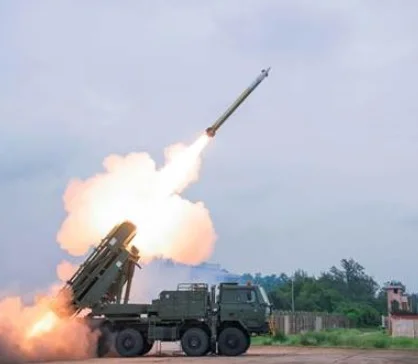
  • DRDO recently conducted successful flight-tests of the Pinaka Long Range Guided Rocket.
  • These successful trials validate the performance of the indigenous guided rocket system and mark another important step in the modernization of India’s artillery forces.

What Is the Pinaka Long Range Guided Rocket (LRGR) ?

  • The Pinaka Long Range Guided Rocket is an advanced guided variant of the Pinaka rocket family. The LRGR combines the mobility and rapid-fire capability of the Pinaka launcher with improved precision.
  • Major Characteristics are that it provides extended range compared with earlier Pinaka rockets, incorporates guidance and control features, offers improved accuracy against designated targets, and enhances the Indian Army’s long-range strike capability.

What Is the Pinaka Rocket System ?

  • The Pinaka is an indigenous Multi-Barrel Rocket Launcher (MBRL) developed to provide rapid and intense artillery support to the Indian Army. The system enables artillery units to deliver powerful strikes while maintaining mobility and operational flexibility.
  • Important features are that it is indigenous in design and developed by DRDO, mounted on highly mobile vehicles for quick deployment, capable of launching multiple rockets within a short duration, provides heavy firepower against enemy positions, and suitable for operations across diverse terrains.
  • Components of a Typical Pinaka System are launcher vehicle, loader-cum-replenishment vehicle, command post vehicle, fire control system, and rocket ammunition.

Evolution of the Pinaka System

  • The Pinaka system was developed by DRDO, primarily through the Armament Research & Development Establishment (ARDE), Pune, to provide an indigenous alternative to imported multi-barrel rocket systems.
  • Following successful trials and its performance during the 1999 Kargil conflict, the Pinaka system was inducted into the Indian Army in the early 2000s. The original variant (Pinaka Mk-I) was designed mainly for area saturation and had an operational range of about 37–40 km.
  • DRDO later developed the Enhanced Range Pinaka, which extended the range to approximately 75 km while improving reliability and overall performance.
  • The latest evolution is the Long Range Guided Rocket (LRGR-120), designed to engage designated targets at ranges up to 120 km. Its maiden test at the maximum range was conducted in December 2025, followed by a successful minimum-range user trial of 60 km from the Integrated Test Range (ITR), Chandipur, in July 2026.

Guided vs Unguided Rockets

The Pinaka LRGR belongs to the guided category and reflects the global shift toward precision-guided munitions.

FEATURES

UNGUIDED ROCKET

GUIDED ROCKET

Flight Control

Ballistic after launch

Guidance during flight

Accuracy

Lower

Higher 

Primary Role

Area saturation 

Precision engagement

Target Type 

Broader target area 

Designated target 

Strategic Significance

  • Enhanced Long-Range Strike Capability : Modern battlefields require the ability to engage targets from significant distances. The LRGR strengthens the Indian Army’s capability to strike important targets while maintaining stand-off distance.
  • Improved Precision : Guidance features improve the accuracy of artillery operations and enhance the effectiveness of target engagement.
  • High Mobility: The vehicle-mounted launcher allows forces to deploy quickly, fire rapidly, and relocate before enemy counter-fire arrives.
  • Strengthening Indigenous Capability : The successful development of the LRGR demonstrates India’s growing expertise in advanced rocket technologies and supports strategic autonomy in defence production.
  • Strengthening Deterrence : A capable indigenous artillery system contributes to military preparedness and enhances India’s overall deterrence posture.

Importance for the Indian Army

As warfare becomes increasingly technology-driven, such systems are essential for maintaining operational readiness.

ADVANTAGE 

BENEFIT

Longer Reach

Ability to engage distant targets

Better Accuracy

Higher probability of successful target engagement

Rapid Firepower

Multiple rockets can be launched quickly

High Mobility 

Fast deployment and relocation

Indigenous support

Easier maintenance and upgrades through domestic production

Role of DRDO and Indian Industry

This collaboration strengthens India’s domestic defence manufacturing ecosystem and advances the goal of Atmanirbhar Bharat.

  • DRDO's Contribution includes Research and development, System design, Technology development, Testing and evaluation and Integration of various subsystems.
  • Contribution of Indian Industry includes Manufacturing components, Producing launchers and support vehicles, System integration and supporting production and supply chains.

Challenges Ahead

  • Continuous technological upgradation is necessary to keep pace with evolving warfare.
  • Integration with modern surveillance and targeting systems is important.
  • Ensuring efficient large-scale production and maintenance remains essential.
  • Future conflicts will demand greater precision, networking, and rapid response capabilities.

Way Forward

  • Continue indigenous development of advanced artillery systems.
  • Strengthen collaboration between DRDO, the armed forces, and industry.
  • Enhance research in guidance, navigation, and precision-strike technologies.
  • Promote self-reliance in critical defence manufacturing and supply chains.

PRELIMINARY MCQ

Q. Consider the following statements:

  1. Pinaka is a missile defence system designed to intercept incoming ballistic missiles.

  2. Pinaka is an indigenous rocket artillery system developed by DRDO.

  3. The Long Range Guided Rocket is intended to improve precision in target engagement.

Which of the statements given above are correct?

(a) 1 and 2 only

(b) 2 and 3 only

(c) 1 and 3 only

(d) 1, 2 and 3

MAINS PRACTICE QUESTION

Q. Discuss the significance of the successful flight-test of the Pinaka Long Range Guided Rocket for India’s indigenous defence capabilities and military preparedness.

FAQs

1. What is the Pinaka Long Range Guided Rocket ?

It is an indigenously developed guided rocket belonging to the Pinaka rocket family and is designed to enhance the Indian Army's long-range precision strike capability.

2. Where was the recent flight-test conducted ?

The recent successful flight-test was conducted at the Integrated Test Range (ITR), Chandipur, Odisha.

3. What is the Pinaka weapon system ?

Pinaka is an indigenous Multi-Barrel Rocket Launcher (MBRL) designed to provide rapid and powerful artillery fire support to the Indian Army.

4 .How does the Pinaka LRGR support Aatmanirbhar Bharat ?

It strengthens indigenous defence research, development, manufacturing, and technological self-reliance.

5. What is the primary role of the Indian Army in the Pinaka programme ?

The Indian Army is the primary user of the Pinaka system and employs it for artillery fire support and battlefield operations.

Have any Query?

Our support team will be happy to assist you!

OR