New
GS Foundation (P+M) - Delhi : 05th Jan., 2026 Winter Sale offer UPTO 75% + 10% Off GS Foundation (P+M) - Prayagraj : 15th Dec., 11:00 AM Winter Sale offer UPTO 75% + 10% Off GS Foundation (P+M) - Delhi : 05th Jan., 2026 GS Foundation (P+M) - Prayagraj : 15th Dec., 11:00 AM

Current Affairs for 11 December 2025

Solar Storms

(Prelims: Current Events of National and International Importance, General Science)
(Mains, General Studies Paper 3: Achievements of Indians in Science and Technology; Indigenous Development of Technology and Development of New Technology, Space)

Context

Recently, ISRO stated that India's first solar observatory, Aditya-L1, played a key role in helping scientists understand why the most powerful solar storm in more than two decades, expected to hit Earth in May 2024, was behaving so unusually.

About Solar Storms

  • A solar storm is a sudden burst of particles, energy, magnetic fields, and matter from the Sun into the solar system.
  • The Sun produces a complex network of magnetic fields. These magnetic fields are distorted by the Sun's rotation, as the equator rotates faster than its poles.
  • Solar storms often begin when these distorted magnetic fields on the Sun become so distorted and expanded that they separate and reconnect (a process called magnetic reconnection), releasing large amounts of energy.
  • These powerful explosions can produce any or all of the following:
    • Intense bright light (flare) as in a 'solar flare'
    • A 'radiation storm' or 'plume of solar particles' projected into space at high speed
    • A massive cloud of solar material ejected from the Sun as in a 'coronal mass ejection'

Effects of a Solar Storm

  • When a solar storm is directed toward Earth, it can cause a major disruption in Earth's magnetic field, called a geomagnetic storm. This can produce effects such as radio blackouts, power outages, and aurora borealis.
  • However, these storms do not directly harm anyone on Earth because the Earth's magnetic field and atmosphere shield them from the worst effects.

About Solar Flares

  • A solar flare is an intense burst of radiation or light on the Sun.
  • These flashes cover all parts of the electromagnetic spectrum, including X-rays, gamma rays, radio waves, ultraviolet, and visible light.
  • Solar flares are the most powerful explosions in the solar system, and the largest solar flares can have the energy equivalent of a billion hydrogen bombs.

About Radiation Storms

  • Solar eruptions can accelerate charged particles (electrons and protons) into space at incredibly high speeds, triggering a radiation storm.
  • The fastest particles travel so fast that they can cover the distance of approximately 93 million miles from the Sun to Earth in about 30 minutes or less.

About Coronal Mass Ejection (CME)

  • A CME is a massive cloud of electrically charged gas called plasma ejected from the Sun.
  • A single CME can blast billions of tons of material into the solar system at once.
  • CMEs occur in the Sun's outer atmosphere, called the corona, and often appear as giant bubbles erupting from the Sun.

Aditya-L1

  • It is the first space-based observatory-class Indian solar mission to study the Sun.
  • It was launched by the Indian Space Research Organisation (ISRO) on September 2, 2023.
  • The spacecraft is placed in a halo orbit around Lagrangian point 1 (L1) of the Sun-Earth system, approximately 1.5 million km from Earth.
  • The major advantage of a satellite placed in a halo orbit around the L1 point is that it can observe the Sun continuously without any obstruction/eclipse.
  • This provides greater advantage in continuously observing solar activities.
  • The spacecraft is carrying seven payloads using electromagnetic and particle detectors to observe the Sun's photosphere, chromosphere, and outermost layers.

Border Roads Organisation

The Defence Minister recently dedicated 125 newly constructed infrastructure projects of the Border Roads Organisation (BRO) to the nation, marking the highest number and significance of inaugurations by the agency in a single day.
About the Border Roads Organisation

  • It is a road construction executive force in India that supports the Indian Armed Forces. In 2015, the BRO was fully placed under the Ministry of Defence.
  • It was formed on May 7, 1960, to secure India's borders and develop infrastructure in remote areas of the country's northern and northeastern states.
  • It develops and maintains road networks in India's border areas and friendly neighboring countries.
  • It operates infrastructure in 19 states and three union territories (including the Andaman and Nicobar Islands) and neighboring countries such as Afghanistan, Bhutan, Myanmar, Tajikistan, and Sri Lanka.
  • The BRO specializes in the construction and maintenance of roads, bridges, tunnels, airports, and maritime works in some of the world's most challenging terrain.
  • The BRO also has an operational role during national emergencies and wartime, providing direct support to the Army in maintaining roads in forward areas and performing other tasks as assigned by the government.
  • It also provides manpower for the rehabilitation of some of the Indian Air Force's forward airbases during operations. The BRO is also included in the Order of Battle (ORBAT) of the Armed Forces, ensuring their support at any time.
    • The Order of Battle (ORBAT) provides a detailed description of a military force's structure, command, personnel, equipment, and their deployment for an operation.
  • To ensure coordination and expeditious execution of projects, the Government of India established the Border Roads Development Board (BRDB), with the Prime Minister as its Chairman and the Defence Minister as its Vice Chairman.
  • The executive head of the BRO is the Director General of Border Roads (DGBR), who holds the rank of Lieutenant General. Officers and personnel of the General Reserve Engineer Force (GREF) form the core cadre of the BRO.
  • It also employs officers and soldiers on extra-regimental employment (deputation) from the Corps of Engineers of the Indian Army. The BRO also employs over two lakh (200,000) local workers, ensuring employment in remote areas.
  • Motto: Shramen Sarvam Sadhyam (Everything is achieved through hard work)

Global Inequality Report 2026 Released

Prelims: (Economy + CA)
Mains: (GS 2 - Welfare Schemes, Government Policies; GS 3 – Economy)

Why in News ?

The World Inequality Report 2026, released by the World Inequality Lab (led by economists Thomas Piketty, Lucas Chancel, Emmanuel Saez & Gabriel Zucman), highlights widening income, wealth, gender, and climate inequalities across India and the world. It is the 3rd major edition after 2018 and 2022, and its findings are crucial for debates on inclusive growth, SDGs, climate equity, redistribution policies, and welfare economics.
Background & Context

Global inequality has intensified since the 1980s with rising wealth concentration, stagnant wages, weak social protection systems, and the rise of billionaire capital.
In India, liberalisation accelerated economic growth but also deepened disparities due to unequal access to education, health, employment, digital technology, and assets.

The 2026 report comes amid:

  • Slow post-pandemic recovery
  • Concentration of global capital among ultra-rich groups
  • Rising climate vulnerability
  • Weak multilateralism
  • Declining female labour participation in many developing economies

The report argues that inequality is not inevitable, but a policy choice driven by taxation structures, labour market design, and redistribution frameworks.

India’s Income and Wealth Inequality

Average Levels

  • Average annual income: ~€6,200 (PPP)
  • Average wealth: ~€28,000 (PPP)

Income Inequality

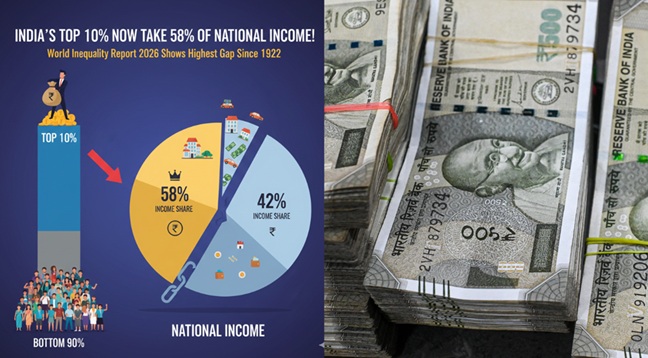
  • Top 10% earn 58% of national income.
  • Bottom 50% receive only 15%.
  • Gap increased from 2022 (Top 10%: 57%; Bottom 50%: 13%).

Wealth Inequality

  • Top 10% own 65% of total wealth.
  • Top 1% hold 40% of India’s wealth — among the highest globally.

Global Inequality Trends

  • Top 0.001% (~60,000 ultra-rich) own 3× more wealth than the bottom 50% of humanity.
  • Global top 10% own 75% of world wealth;
  • Bottom 50% hold just 2%.
  • Top 1% control 37% of global wealth — more than 18× the bottom 50%.

Geographic Inequality Shift (1980–2025)

China – Upward Shift

  • Majority population has moved into global middle-income segments.

India – Relative Decline

  • In 1980: More Indians were in the global middle 40%.
  • Today: Most fall in the bottom 50%.

Sub-Saharan Africa

  • Still concentrated overwhelmingly in the global bottom half.

Gender Inequality

India

  • Female Labour Force Participation Rate (FLFPR): 15.7%
  • Persistent wage gaps across sectors.

Global Trends

  • Women earn 61% of men’s wages (excluding unpaid care).
  • Including unpaid work → women’s earnings fall to 32%.
  • Women’s share of global labour income: 25% (unchanged since 1990).

Regional Shares of Women’s Labour Income

  • MENA: 16%
  • South & Southeast Asia: 20%
  • Sub-Saharan Africa: 28%
  • East Asia: 34%
  • Europe/North America: ~40%

Climate Inequality

  • Bottom 50% of population contributes only 3% of emissions.
  • Top 10% contribute 77% of emissions.
  • Top 1% alone account for 41% of emissions linked to private capital ownership — more than the entire bottom 90%.

Reasons Behind Worsening Inequality

  • Rising ultra-wealth concentration
  • Weak progressive taxation
  • Low female labour participation
  • Erosion of global multilateral frameworks
  • Expansion of informal employment
  • Unequal access to health, education, tech and financial services
  • Climate impact burden on poorest regions
  • Digital divide and unequal asset ownership

Challenges Identified & Policy Recommendations

1. Regressive Taxation

  • Effective tax rates fall sharply for billionaires → loss of state revenue.
  • Recommendations
    • Introduce wealth & inheritance taxes
    • Remove tax loopholes for ultra-rich
    • Strengthen tax compliance

2. Gendered Inequalities

  • Unpaid domestic work limits women's economic mobility.
  • Recommendations
    • Public investment in childcare
    • Skill development for women
    • Reduce unpaid care burden
    • Encourage flexible, safe employment

3. Inter-country Inequality

  • India lagging behind China in shifting population to the middle class.
  • Recommendations
    • Expand social protection (cash transfers, pensions, unemployment insurance)
    • Increase rural incomes and urban mobility

4. Climate Responsibility Gap

  • High-emission groups escape accountability.
  • Recommendations
    • Climate justice framework
    • Green taxation on high emitters
    • Incentivize renewable energy

5. Inequality Within the Top

  • Extreme income concentration even among high earners.
  • Recommendations
  • Larger public investment in human capital:
    • Universal high-quality education
    • Healthcare
    • Childcare
    • Nutrition
      • Reduce early-life disparity

FAQs

1. What is the World Inequality Report ?

It is a global assessment of income, wealth, gender, and climate inequalities, prepared by the World Inequality Lab using tax data, national accounts, and survey datasets.

2. Why is the 2026 report significant for India ?

Because it shows India’s rising concentration of wealth among the top 1% and a relative decline in its share of the global middle class.

3. Who prepares the report ?

The World Inequality Lab, led by economists Thomas Piketty, Emmanuel Saez, Lucas Chancel, and Gabriel Zucman.

4. How unequal is India according to the report ?

  • Top 10% earn 58% of income.
  • Bottom 50% earn only 15%.
  • Top 1% own 40% of wealth.

5. How is climate inequality measured ?

By analysing emissions linked to private capital ownership. Top 1% account for 41% of these emissions.

Blue Corner Notice

Prelims: (Security + CA)
Mains: (GS 2 - International Organisations; GS 3 – Security)

Why in News ?

INTERPOL has issued a Blue Corner Notice to trace the missing owners of a Goa-based nightclub where a major fire incident recently occurred. The notice seeks assistance from all member countries in locating them and obtaining key identity and background details. The step was taken after local authorities reported that the owners absconded soon after the tragedy, highlighting gaps in accountability and cross-border crime tracking.

Background & Context

  • Goa’s nightclub fire incident resulted in significant casualties and raised concerns regarding fire safety compliance, illegal construction, and regulatory failures.
  • As the accused went missing, Indian authorities requested INTERPOL assistance to expand the search beyond national borders.
  • Blue Corner Notices are commonly used in cases involving fugitives before formal charges, missing suspects, or individuals wanted for questioning.

What is a Blue Corner Notice ?

A Blue Corner Notice is an “Enquiry Notice” issued by INTERPOL to collect additional information about a person’s identity, location, or criminal activities.
It allows law enforcement agencies across 196 member countries to share or request information connected to an ongoing investigation.

Key Features

  • Used before filing formal criminal charges.
  • Helps verify identity, background, or criminal record.
  • Facilitates cross-border information sharing and police cooperation.
  • Can be issued for persons who are missing, absconding, or wanted for questioning.

Other Types of INTERPOL Notices

INTERPOL uses a colour-coded alert system:

1. Red Notice

  • For locating and arresting individuals wanted for prosecution or to serve a sentence.

2. Yellow Notice

  • To trace missing persons, especially children, or identify people unable to confirm their identity.

3. Black Notice

  • For identifying unknown deceased bodies.

4. Green Notice

  • Alerts about individuals with criminal history who could pose a threat.

5. Orange Notice

  • Warns about dangerous persons, objects, or events that pose immediate risk.

6. Purple Notice

  • Shares information on criminal modus operandi, tools, or concealment techniques.

7. Silver Notice (Pilot)

  • Helps identify, locate, or recover assets linked to criminal activity.

What is INTERPOL ?

INTERPOL (International Criminal Police Organization) is the world’s largest international police cooperation body.

Key Highlights

  • Members: 196 countries
  • India became a member: 1949
  • Headquarters: Lyon, France
  • Special Status: Permanent Observer at the United Nations since 1996

Functions

  • Facilitates international police cooperation.
  • Helps combat terrorism, cybercrime, trafficking, money laundering, and organized crime.
  • Maintains global criminal databases and secure communication networks.
  • Issues Notices and Diffusions to assist investigations worldwide.

Why Blue Corner Notices Are Important

  • Enable quick cross-border tracing of suspects or missing persons.
  • Strengthen cooperation between Indian agencies and global policing networks.
  • Help curb international flight of offenders and support timely investigations.
  • Are essential when suspects abscond immediately after a crime, as in the Goa nightclub case.

FAQs

1. Is a Blue Corner Notice the same as an arrest warrant ?

No. A Blue Notice does not authorize arrests. It only seeks information. Arrests typically follow Red Notices.

2. Who requests a Blue Corner Notice in India ?

Central agencies like CBI (National Central Bureau – New Delhi) or state police through the CBI request INTERPOL to issue such notices.

3. Can a Blue Notice be issued even without formal charges ?

Yes. It is specifically designed for cases before charges are filed, especially when a person is missing or required for questioning.

4. Does a Blue Notice make someone a fugitive ?

Not necessarily. It depends on the case. It simply means police need help locating or identifying the individual.

5. How long does a Blue Notice remain active ?

Usually until the requesting country withdraws it or until the investigation concludes.

PM Dhan-Dhaanya Krishi Yojana

Prelims: (Agriculture + CA)
Mains: (GS 2 -  Governance; GS 3 – Agriculture)

Why in News ?

The Ministry of Agriculture & Farmers’ Welfare recently conducted the PM Dhan-Dhaanya Krishi Yojana (PM-DDKY) – FPO Sangam, which saw participation from 72 Farmer Producer Organisations (FPOs) representing 15 states. The event aimed to strengthen market linkages by connecting FPOs with buyers, processors, exporters, warehouses, e-commerce chains, and retail networks.
Background & Context

India’s agriculture sector faces structural challenges such as:

  • Low productivity in many districts
  • Heavy concentration in water-intensive crops
  • Supply chain fragmentation between farms and markets
  • Low levels of post-harvest value addition
  • Limited access to institutional credit
  • Weak aggregation systems for small and marginal farmers

Recognising these gaps, the Government launched the PM Dhan-Dhaanya Krishi Yojana (2025–26 to 2030–31) as a comprehensive, converged agricultural development programme, integrating efforts across multiple ministries. The FPO Sangam platform is an important component of the scheme, aimed at improving market access, price realisation, and long-term farmer–buyer partnerships.

What is PM Dhan-Dhaanya Krishi Yojana ?

Overview

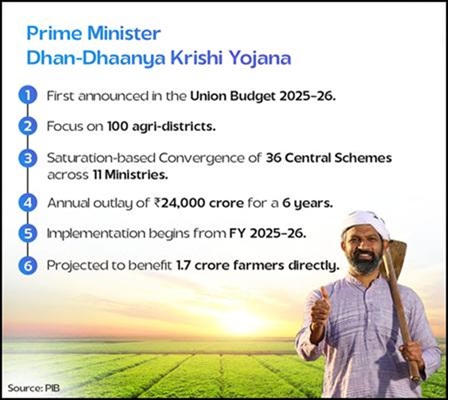
The PM Dhan-Dhaanya Krishi Yojana (PM-DDKY) is a nationwide agricultural mission to enhance productivity, strengthen value chains, promote diversification, support women & youth in farming, and achieve long-term food self-sufficiency.
Duration

2025–26 to 2030–31 (6-Year Mission)

Convergence Approach

The scheme brings together:

  • 36 existing schemes
  • 11 ministries/departments
  • One unified funding and monitoring architecture

This avoids duplication, reduces administrative fragmentation, and ensures better resource utilization.

Fund Allocation Structure

PM-DDKY funds are divided into:

Component

Allocation

Subsidies

40%

Infrastructure Development

30%

Loans & Credit Support

20%

Training, Skill Development & Market Linkages

10%

Key Objectives of the Scheme

  • Boost crop productivity across lagging districts
  • Promote crop diversification away from water-guzzling crops
  • Strengthen post-harvest value addition (storage, grading, processing)
  • Achieve self-sufficiency in foodgrains, pulses, and oilseeds
  • Support women-led farming groups and agri-startups
  • Improve credit access, especially for small and marginal farmers
  • Build resilient supply chains for climate-related disruptions

District Selection Criteria

Districts are chosen using three major indicators:

1. Low Productivity

  • Yield lower than national averages across major crops.
  • Focus on underperforming agro-climatic zones.

2. Moderate Cropping Intensity

  • Districts with less than 1.55 crop cycles per year, indicating scope for increasing crop intensity.

3. Low Credit Access

  • Institutional credit coverage below 30%, highlighting dependence on informal credit.

This ensures that support is directed to districts with the highest development potential.

Implementation Architecture

1. District DDKY Samiti

  • Established in each selected district
  • Chaired by District Collector/DM
  • Responsible for:
    • Preparing the District Agriculture Development Plan (DADP)
    • Monitoring implementation
    • Ensuring convergence with other schemes

2. Central Monitoring

  • 100 Central Nodal Officers, mostly Joint Secretaries
  • Provide technical guidance, review progress, and address bottlenecks.

3. State Agriculture Departments

  • Facilitate coordination between districts, state agencies, and central ministries.

Role of FPO Sangam under PM-DDKY

The FPO Sangam initiative aims to:

  • Link FPOs with organized markets
  • Facilitate contract farming partnerships
  • Enable bulk sales for better price realization
  • Promote export-ready clusters
  • Expand access to:
    • Quality inputs
    • Digital platforms
    • Post-harvest infrastructure
    • Livelihood diversification avenues

FPOs help small farmers overcome low bargaining power and achieve economies of scale.

Expected Outcomes of PM-DDKY

  • Enhanced productivity across 300+ districts
  • Improved farm incomes through market-driven interventions
  • Better credit penetration for small farmers
  • Reduction in post-harvest losses
  • Development of modern agri-infrastructure
  • Strengthening of pulses and oilseeds self-sufficiency
  • Boost to rural employment, especially for women and youth
  • Transformation of India’s agriculture into a more resilient and sustainable sector

FAQs

1. Is PM-DDKY a new scheme or restructured from old ones ?

It is a new umbrella programme that converges 36 existing schemes into one coordinated mission.

2. What is the duration of PM-DDKY ?

It will run from 2025–26 to 2030–31.

3. Who will implement the scheme at the district level ?

The District DDKY Samiti, led by the District Collector, will prepare and execute the District Agriculture Development Plan.

4. How will PM-DDKY help small farmers ?

Through subsidies, credit support, improved market access, and FPO-led aggregation which increases bargaining power.

5. What role do FPOs play ?

FPOs form the backbone of market linkages, helping farmers achieve better prices and access larger buyers and processors.

India’s 8.2% Growth: Strengths & Fault Lines

Prelims: (Economy + CA)
Mains: (GS 3 – Economy)

Why in News?

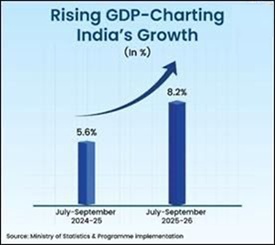
India recorded a strong 8.2% GDP growth, supported by robust manufacturing and services performance. However, the IMF graded India’s national income accounting system as ‘Grade C’, pointing to statistical limitations and structural data gaps.
Background & Context

  • India is currently among the fastest-growing major economies, outpacing global growth expectations.
  • The growth is taking place amid global economic uncertainties—weak global demand, geopolitical tensions, and tightening international financial conditions.
  • The IMF’s assessment has reopened a key debate: Is strong economic growth sustainable without strengthening India’s statistical and institutional framework ?

Current Growth Performance

India’s GDP for the quarter rose to ₹48.63 lakh crore, surpassing last year’s output and showing sustained recovery beyond post-COVID normalisation.

Sector-wise Performance

  • Manufacturing: 9.1% — improved industrial demand and rising capacity utilisation.
  • Services:9.2% — now 60% of GDP; financial services witnessed 10.2% growth.
  • Agriculture: 3.5% — helped by better reservoir levels and horticulture output.

Additional Growth Indicators

  • Real GVA: ₹82.88 lakh crore → ₹89.41 lakh crore — indicating genuine value addition.
  • Nominal GDP: up 8.8%, reflecting subdued inflation.
  • Private consumption:7.9%, signalling strong household demand.

Macroeconomic Stability Indicators

India’s macroeconomic fundamentals remain stable:

  • Inflation eased and remained close to the RBI’s target band.
  • Bank credit grew steadily, supported by well-capitalised banks.
  • Fiscal consolidation progressed: GST collections and direct tax revenues continued to perform strongly.
  • Current account deficit remained modest—supported by strong services exports and stable forex reserves.

These indicators reinforce India’s economic resilience.

IMF’s Grade C Assessment: Implications

The IMF’s ‘Grade C’ rating reflects deficiencies in India’s statistical system, not its growth performance.

Key Concerns Highlighted by IMF

  • Use of an outdated 2011–12 base year.
  • Overreliance on WPI, absence of a comprehensive Producer Price Index (PPI).
  • Single deflation method creating cyclical distortions.
  • Mismatch between production and expenditure GDP estimates.
  • Gaps in representing the informal sector.
  • Absence of seasonally adjusted data.
  • Lack of consolidated state and local government finances since 2019.

The IMF notes that India requires a stronger statistical backbone to match its economic scale.

Uneven Recovery Across Sectors

Growth is strong but not evenly distributed.

  • Mining: barely grew (0.04%) — due to extended monsoon disruptions.
  • Electricity, gas & utilities: 4.4%, limited by a milder winter reducing energy demand.

Sectoral Composition of GVA

  • Primary sector: 14%
  • Secondary sector: 26%
  • Tertiary sector: 60%

Despite a high-services share, India’s workforce remains concentrated in low-productivity agriculture and informal services—reflecting a structural imbalance.

Structural Vulnerabilities

1. Weak Export Competitiveness

  • Slow scaling of high-value manufacturing
  • Global geopolitical uncertainties
  • Frequent tariff changes impacting investor confidence

2. Low Labour Productivity

  • Majority of labour still in low-productivity sectors
  • Slow pace of formalisation despite rapid digital growth

3. Weak Institutional and Statistical Capacity

  • Outdated base year
  • Incomplete data representation
  • Lack of uniform data from States and local bodies

4. Persistent External Pressures

  • Rupee faces downward pressure due to a strong USD
  • Volatile foreign capital flows
  • Structural current account pressures

These vulnerabilities do not undermine India’s 8.2% growth but highlight the reforms needed to sustain long-term economic momentum.

FAQs

1. Does the IMF’s Grade C mean India’s GDP numbers are unreliable ?

No. It reflects weaknesses in data systems, not the GDP growth outcome. It calls for modernising India’s statistical framework.

2. Why is India’s GDP growth so strong despite global slowdown ?

Strong domestic demand, resilient manufacturing, expansion in services, and controlled inflation have supported growth.

3. Why is the base year 2011–12 considered outdated ?

It no longer captures current consumption patterns, production structures, digital activity, and post-pandemic economic shifts.

4. What sectors contributed most to the 8.2% growth ?

Manufacturing (9.1%) and services (9.2%), particularly financial services.

5. What does low mining and utilities growth indicate ?

It signals uneven recovery and weak performance in key input sectors that drive industrial activity.

International Big Cat Alliance (IBCA) and India

India has recently urged all countries with big-cat habitats to participate in the Global Big Cats Summit to be held in New Delhi in 2026, and to join the International Big Cat Alliance (IBCA). This reflects India’s commitment to wildlife conservation and its intent to build stronger global cooperation for species protection.
IBCA: Concept and Significance

Establishment & Objective

  • Launched: 2023, on the 50th anniversary of Project Tiger.
  • Objective: To strengthen global cooperation for the conservation of seven big cat species and their habitats.

Seven Big Cat Species Covered by IBCA

  1. Tiger
  2. Lion
  3. Leopard
  4. Snow Leopard
  5. Cheetah
  6. Jaguar
  7. Puma

India hosts five of these seven species (all except Jaguar and Puma).

Headquarters

  • New Delhi, India

Nature of the Alliance

  • A multinational and multi-agency coalition aimed at large-scale scientific, financial, and collaborative action.

Eligible Members

  • 95 countries where big cats naturally occur
  • Countries without big cats but interested in conservation
  • Scientific institutions, conservation partners
  • All UN member states
  • Nine international organizations have agreed to join IBCA so far.

Financial Support

  • India has committed 150 crore (2023–24 to 2027–28) as initial budgetary support.

Conservation Status of Big Cats

IUCN Red List Status

  • Endangered: Tiger
  • Vulnerable: Lion, Cheetah, Snow Leopard, Leopard
  • Near Threatened: Jaguar
  • Least Concern: Puma

Legal Protection in India

  • The five big cat species found in India are listed under the
    • Wildlife (Protection) Act, 1972 – Schedules I & IV
    • CITES Appendix I (highest level of international protection)

India and Big Cats: Foundation of Global Leadership

India is home to the world’s largest population of tigers and hosts five big cat species:

  • Tiger
  • Asiatic Lion
  • Leopard
  • Snow Leopard
  • Cheetah (reintroduced in 2022)

India has successfully implemented conservation programmes such as:

  • Project Tiger
  • Lion Conservation Programme
  • Snow Leopard Landscape Conservation
  • Cheetah Reintroduction Project

IBCA builds upon this leadership and expands it to a global platform.

Ecological Importance of Big Cats

1. Apex Predators

  • Maintain ecological balance by regulating herbivore populations.
  • Prevent overgrazing and ensure vegetation health.

2. Keystone Species

  • Their decline disrupts entire ecosystems.
  • Conservation benefits numerous associated species.

3. Seed Dispersal and Forest Sustainability

  • Indirectly aid seed dispersal by preying on small mammals and birds, supporting forest regeneration.

4. Carbon Sink Protection

  • Intact habitats such as forests and grasslands, maintained through predator–prey balance, act as major carbon sinks, aiding climate mitigation.

5. Flagship Species

  • Charismatic species that promote public awareness.
  • Their conservation leads to protection of broader ecosystems.

Major Threats and Challenges

1. Habitat Loss and Fragmentation

  • Deforestation, infrastructure expansion, and land-use change shrink and divide natural habitats.

2. Human–Wildlife Conflict

  • Habitat compression pushes big cats towards settlements, increasing livestock depredation, human casualties, and retaliatory killings.

3. Poaching and Illegal Wildlife Trade

  • High demand for tiger skins, bones, and leopard parts fuels transnational illegal trade.

4. Climate Change

  • Alters snow leopard habitats; reduces prey base; shifts ecosystems upward.

5. Genetic Bottlenecks

  • Small and isolated populations suffer from inbreeding (e.g., Asiatic lions confined to Gir Forest).

Global Importance of IBCA

1. Platform for International Cooperation

  • Facilitates joint scientific research, technology exchange, habitat management, and monitoring.

2. Funding and Technical Support

  • Can mobilize global financial resources for conservation, community participation, and capacity building.

3. Strengthening Action Against Wildlife Crime

  • Enhances collaboration to counter transnational poaching and illegal wildlife trade.

4. Climate–Biodiversity Integration

  • Aligns big cat conservation with
    • climate policies,
    • nature-based solutions,
    • and Sustainable Development Goals (SDGs).

5. Boost to India’s Soft Power

  • Strengthens India’s role in global biodiversity diplomacy and showcases successful conservation models.

Way Forward (UPSC Perspective)

  1. Transboundary landscape management – Joint conservation strategies across the Himalayas, Sundarbans, Central Asia, etc.
  2. Community-Based Conservation (CBC) Enhancing livelihood support and conflict-mitigation measures in buffer zones.
  3. Advanced Monitoring Technology AI-enabled camera traps, drones, genetic sampling (e-DNA).
  4. Legal recognition and restoration of wildlife corridors Ensuring landscape connectivity.
  5. Strengthening enforcement mechanisms Cross-border intelligence sharing and integrated databases to curb wildlife crime.
  6. Climate-resilient conservation models Particularly for snow leopard ecosystems and grasslands required for cheetahs.
  7. Awareness and education campaigns Leveraging flagship species to build broader conservation ethics.

Digital Census 2027

  • The Government of India has announced that the 2027 Census will be conducted entirely through digital means, marking a historic technological shift in India’s decennial population-counting exercise.
  • Minister of State for Home Affairs Nityanand Rai shared details in the Lok Sabha on 9 December.
  • This will be India’s first fully digital census.

Digital Census 2027

  • India’s Census is one of the largest administrative exercises in the world.
  • The 2027 Census will be conducted 100% digitally.
  • Data will be collected using a dedicated Mobile Application.
  • Respondents will have the option of Self-Enumeration through a web portal.
  • A Dedicated Census Portal will manage and monitor the entire process.
  • The Census Questionnaire will be notified in the Official Gazette before fieldwork begins.

Constitutional and Legal Basis

  • The Census is conducted under the Census Act, 1948, which empowers the Central Government to collect demographic and socio-economic data.
  • The Census is a Union Subject under Entry 69 of the Seventh Schedule, Union List.
  • It is conducted every 10 (decimal) years.
  • This comes under the Ministry of Home Affairs, Government of India.
  • The Census Questionnaire is notified in the Official Gazette before the Census begins.

How Will the Digital Census Be Conducted ?

A. Data Collection Through Mobile App

  • Enumerators will use a secure mobile application.
  • The app will have features like:
    • Real-time data uploading
    • GPS-tagging
    • Automated error checking
  • Tablets/Mobile devices will replace paper forms, saving both time and resources.

B. Self-Enumeration

  • For the first time, individuals can enter their own data.
  • Respondents will receive Unique Login ID / OTP-based access.
  • Data for all household members can be uploaded through the portal.
  • This will increase participation, especially in urban areas.

C. Data Management & Monitoring

  • A unified digital portal will monitor the progress of enumeration in real time.
  • Tracking will be possible at the state, district, block, and enumeration-unit levels.
  • Strong security measures will include:
    • Data encryption
    • Server-level security
    • Cloud storage protection

What Information Will the Census Collect ?

A. Individual-Level Data

  • Name, age, sex, marital status
  • Mother tongue, literacy level, educational status
  • Economic activity and employment details

B. Housing & Living Conditions

  • Duration of stay at current residence
  • Type of house, amenities, housing conditions
  • Indicators of quality of life

C. Migration-Related Information

The existing methodology will continue:

  • Place of Birth
  • Place of Last Residence
  • Duration of stay at current residence
  • Reasons for migration—employment, education, marriage, family reasons, displacement, etc.

This information is crucial for understanding internal migration patterns, urbanisation trends, and labor mobility in India.
Why is the Digital Census Important ?

(i) Improved Transparency and Accuracy

  • Digital forms auto-detect errors.
  • Reduces human error and duplication of entries.

(ii) Cost Reduction

  • Saves large expenditure on printing, transport, and storage of paper forms.
  • Digital systems lower long-term administrative costs.

(iii) Faster Data Processing

  • Data is available instantly on secure servers.
  • Reports can be generated quickly, aiding timely policymaking.

(iv) Better Policy-Making

Accurate data will help in:

  • Education and health planning
  • Welfare schemes
  • Resource allocation
  • Understanding demographic and migration trends

(v) Boost to E-Governance

  • Strengthens the Digital India initiative.
  • Enhances the use of technology in public administration.

Challenges

1. Digital Divide

  • Low smartphone and internet penetration in rural or remote areas may hinder enumeration.

2. Cybersecurity Risks

  • Protecting sensitive personal data from hacking and breaches is a major concern.

3. Training of Enumerators

  • Millions of field workers must be trained to use the new digital tools.

4. Data Privacy

  • Census data must remain confidential.
  • Requires strong legal frameworks, security systems, and oversight mechanisms.

Which ministry oversees the Census in India ?

(a) Ministry of Statistics and Programme Implementation

(b) Ministry of Home Affairs

(c) Ministry of Digital India

(d) Ministry of Planning

« »
  • SUN
  • MON
  • TUE
  • WED
  • THU
  • FRI
  • SAT
Have any Query?

Our support team will be happy to assist you!

OR