
- UPSC Exam
- State PCS
- One Day Exam
- Current Affairs
- PT Quiz
- Downlaods
- About Coaching
- Blog
- Videos

| Prelims: (Economy + CA) Mains: (GS 3 – Economy) |
India recorded a strong 8.2% GDP growth, supported by robust manufacturing and services performance. However, the IMF graded India’s national income accounting system as ‘Grade C’, pointing to statistical limitations and structural data gaps.
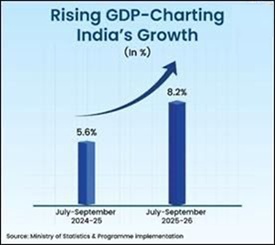
India’s GDP for the quarter rose to ₹48.63 lakh crore, surpassing last year’s output and showing sustained recovery beyond post-COVID normalisation.
Sector-wise Performance
Additional Growth Indicators
India’s macroeconomic fundamentals remain stable:
These indicators reinforce India’s economic resilience.
The IMF’s ‘Grade C’ rating reflects deficiencies in India’s statistical system, not its growth performance.
The IMF notes that India requires a stronger statistical backbone to match its economic scale.
Growth is strong but not evenly distributed.
Sectoral Composition of GVA
Despite a high-services share, India’s workforce remains concentrated in low-productivity agriculture and informal services—reflecting a structural imbalance.
1. Weak Export Competitiveness
2. Low Labour Productivity
3. Weak Institutional and Statistical Capacity
4. Persistent External Pressures
These vulnerabilities do not undermine India’s 8.2% growth but highlight the reforms needed to sustain long-term economic momentum.
FAQs1. Does the IMF’s Grade C mean India’s GDP numbers are unreliable ? No. It reflects weaknesses in data systems, not the GDP growth outcome. It calls for modernising India’s statistical framework. 2. Why is India’s GDP growth so strong despite global slowdown ? Strong domestic demand, resilient manufacturing, expansion in services, and controlled inflation have supported growth. 3. Why is the base year 2011–12 considered outdated ? It no longer captures current consumption patterns, production structures, digital activity, and post-pandemic economic shifts. 4. What sectors contributed most to the 8.2% growth ? Manufacturing (9.1%) and services (9.2%), particularly financial services. 5. What does low mining and utilities growth indicate ? It signals uneven recovery and weak performance in key input sectors that drive industrial activity. |



Our support team will be happy to assist you!

 Contact Us
  New Batch : 9555124124/ 7428085757
  Tech Support : 9555124124/ 7428085757