- UPSC Exam
- State PCS
- One Day Exam
- Current Affairs
- PT Quiz
- Downlaods
- About Coaching
- Blog
- Videos

| Prelims : (International Relations, CA) Mains : (GS 2 – India–US Relations, Global Trade Governance; GS 3 – External Sector, Trade Policy, Manufacturing) |
The United States Trade Representative has launched a Section 301 investigation into several economies, including India and China, over concerns about structural excess capacity and overproduction in key manufacturing sectors.
The probe comes shortly after the Supreme Court of the United States struck down tariffs imposed under the International Emergency Economic Powers Act, forcing the US administration to rely on other trade enforcement mechanisms.
The investigation will examine economies with large trade surpluses or underutilised industrial capacity, which the US believes may distort global trade and affect American manufacturing.
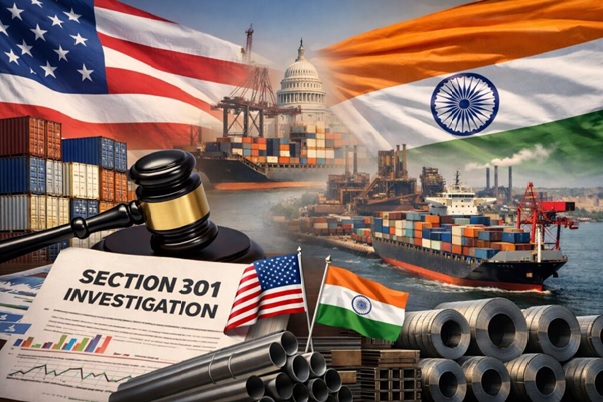
Section 301 is part of the Trade Act of 1974 (Sections 301–310).
It authorises the United States Trade Representative to investigate foreign trade practices that may violate international agreements or unfairly restrict US commerce.
Section 301 is therefore one of the most powerful tools in US trade enforcement policy.
Historically, it has been used to impose tariffs during trade disputes, most prominently during the US–China trade tensions beginning in 2018.
Trade analysts indicate that the current investigation is moving rapidly under an accelerated timeline.
Key procedural steps include :
If the investigation concludes that excess capacity or government policies are distorting trade, the US may impose additional tariffs or trade restrictions on the targeted countries.
According to the USTR’s notice, India is being examined for structural excess capacity in several manufacturing sectors.
The US highlighted that India recorded approximately $58 billion trade surplus with the United States in 2025, raising concerns in Washington over trade imbalances.
The investigation mentions several sectors where the US believes India may have export-oriented surplus capacity :
One of the key concerns relates to solar manufacturing, where India’s production capacity is estimated to be almost three times higher than domestic demand, suggesting reliance on exports.
The investigation comes at a time when India and the United States are negotiating a bilateral trade agreement aimed at expanding economic cooperation.
However, uncertainty surrounding potential US tariffs may complicate the negotiations.
Washington argues that government-supported industrial overcapacity in certain countries :
These concerns are linked to broader US efforts to reshore supply chains and create domestic jobs.
According to the Global Trade Research Initiative, the investigation highlights sectors where India’s industrial expansion could attract scrutiny.
Experts note that India’s export growth is primarily demand-driven, supported by competitive industries and diversified markets. However, the probe signals that India’s manufacturing expansion will face increasing scrutiny from trading partners.
The United States has several domestic laws that allow it to impose tariffs or trade restrictions.
This law allows the US President to regulate commerce during national emergencies.
The Trump administration invoked it in 2025 to impose tariffs, but the Supreme Court of the United States ruled in 2026 that the law cannot be used for tariff imposition, limiting its application.
This provision allows the US President to impose temporary tariffs of up to 15% for 150 days to address balance-of-payments problems.
In February 2026, the US government invoked this section to impose 10% tariffs on imports from multiple countries.
This law allows trade restrictions on national security grounds.
It has previously been used to impose tariffs on :
Section 301 addresses unfair trade practices and allows the US to impose retaliatory tariffs if foreign policies are deemed unjustifiable or discriminatory.
Under this provision, the USTR can self-initiate investigations under Section 301 without waiting for industry complaints.
This is the mechanism currently being used to initiate the investigation into India and other countries.
The probe introduces uncertainty into India–US economic ties, particularly at a time when both countries are negotiating deeper trade cooperation.
If the investigation leads to tariffs, Indian exports in key sectors such as steel, solar equipment, and textiles may face higher barriers in the US market.
The investigation reflects growing global concerns over excess manufacturing capacity, which can lead to price distortions and trade disputes.
India’s push for manufacturing expansion through initiatives like industrial incentives and production-linked schemes could attract greater scrutiny from trading partners.
The United States remains one of India’s largest export destinations, making the outcome of the investigation significant for India’s external trade sector.
FAQs1. What is Section 301 of the US Trade Act ? Section 301 of the Trade Act of 1974 allows the US government to investigate and respond to foreign trade practices that harm US commerce, including through tariffs or other restrictions. 2. Why has the US launched a Section 301 probe into India ? The US is examining whether structural excess manufacturing capacity and trade surpluses in certain sectors may distort global trade. 3. Which sectors in India are under scrutiny ? Key sectors include solar modules, steel, petrochemicals, textiles, healthcare products, construction materials, and automobiles. 4. Could the investigation lead to tariffs on Indian exports ? Yes. If the US concludes that unfair trade practices exist, it may impose tariffs or other trade restrictions. 5. Why is this investigation important for India ? The probe could influence India–US trade negotiations, export competitiveness, and the future of India’s manufacturing expansion strategy. |
| Prelims : (History & Culture, CA) Mains : (GS 1 – Indian Culture, Temple Architecture, Cultural Heritage) |
The South Central Railway has announced the operation of the Amrut Bharat Express connecting Assam with the Telugu-speaking states to facilitate pilgrims travelling to the sacred Kamakhya Temple.
The initiative is expected to improve connectivity for devotees visiting the temple located on Nilachal Hill in Guwahati, one of the most important centres of Shakti worship and Tantric traditions in India.
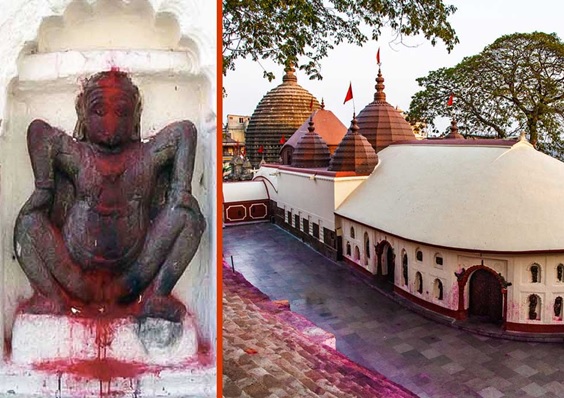
Kamakhya Temple is one of the most revered Hindu pilgrimage sites dedicated to Shakti worship.
The temple is situated on Nilachal Hill along the southern bank of the Brahmaputra River in Guwahati.
It is dedicated to Goddess Sati, regarded as an incarnation of Durga and the consort of Shiva.
The temple holds immense religious significance as a major centre of Tantric worship, attracting devotees, ascetics, and scholars from across India and beyond.
The temple is considered one of the 51 sacred Shakti Peethas of Hinduism.
According to mythology, these sites mark the locations where body parts of Goddess Sati fell after the cosmic event associated with her self-immolation.
The story is linked to the mythological episode involving Shiva, who carried Sati’s body across the universe in grief until Vishnu used his Sudarshan Chakra to dismember it.
Kamakhya is believed to be the site where the goddess’s womb and reproductive organ fell, making it uniquely associated with fertility, feminine power, and creation.
The history of the temple dates back many centuries and reflects multiple phases of destruction and reconstruction.
The earlier structure of the temple was destroyed during medieval invasions by Kala Pahar.
Later, the temple was rebuilt in 1565 CE by Chilarai, a prominent ruler of the Koch dynasty.
The reconstruction revived the temple as a major pilgrimage centre and ensured the continuation of its religious traditions.
One of the most significant events associated with the temple is the Ambubachi Mela.
The festival attracts lakhs of pilgrims, ascetics, and Tantric practitioners from across India and abroad.
It symbolises the sacredness of fertility and feminine power in Hindu tradition.
The temple exhibits a distinctive architectural style known as the Nilachala Style, which blends different architectural traditions.
The structure combines :
This fusion creates a unique architectural identity characteristic of temples in the region.
The temple has a distinctive beehive-shaped dome, surrounded by sculptures depicting various Hindu deities.
It is also notable for being the only temple in Assam with a fully developed ground plan.
The temple complex consists of five chambers, each serving a specific religious or ceremonial purpose:
Interestingly, the superstructure of each chamber displays different architectural features, showcasing the artistic diversity of the temple.
The temple is not only an important pilgrimage site but also a centre of Tantric spiritual traditions.
Unlike many Hindu temples that worship anthropomorphic idols, Kamakhya Temple worships the yoni-shaped stone symbolising the creative energy of the goddess.
This makes it one of the most significant temples representing feminine divinity and fertility in Hindu philosophy.
The introduction of new train services such as the Amrut Bharat Express reflects growing recognition of the temple’s national religious importance.
Key Implications
FAQs1. Where is Kamakhya Temple located ? Kamakhya Temple is located on Nilachal Hill in Guwahati, Assam, on the southern bank of the Brahmaputra River. 2. Which deity is worshipped at Kamakhya Temple ? The temple is dedicated to Goddess Sati (Kamakhya), an incarnation of Goddess Durga and the consort of Lord Shiva. 3. Why is Kamakhya Temple considered a Shakti Peetha ? It is believed to be the site where the womb of Goddess Sati fell, making it one of the 51 sacred Shakti Peethas. 4. What is the Ambubachi Mela ? Ambubachi Mela is an annual festival celebrating the menstruation of Goddess Kamakhya, symbolising fertility and feminine power. 5. What is unique about the architecture of the Kamakhya Temple ? The temple follows the Nilachala style, combining Nagara and Saracenic architectural elements, with a distinctive beehive-shaped dome and five ritual chambers. |
| Prelims: (Polity & Governance + CA) Mains: (GS 2 – Representation of Women, Electoral Reforms, Democratic Participation) |
Recent analyses of electoral data show that women in India now vote at nearly the same rate as men, marking a major transformation in democratic participation.
However, despite this significant rise in voter turnout, women continue to remain underrepresented in legislatures, political parties, and campaign activities, highlighting a persistent gender gap in political power.
This situation creates a paradox in Indian democracy — high participation as voters but limited representation in decision-making institutions.
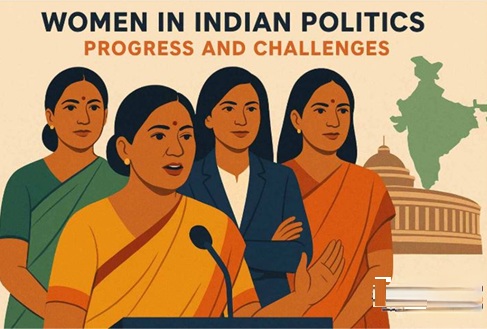
Women’s participation in India’s electoral politics has evolved dramatically since Independence.
In the early decades after 1947, women faced multiple barriers in accessing the electoral process, including low literacy rates, social restrictions, and limited political outreach.
Over the last six decades, however, India has witnessed a steady improvement in women’s electoral participation. Today, women constitute nearly half of the country’s electorate and have become a decisive voting bloc in many elections.
Despite this progress, women continue to face institutional and socio-cultural barriers that limit their representation in legislative bodies and political leadership.
In the decades following Independence, women voted at significantly lower rates than men.
For example, during the 1967 Indian general election:
This created a gender gap of more than 11 percentage points.
Several structural factors contributed to this gap:
From the 1980s onwards, the gap between male and female voter turnout began to narrow steadily.
By the 2009 Indian general election, the gender gap had reduced to around 4.4 percentage points.
The most dramatic shift occurred in the last decade:
This reflects a historic expansion of women’s participation in India’s democratic process.
The trend of rising female voter turnout is even more visible in State Assembly elections.
In the early 1990s, women’s turnout was typically 4–5 percentage points lower than men’s turnout.
However, by the late 2000s, this difference had almost disappeared.
After 2011, several states witnessed women voting at slightly higher rates than men.
Between 2015 and 2016:
Women’s turnout exceeded men’s by around 2.8 percentage points in multiple state elections.
Even during the 2020–2025 period, female voter turnout remained marginally higher than male turnout in several states, indicating a sustained shift in political engagement.
Although women have become more active as voters, their participation in other political activities remains relatively limited.
Across parliamentary elections between 2009 and 2024, men consistently reported higher involvement in campaign-related activities.
While these figures show gradual improvement, men’s participation in such activities remains roughly double that of women.
One key factor limiting women’s public political participation is family approval.
Surveys indicate that many women require permission from family members to attend rallies, political meetings, or campaign events.
Despite improvements in voter participation, women remain underrepresented in India’s legislatures.
In the first Lok Sabha election in 1952:
For several decades, the number of women Members of Parliament remained relatively small.
A gradual increase began in the 21st century:
Even at its peak, women constituted only about 14% of the Lok Sabha, far below their nearly 50% share of the electorate.
One major reason for women’s underrepresentation is the limited number of female candidates nominated by political parties.
In the 1957 Indian general election:
Over the decades, the number of women candidates has gradually increased:
However, these numbers remain small compared to male candidates, who number in the thousands.
Evidence also challenges the argument that women candidates are less likely to win elections.
In several elections, women have had equal or even higher success rates than men.
For example:
This suggests that when political parties nominate women candidates, they perform competitively.
Women’s underrepresentation in politics is shaped by multiple structural factors.
Survey findings reveal several perceptions about barriers to entry:
Several social and institutional challenges continue to limit women’s participation:
These barriers collectively restrict women’s entry into formal political leadership roles.
Enhancing women’s political participation requires both institutional reforms and societal change.
A major reform is the Nari Shakti Vandan Adhiniyam, which proposes 33% reservation for women in the Lok Sabha and State Assemblies.
Once implemented, the law could significantly increase women’s representation in legislatures.
Political parties must:
Local government institutions have already demonstrated the potential of reservation policies.
Women’s participation in Panchayati Raj institutions expanded significantly after the 73rd Constitutional Amendment and the 74th Constitutional Amendment, which reserved seats for women.
Long-term progress requires addressing structural issues such as:
The growing participation of women voters represents a major democratic transformation in India.
It reflects:
However, the gap between participation and representation highlights the need for deeper reforms to ensure that women play a larger role in political decision-making and governance.
FAQs1. How has women’s voter turnout changed in India over time ? Women’s voter turnout has increased significantly over the past decades and now stands almost equal to men’s turnout in national elections. 2. What is the current representation of women in the Lok Sabha ? Women constitute around 14% of Lok Sabha members, which remains far below their share in the electorate. 3. Why are fewer women elected to legislatures despite high voter turnout ? Factors include limited party nominations, patriarchal norms, financial barriers, and lower participation in political campaigning. 4. What reform aims to increase women’s representation in legislatures ? The Nari Shakti Vandan Adhiniyam (Women’s Reservation Bill) proposes 33% reservation for women in the Lok Sabha and State Assemblies. 5. How can women’s political participation be improved further ? Through greater political party support, legislative reservation, leadership training, and social empowerment of women. |
| Prelims: (Polity & Governance + CA) Mains: (GS 3 – Public Finance, Fiscal Federalism, Economic Governance) |
The NITI Aayog recently released the second annual edition of the Fiscal Health Index (FHI) 2026 in New Delhi.
The index evaluates the fiscal performance and financial sustainability of Indian states, providing a comprehensive framework to compare fiscal management practices across the country.
It aims to promote data-driven fiscal reforms and responsible budgeting among states.
India’s fiscal structure is based on cooperative federalism, where both the Union and states share responsibilities for taxation and public expenditure.
State governments play a critical role in financing key sectors such as:
However, many states face challenges such as:
To address these concerns and encourage fiscal discipline, the NITI Aayog introduced the Fiscal Health Index as a structured mechanism to measure and compare fiscal performance across states.
The Fiscal Health Index (FHI) is a data-driven framework designed to evaluate the fiscal soundness of state governments in India.
It provides a systematic and comparable assessment of fiscal performance, helping policymakers understand strengths, weaknesses, and areas requiring reform.
The index covers:
By analysing fiscal indicators across states, the index seeks to:
The index evaluates fiscal performance using five major pillars.
This pillar measures how effectively states allocate spending toward productive and development-oriented sectors such as infrastructure, education, and health.
Higher-quality expenditure indicates efficient use of public resources.
This assesses a state’s ability to generate its own revenue through:
States with strong revenue mobilisation are less dependent on central transfers and enjoy greater fiscal autonomy.
This indicator measures how well states manage their budget deficits and expenditure levels.
It reflects adherence to fiscal discipline, including compliance with the Fiscal Responsibility and Budget Management (FRBM) framework.
This pillar evaluates the level and structure of state government debt, including debt-to-GSDP ratios.
Higher debt levels can constrain future fiscal flexibility.
This assesses whether a state can service its debt without compromising developmental spending.
Sustainable debt management ensures long-term fiscal stability.
The Fiscal Health Index categorises states into four performance tiers.
These states demonstrate:
They represent the best performers in fiscal management.
These states maintain generally sound fiscal conditions, though they may fall short of top-tier performance in certain indicators.
States in this category show mixed results across the five pillars, indicating moderate fiscal health with room for improvement.
These states face significant fiscal stress, characterised by:
They require targeted reforms to improve fiscal sustainability.
According to the latest report released by NITI Aayog:
The states classified as Achievers include:
These states demonstrated strong fiscal discipline and efficient financial management.
Some states experienced changes in their performance tiers:
Among the North-Eastern and Himalayan states, the top performers include:
These rankings highlight the fiscal performance of states with smaller economies and challenging geographical conditions.
1. Strengthening Fiscal Federalism
The index promotes competitive and cooperative federalism by encouraging states to improve fiscal performance.
2. Evidence-Based Policy Formulation
By using a data-driven framework, the index helps policymakers identify fiscal weaknesses and design targeted reforms.
3. Encouraging Fiscal Discipline
Regular evaluation motivates states to maintain sustainable borrowing and responsible spending practices.
4. Improving Public Financial Management
The index encourages states to improve budget planning, transparency, and financial accountability.
5. Supporting Long-Term Economic Stability
Sound fiscal management at the state level is crucial for macroeconomic stability and sustainable development.
Despite improvements in fiscal monitoring, several structural challenges remain:
Addressing these issues requires balanced fiscal reforms and stronger revenue systems.
Improving fiscal health across states requires a combination of institutional reforms and policy innovation.
Key priorities include:
Such measures will help states maintain fiscal stability while supporting economic growth.
FAQs1. What is the Fiscal Health Index (FHI) ? The Fiscal Health Index is a framework developed by NITI Aayog to evaluate the financial performance and fiscal sustainability of Indian states. 2. Which organisation publishes the Fiscal Health Index ? The index is published by NITI Aayog, the Government of India’s policy think tank. 3. What are the five pillars used in the Fiscal Health Index ? The five pillars are Quality of Expenditure, Revenue Mobilisation, Fiscal Prudence, Debt Index, and Debt Sustainability. 4. Which states topped the Fiscal Health Index 2026 ? Odisha, Goa, and Jharkhand were classified as Achievers, indicating strong fiscal performance. 5. Why is fiscal health important for states ? Strong fiscal health ensures sustainable public finances, efficient service delivery, and long-term economic stability. |
| Prelims : (Polity + Governance + CA) Mains : (GS 2 – Judiciary, Health Policy, Fundamental Rights; GS 3 – Disaster Management & Public Health Governance) |
The Supreme Court of India directed the Union government to formulate a “no-fault compensation” policy for individuals who suffered severe side-effects or died after receiving Covid-19 vaccines.
The Court observed that families of vaccine-injury victims should not be compelled to prove negligence in lengthy legal proceedings. Instead, the State must establish a structured compensation mechanism as part of its public health responsibility during the nationwide vaccination drive.

The case arose from petitions filed by families who lost young relatives aged between 18 and 40 years due to rare complications reported after vaccination with Covishield and Covaxin during 2021.
Some petitioners alleged that deaths were linked to rare blood clotting disorders, which were reported globally as extremely uncommon adverse reactions following certain vaccines.
Petitioners argued that vaccine recipients were not sufficiently informed about potential risks associated with Covid-19 vaccines. They claimed that the vaccination programme did not adequately highlight rare adverse events.
Although vaccination was officially voluntary, several administrative restrictions — such as travel rules, workplace policies, and entry restrictions in public places — allegedly made vaccination practically compulsory.
According to the petitioners, this indirectly infringed fundamental rights and placed citizens in a position where they had little practical choice but to vaccinate.
The Union government defended the vaccination programme, highlighting the following points:
1. Rigorous Safety and Regulatory Approval
Authorities emphasised that vaccines were approved after scientific trials and regulatory scrutiny, following emergency use authorisation procedures during the pandemic.
2. Rare Incidence of Vaccine-Related Deaths
The government stated that serious adverse reactions were extremely rare. Data presented suggested a reporting rate of approximately 0.001 cases per one lakh doses for specific clotting disorders.
3. Existing Legal Remedies
The government argued that affected families could approach civil courts or consumer courts to seek compensation from vaccine manufacturers if negligence could be proven.
The Court rejected the suggestion that families should pursue individual civil lawsuits.
It noted that vaccine injury cases involve complex medical and scientific evidence, making it extremely difficult for ordinary citizens to establish negligence.
The Bench also warned that forcing families into multiple individual court battles could result in:
Such outcomes, the Court said, could undermine the principle of equality under Article 14 of the Constitution.
The Court grounded its reasoning in Article 21 of the Constitution, which guarantees the right to life and personal liberty, including the right to health and bodily integrity.
It emphasised that the State cannot remain passive in the face of human suffering arising from a government-led public health programme.
Because the Covid vaccination drive was organised and promoted by the State, the government has a duty to support individuals who suffer serious adverse outcomes — even if those cases are rare.
The Court clarified that its order does not question the scientific validity of Covid vaccines.
It referred to its earlier judgment in Jacob Puliyel vs Union of India, where the Court upheld:
At the same time, the Court had recognised that bodily autonomy under Article 21 prevents forced vaccination, even though vaccination remains an important public health measure.
The Court stated that India’s existing Adverse Events Following Immunisation (AEFI) mechanism remains the appropriate framework for investigating vaccine-related complications.
Therefore, it declined the petitioners’ request to create a new expert medical board for vaccine injury investigations.
Instead, the Court emphasised that AEFI committees already possess the expertise and institutional capacity required to assess adverse events.
The Court directed the Ministry of Health and Family Welfare to design and notify a no-fault compensation scheme for serious vaccine-related adverse events.
Key features expected in the framework include:
Importantly, the Court clarified that the creation of such a scheme should not be interpreted as an admission of negligence or liability by the government.
Instead, it represents a welfare-based approach to public health governance.
Global Practice: Vaccine Injury Compensation Programmes
Many countries operate no-fault vaccine compensation schemes to maintain public trust in immunisation programmes.
Examples include:
Such programmes balance public health objectives with individual welfare, ensuring that rare adverse events do not leave affected families without support.
The Court’s approach mirrors its earlier intervention during the pandemic in Gaurav Kumar Bansal vs Union of India.
In that case, the Court directed the National Disaster Management Authority to frame guidelines for compensating families of Covid-19 victims.
Following the Court’s direction, the NDMA issued guidelines in September 2021 providing ₹50,000 ex-gratia compensation for each Covid-19 death.
Key features included:
Deaths occurring within 30 days of a positive Covid-19 test were treated as Covid deaths for compensation purposes.
1. Strengthening Public Health Accountability
The decision reinforces the principle that large-scale public health programmes must include safety nets for rare adverse outcomes.
2. Protecting Citizens’ Right to Health
By linking vaccine injury compensation to Article 21, the Court expands the constitutional interpretation of the right to health and welfare.
3. Reducing Litigation Burden
A structured compensation scheme will avoid prolonged court battles, ensuring faster relief for affected families.
4. Maintaining Public Trust in Vaccination
Providing support to rare victims of vaccine injuries can increase transparency and public confidence in immunisation programmes.
5. Aligning India with Global Best Practices
The directive moves India closer to international standards for vaccine injury compensation frameworks.
FAQs1. What did the Supreme Court direct regarding Covid-19 vaccine injuries ? The Court directed the Union government to formulate a no-fault compensation policy for individuals who suffered serious side effects or deaths linked to Covid-19 vaccines. 2. What is meant by “no-fault compensation ”? It is a system where victims receive compensation without needing to prove negligence or wrongdoing by the government or vaccine manufacturers. 3. Which constitutional provision did the Court rely on ? The judgment relied primarily on Article 21 of the Constitution, which guarantees the right to life and health. 4. Does the order question the safety of Covid vaccines ? No. The Court clarified that it does not challenge the scientific validity of vaccines, which had already been upheld in earlier rulings. 5. How does this decision relate to earlier Covid-19 compensation orders ? The decision follows the Court’s earlier direction in 2021, which required the government to provide ₹50,000 ex-gratia compensation to families of Covid-19 victims. |

Our support team will be happy to assist you!

 Contact Us
  New Batch : 9555124124/ 7428085757
  Tech Support : 9555124124/ 7428085757