- UPSC Exam
- State PCS
- One Day Exam
- Current Affairs
- PT Quiz
- Downlaods
- About Coaching
- Blog
- Videos

PrelimsEconomy + Current Affairs - Free Trade Agreements (FTAs), International Trade, Tariffs, and India-UK CETA. MainsGS Paper III : Economy - Foreign Trade, Free Trade Agreements (FTAs), Liberalisation, Exports, and Economic Development. GS Paper II : International Relations - India–UK Bilateral Relations and Economic Diplomacy. |
The India-UK Comprehensive Economic and Trade Agreement (CETA) comes into effect on July 15, 2026, marking a major milestone in bilateral trade relations. The agreement will make several British products cheaper in India while providing duty-free access to nearly all Indian exports to the UK.

India-UK merchandise trade has continued to grow.
|
Year |
Bilateral Trade |
|
FY22 |
$17.48 Billion |
|
FY25 |
$23.13 Billion |
|
FY26 |
$25.13 Billion |
Prelims QuestionQ. Which of the following sectors are expected to benefit the most from the India–UK FTA?
Select the correct answer using the code below:
Mains QuestionQ. The India–UK Comprehensive Economic and Trade Agreement (CETA) is expected to strengthen bilateral trade and improve market access for Indian exports. Discuss the key features of the agreement and examine its likely impact on India's economy. |
Q1. What is the India–UK Comprehensive Economic and Trade Agreement (CETA) ?Answer: It is a Free Trade Agreement (FTA) between India and the United Kingdom aimed at reducing tariffs, improving market access, promoting investment, and strengthening cooperation in trade, services, innovation, and digital economy. Q2. What is the biggest benefit for Indian exporters ?Answer: Indian exports will receive zero-duty access on around 99% of tariff lines, covering almost the entire value of India's exports to the UK. Q3. How will Indian professionals working in the UK benefit ?Answer: Under the Double Contributions Convention (DCC), eligible temporary workers will not have to pay social security contributions in both countries, resulting in significant savings. Q4. Will imported British cars become cheaper ?Answer: Yes. Import duties on UK-built vehicles will gradually reduce from 110% to 10% under a quota system over a period of 10 years. Q5. What is the Double Contributions Convention (DCC) ?Answer: It is a social security agreement that prevents eligible temporary workers from paying social security contributions in both India and the UK for the same period. |
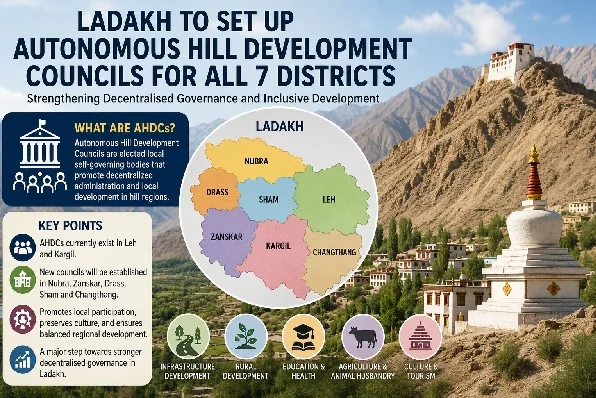
PrelimsPolity & Governance | Indian Constitution | Local Self-Government MainsGS Paper II — Indian Constitution; Devolution of Powers and Finances to Local Levels; Federalism |
|
Aspect |
Current System (Pre-Announcement) |
Proposed System |
|---|---|---|
|
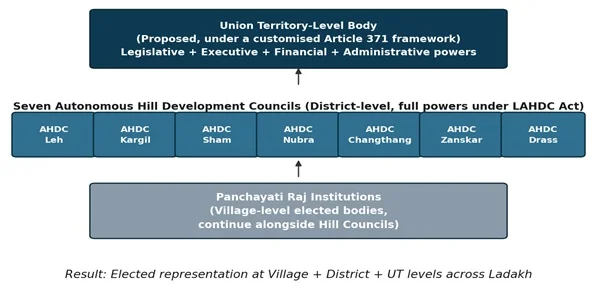
District-level councils |
Only 2 (Leh and Kargil) |
7 (Leh, Kargil, Sham, Nubra, Changthang, Zanskar, Drass) |
|
Legal basis |
LAHDC Act, 1997 (extended only to Leh & Kargil) |
Same Act, extended to all 7 districts under Section 3(1) |
|
UT-level elected body |
None — UT administered directly by Lieutenant Governor |
Proposed apex body under a customised Article 371 framework |
|
Tiers of representation |
Village (Panchayat) + District (Leh/Kargil only) |
Village + District (all 7) + Union Territory level |
|
Constitutional protection sought |
Sixth Schedule demand pending since 2019 |
Customised Article 371 model proposed as alternative |
| Feature | AHDC | Sixth Schedule ADC |
| Constitutional Status | No | Yes |
| Constitutional Provision | Created by Act/Regulation | Articles 244(2) & 275(1) |
| Legislative Powers | Limited | Wider |
| Financial Autonomy | Limited | Greater |
| Applicable to | Ladakh | Tribal Areas of Assam, Meghalaya, Mizoram and Tripura |
PRELIMINARY MCQQ. Consider the following statements regarding the Autonomous Hill Development Councils (AHDCs) in Ladakh:
1. The first Autonomous Hill Development Council in Ladakh was established in Leh in 1995. 2. AHDCs are constitutional bodies created under the Sixth Schedule of the Constitution. 3. The Councils primarily promote decentralized planning and local development. 4. Law and Order falls under the jurisdiction of AHDCs. Which of the statements given above are correct?
A. 1 and 3 only
B. 2 and 4 only
C. 1, 2 and 3 only
D. 1, 3 and 4 only
MAINS PRACTICE QUESTIONQ. The expansion of Autonomous Hill Development Councils in Ladakh reflects India's commitment to democratic decentralisation in strategically important border regions." Discuss the significance of this initiative. |
FAQs1. What is an Autonomous Hill Development Council (AHDC) ?It is an elected local self-governing body that promotes decentralized governance and development in Ladakh's hill districts.2. Why are new AHDCs being established ?To extend decentralized governance and balanced development to all seven districts of Ladakh.3. Why does Ladakh need Autonomous Hill Development Councils in all seven districts ?To strengthen decentralised governance, ensure balanced regional development, and improve local participation in decision-making.4. Do AHDCs have legislative powers like State Legislatures ?No. AHDCs primarily exercise administrative and developmental powers and have limited legislative authority.5. What is the difference between AHDCs and Sixth Schedule Autonomous District Councils ?AHDCs are statutory bodies, whereas Sixth Schedule Councils enjoy constitutional status with greater legislative and financial autonomy. |
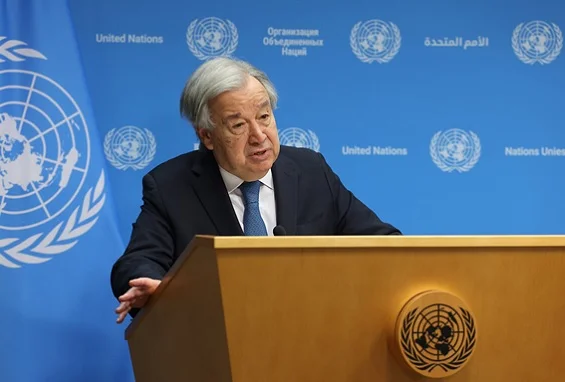
The report has been prepared by the Independent International Scientific Panel on AI, a 40-member panel established under the United Nations.
The panel is co-chaired by :
This preliminary report is the first in a series of periodic scientific assessments, with a comprehensive report expected next year.
The report evaluates Artificial Intelligence across seven broad themes :
One of the report's biggest concerns is the rapid emergence of Frontier AI Models and Autonomous AI Agents.
These advanced AI systems can :
However, they also create new risks, including :
The report argues that existing governance mechanisms are not adequately prepared to manage these emerging risks.
According to the report: -Numerous AI ethics frameworks and governance instruments already exist worldwide.
However,
As a result, governments currently lack the institutional capacity to independently evaluate advanced AI systems.
The Growing "Compute Divide :- One of the report's most important findings is the emergence of the Compute Divide.
Developing advanced AI models requires enormous computing resources, including:High-performance GPUs.
Collectively, these resources are referred to as AI Compute Infrastructure.
According to the report :
The report also notes that in 2025 :
This demonstrates the increasing concentration of advanced AI capabilities.
The report warns that countries lacking advanced computing infrastructure may become :
Consequently, computing power is no longer merely a technological resource but a strategic national asset.
The report has significant implications for India.
India has launched the IndiaAI Mission, aimed at strengthening the country's AI ecosystem through :
The report reinforces the importance of expanding India's indigenous AI computing capacity.
Without sufficient compute infrastructure, India risks becoming increasingly dependent on foreign AI platforms and technologies.
Beyond the compute divide, the report highlights the increasing concentration of AI capabilities among a small number of countries and technology companies.
Developing frontier AI today requires :
Only a handful of global corporations possess these capabilities.
The report warns that excessive concentration could lead to :
The report also cautions that countries in the Global South remain disproportionately vulnerable due to limited local AI infrastructure and institutional capacity.
The report emphasizes that AI governance is no longer purely a technological issue.
Improperly regulated AI could affect :
It therefore recommends integrating ethical principles and human rights safeguards into AI development and deployment.
The report recommends that governments should :
For India, the report highlights the need to :
FAQs: UN AI Report 20261. Why is the UN AI Report 2026 in the news ?Ans :- It is the first comprehensive scientific assessment on AI conducted by the United Nations, analyzing AI governance, safety, human rights, economics, and global inequalities. 2. Who prepared the UN AI Report 2026?Ans :- The report was prepared by a panel of 40 independent international scientists, co-chaired by Yoshua Bengio (Turing Award winner) and Maria Ressa (Nobel Peace Prize winner). 3. What is the main message of the UN AI Report 2026 ?Ans :- AI technologies are evolving far faster than regulators can keep up. Therefore, a global governance framework for safe and responsible AI needs to be urgently developed. 4. What is the Compute Divide ?Ans :- It reflects the global disparity in capabilities such as supercomputers, GPUs, advanced chips, and cloud data centers needed to develop AI. |
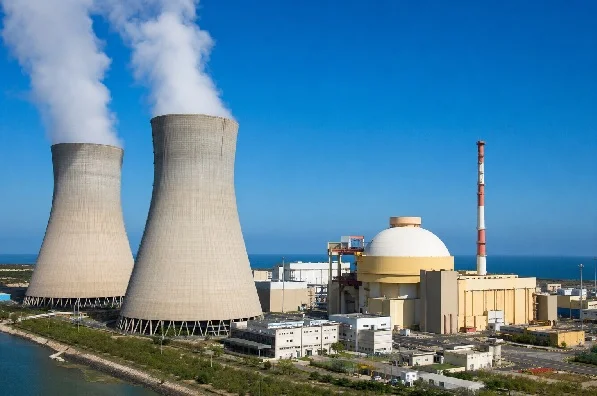
PrelimsScience & Technology | Energy | Government Schemes | Current Affairs MainsGS Paper III — Infrastructure: Energy | Science and Technology; GS Paper II — Government Policies and Legislative Reforms |
| Stage | Fuel | Objective |
| Stage I | Natural Uranium | Produce electricity while generating Plutonium |
| Stage II | Fast Breeder Reactors (FBRs) | Produce more fissile material than consumed |
| Stage III | Thorium-based Reactors | Utilize India's vast thorium reserves (U-233 fuel cycle) |
For years, the CLND Act, 2010 deterred foreign nuclear suppliers through stringent liability provisions. To address this, Parliament enacted the SHANTI Act, 2025 in December 2025.
|
Aspect |
Earlier Framework (AE Act 1962 & CLND Act 2010) |
Reformed Framework (SHANTI Act, 2025) |
|---|---|---|
|
Ownership |
Exclusive public-sector monopoly (NPCIL) |
Private and limited foreign participation permitted |
|
Operator liability cap |
Capped at about ₹1,500 crore |
Cap roughly doubled to attract investment |
|
Supplier liability |
Explicit statutory right of recourse against suppliers |
Recourse against suppliers now primarily contractual |
|
Dispute resolution |
Claims Commissioner/Tribunal under CLND Act |
Dedicated Nuclear Damage Claims Commission |
|
Investment climate |
Deterred major foreign vendors for over a decade |
Aims to enable partnerships with firms like Westinghouse, GE, Holtec, TerraPower |
|
Plant |
State |
Reactor Type |
|
Tarapur |
Maharashtra |
BWR + PHWR |
|
Kakrapur |
Gujarat |
PHWR |
|
Rawatbhata |
Rajasthan |
PHWR |
|
Narora |
Uttar Pradesh |
PHWR |
|
Kaiga |
Karnataka |
PHWR |
|
Kudankulam |
Tamil Nadu |
VVER (Russia) |
|
Kalpakkam |
Tamil Nadu |
PHWR + PFBR |
BWR → Boiling Water Reactor
PHWR → Pressurised Heavy Water Reactor
VVER → Russian Pressurised Water Reactor
PFBR → Prototype Fast Breeder Reactor
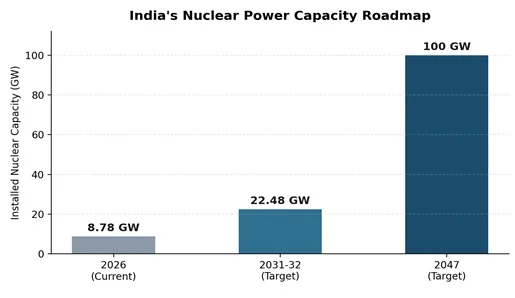
PRELIMINARY MCQQ. Consider the following statements regarding India's nuclear power sector: 1. India's three-stage nuclear power programme was conceived by Dr Homi J. Bhabha to primarily exploit the country's abundant thorium reserves. 2. The Prototype Fast Breeder Reactor (PFBR) at Kalpakkam belongs to the second stage of India's three-stage nuclear power programme. 3. The SHANTI Act, 2025 repealed the Atomic Energy Act, 1962 and the Civil Liability for Nuclear Damage Act, 2010. 4. Small Modular Reactors under India's Nuclear Energy Mission are being developed exclusively for electricity generation. Which of the statements given above are correct? A. 1, 2 and 3 only B. 2, 3 and 4 only C. 1, 3 and 4 only D. 1, 2, 3 and 4 MAINS PRACTICE QUESTIONQ. India has set a target of achieving 100 GW of nuclear power capacity by 2047. Discuss the significance of recent policy and legislative reforms, including the Nuclear Energy Mission and the SHANTI Act, 2025, in realising this target. |
FAQs1. What is nuclear power ?Nuclear power is electricity generated by the controlled fission of uranium or plutonium atoms inside a nuclear reactor. 2. What is India's Three-Stage Nuclear Programme ?It is a long-term strategy to use natural uranium first and ultimately harness India's abundant thorium reserves for power generation. 3. Which organization operates commercial nuclear power plants in India ?The NPCIL operates India's commercial nuclear power plants. 4. What is the role of BARC ?BARC is India's premier nuclear research institution responsible for nuclear science, reactor technology, and fuel cycle research. 5. What is the target for India's nuclear power capacity ?India aims to increase its installed nuclear power capacity from about 8.8 GW to 22 GW by 2032. |
KeywordsPM Internship Scheme 2026, PMIS Pilot Round 3, PM Internship Scheme UPSC, Ministry of Corporate Affairs, MSME Internship Scheme, GCC India, Skill Development, Youth Employment, CSR, UPSC Current Affairs 2026 Focus AreaGS Paper II : Government policies, youth empowerment, skill development, cooperative federalism. GS Paper III : Employment generation, MSMEs, demographic dividend, inclusive growth, CSR, human capital development. |
The Union Government has significantly expanded the Prime Minister Internship Scheme (PMIS) under Pilot Round 3 (April 2026 onwards) by allowing Micro, Small and Medium Enterprises (MSMEs), Global Capability Centres (GCCs), statutory bodies, and professional institutes to participate. The decision comes after the first two pilot rounds witnessed low joining rates and high attrition, prompting the government to redesign the scheme to make internships more accessible, attractive and locally available.

|
Particular |
Details |
|---|---|
|
Scheme |
Prime Minister Internship Scheme (PMIS) |
|
Launch |
October 2024 |
|
Ministry |
Ministry of Corporate Affairs (MCA) |
|
Objective |
To improve employability by providing structured internships in leading industries |
|
Target |
1 Crore internship opportunities in five years |
|
Nature |
Paid internship programme |
|
Pilot Round 3 |
Effective from April 2026 |
|
Current Target |
1.10 lakh internship opportunities till December 2026 |
|
Reform |
Earlier |
Revised (Pilot Round 3) |
|---|---|---|
|
Eligible Age |
21–24 years |
18–25 years |
|
Monthly Stipend |
₹5,000 |
₹9,000 |
|
Internship Duration |
12 months |
6–9 months |
|
Eligible Companies |
Around 500 |
Around 2,000 |
|
Pilot Timeline |
Limited |
Extended till December 2026 |
The government has widened participation beyond India's largest corporate houses to ensure greater geographical coverage and more internship opportunities.
|
Newly Eligible Organisations |
Importance |
|---|---|
|
MSMEs |
Create local internship opportunities and reduce migration |
|
Global Capability Centres (GCCs) |
Offer exposure to high-end technology and global business operations |
|
Airports Authority of India (AAI) |
Practical training in aviation and airport management |
|
Shipping Corporation of India (SCI) |
Maritime and logistics sector exposure |
|
ICAI |
Finance, auditing and accounting internships |
|
ICSI |
Corporate governance and compliance exposure |
|
ICMAI |
Cost accounting and financial management training |
|
Other Statutory Bodies |
Expand opportunities across public institutions |
Under the revised framework, every State Government can nominate up to 20 companies for participation in the internship programme. This provision introduces greater flexibility and enables states to include regionally important industries that may not otherwise qualify through the central selection process.
The move also promotes cooperative federalism by allowing states to align internships with local industrial clusters and employment priorities.
The Ministry of Corporate Affairs has broadened company participation while maintaining financial standards to ensure quality internships.
|
Eligibility Parameter |
Requirement |
|---|---|
|
CSR Requirement |
Based on average CSR expenditure during the previous three financial years |
|
Additional Condition |
Annual turnover above ₹1,000 crore OR |
|
Alternative Condition |
Net worth above ₹500 crore |
|
Pilot Round |
Internship Offers |
Candidates Joined |
|---|---|---|
|
Round 1 |
Over 82,000 |
8,760 |
|
Round 2 |
Over 83,000 |
Around 7,300 |
Although companies generated more than 1.65 lakh internship offers across the first two rounds, actual participation remained below expectations. This highlighted that expanding opportunities alone is insufficient unless internships are geographically convenient, financially attractive and better aligned with students' preferences.
The government is now focusing on increasing awareness and improving accessibility rather than merely expanding the number of internship offers.
Major initiatives include :
|
Dimension |
Significance |
|---|---|
|
Employment |
Improves job readiness among youth before entering the labour market. |
|
Skill Development |
Provides practical workplace exposure beyond classroom learning and vocational training. |
|
MSME Growth |
Enables smaller industries to access trained manpower while strengthening local industrial ecosystems. |
|
Demographic Dividend |
Helps India convert its young population into a productive workforce capable of supporting long-term economic growth. |
|
Ease of Hiring |
Companies can identify skilled interns for future recruitment, reducing hiring and training costs. |
The government should establish a robust digital monitoring mechanism that tracks internship quality, completion rates and post-internship employment. Regular feedback from interns and employers can help improve programme design.Greater collaboration with universities, Industrial Training Institutes (ITIs), Skill India centres and state governments can expand outreach, while linking internships with future hiring incentives could significantly improve long-term employment outcomes.
Prelims MCQQ. With reference to the Prime Minister Internship Scheme (PMIS), consider the following statements:
Which of the statements given above is/are correct? A. 1 and 2 only UPSC GS Mains Practice Question"India's demographic dividend can become an economic asset only if skill development is effectively linked with industry requirements." Discuss the significance of the revamped Prime Minister Internship Scheme in this context. |
Frequently Asked Questions (FAQs)1. What is the Prime Minister Internship Scheme (PMIS) ? PMIS is a Government of India initiative launched in October 2024 to provide paid internships that improve employability through practical industry experience. 2. Why has the government expanded the scheme to MSMEs ? MSMEs are spread across the country and can provide internships closer to candidates' homes, reducing travel constraints and improving participation. 3. Which ministry implements the PM Internship Scheme ? The scheme is administered by the Ministry of Corporate Affairs (MCA) in collaboration with participating companies and partner organisations. 4. What are the major changes in Pilot Round 3 ? The stipend has increased to ₹9,000 per month, the internship duration has been reduced to 6–9 months, the eligible age has expanded to 18–25 years and more organisations have been included. 5. Why is this scheme important for UPSC preparation ? The scheme is relevant for questions related to employment, skill development, MSMEs, demographic dividend, government policies and inclusive economic growth in both Prelims and Mains. |

Our support team will be happy to assist you!

 Contact Us
  New Batch : 9555124124/ 7428085757
  Tech Support : 9555124124/ 7428085757