Prelims
Economy + Current Affairs - Free Trade Agreements (FTAs), International Trade, Tariffs, and India-UK CETA.
Mains
GS Paper III : Economy - Foreign Trade, Free Trade Agreements (FTAs), Liberalisation, Exports, and Economic Development.
GS Paper II : International Relations - India–UK Bilateral Relations and Economic Diplomacy.
|
Why is it in News ?
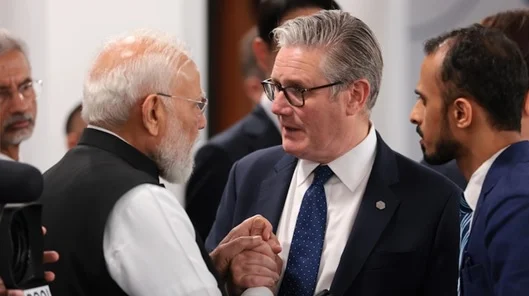
The India-UK Comprehensive Economic and Trade Agreement (CETA) comes into effect on July 15, 2026, marking a major milestone in bilateral trade relations. The agreement will make several British products cheaper in India while providing duty-free access to nearly all Indian exports to the UK.
What is the India-UK CETA ?
- The Comprehensive Economic and Trade Agreement (CETA) is a Free Trade Agreement (FTA) between India and the United Kingdom.
- Signed on : July 24, 2025
- Effective from : July 15, 2026
- Negotiation rounds : 14
- Total chapters : 30
- Besides reducing tariffs, the agreement covers digital trade, financial services, telecommunications, intellectual property, innovation, MSMEs, sustainability, transparency, government procurement, and mobility of professionals.
Key Benefits for India
1. Almost Zero-Duty Access for Exports
- Around 99% of tariff lines receive zero customs duty.
- Covers almost 100% of India's export value to the UK.
Major Beneficiary Sectors
- Textiles
- Leather and Footwear
- Gems & Jewellery
- Marine Products
- Engineering Goods
- Auto Components
- Organic Chemicals
- Sports Goods
- Toys
- This will improve the competitiveness of Indian products in the UK market.
2. Relief for Indian Professionals
- The Double Contributions Convention (DCC) also comes into force on July 15, 2026.
- It allows eligible Indian professionals working temporarily in the UK to avoid paying social security contributions in both countries.
- According to the government, workers could save around 25% of their salary, which will instead be credited to their Provident Fund (PF) accounts in India.
What Gets Cheaper in India ?
- India will reduce tariffs on 90% of tariff lines, with 85% becoming completely duty-free within 10 years.
- Products expected to become cheaper include :
- Scotch Whisky
- Gin
- Chocolates
- Biscuits
- Cosmetics
- Soft Drinks
- Premium Food Products
Whisky Duty Reduction
- Tariff on imported British whisky will reduce :
- 150% → 75% (initially)
- 75% → 40% (within 10 years)
Automobile Sector
- Import duty on UK-made cars will gradually reduce : 110% → 10% Reduction will be quota-based over 10 years.
- Electric and hybrid vehicles will also receive phased access under quotas to protect India's domestic automobile industry.
Bilateral Trade Reaches $25 Billion
India-UK merchandise trade has continued to grow.
|
Year
|
Bilateral Trade
|
|
FY22
|
$17.48 Billion
|
|
FY25
|
$23.13 Billion
|
|
FY26
|
$25.13 Billion
|
FY26 Trade
- India's Exports : $13.44 Billion
- India's Imports : $11.68 Billion
- Trade Surplus : $1.76 Billion
Sensitive Sectors Protected
- India has not offered tariff concessions on several sensitive agricultural products.
- These include :
- Dairy Products
- Apples
- Cheese
- Sugar
- Rice
- Pork
- Chicken
- Eggs
- The objective is to protect Indian farmers and rural livelihoods.
Beyond Tariff Cuts
- The agreement also includes provisions on :
- Digital Trade
- Temporary Movement of Professionals
- Intellectual Property Rights (IPR)
- Financial Services
- Innovation
- MSMEs
- Sustainability
- Government Procurement
- Trade and Gender Equality
Government Procurement
- British companies can participate in India's government procurement market under agreed conditions.
- To qualify, at least 20% of the product or service must originate from the UK.
Future Trade Outlook
- According to UK estimates :
- UK exports to India may increase by 60% by 2040.
- UK imports from India could rise by 25%.
- Bilateral trade may increase by £25.5 billion annually.
- UK's GDP could rise by 0.13% (around £4.8 billion annually) by 2040.
Challenges Ahead
- Despite wider market access, a few issues remain :
- Clarity on steel import quotas.
- UK's Carbon Border Adjustment Mechanism (CBAM).
- Compliance with future carbon reporting requirements.
- Protection of India's domestic industries during phased tariff reductions.
Carbon Border Adjustment Mechanism (CBAM)
- The UK will implement CBAM from January 1, 2027.
- It will apply to sectors such as :
- Iron & Steel
- Aluminium
- Cement
- Fertilisers
- Hydrogen
- Exporters will have to meet additional carbon reporting requirements.
Why is the Agreement Important ?
- Boosts India's exports to the UK.
- Makes British premium products cheaper for Indian consumers.
- Creates new opportunities for Indian MSMEs and exporters.
- Provides relief to Indian professionals working in the UK.
- Strengthens India-UK economic partnership.
- Expands cooperation beyond goods trade into digital economy, innovation, and services.
Prelims Question
Q. Which of the following sectors are expected to benefit the most from the India–UK FTA?
-
Textiles
-
Gems & Jewellery
-
Marine Products
-
Leather & Footwear
Select the correct answer using the code below:
-
1 and 2 only
-
2 and 3 only
-
1, 3 and 4 only
-
1, 2, 3 and 4
Mains Question
Q. The India–UK Comprehensive Economic and Trade Agreement (CETA) is expected to strengthen bilateral trade and improve market access for Indian exports. Discuss the key features of the agreement and examine its likely impact on India's economy.
|
Q1. What is the India–UK Comprehensive Economic and Trade Agreement (CETA) ?
Answer: It is a Free Trade Agreement (FTA) between India and the United Kingdom aimed at reducing tariffs, improving market access, promoting investment, and strengthening cooperation in trade, services, innovation, and digital economy.
Q2. What is the biggest benefit for Indian exporters ?
Answer: Indian exports will receive zero-duty access on around 99% of tariff lines, covering almost the entire value of India's exports to the UK.
Q3. How will Indian professionals working in the UK benefit ?
Answer: Under the Double Contributions Convention (DCC), eligible temporary workers will not have to pay social security contributions in both countries, resulting in significant savings.
Q4. Will imported British cars become cheaper ?
Answer: Yes. Import duties on UK-built vehicles will gradually reduce from 110% to 10% under a quota system over a period of 10 years.
Q5. What is the Double Contributions Convention (DCC) ?
Answer: It is a social security agreement that prevents eligible temporary workers from paying social security contributions in both India and the UK for the same period.
|






 Contact Us
  New Batch : 9555124124/ 7428085757
  Tech Support : 9555124124/ 7428085757