Prelims
Science & Technology | Energy | Government Schemes | Current Affairs
Mains
GS Paper III — Infrastructure: Energy | Science and Technology;
GS Paper II — Government Policies and Legislative Reforms
|
Why Is This in the News?
- India's Prototype Fast Breeder Reactor (PFBR) at Kalpakkam, Tamil Nadu formally moved the country into the second stage of its indigenous three-stage nuclear power programme.
- Parliament passed the SHANTI Act, 2025 (Sustainable Harnessing of Advancement of Nuclear Energy for Transforming India) in December 2025, repealing the Atomic Energy Act, 1962 and the Civil Liability for Nuclear Damage Act, 2010, and opening the sector to private and foreign participation for the first time.
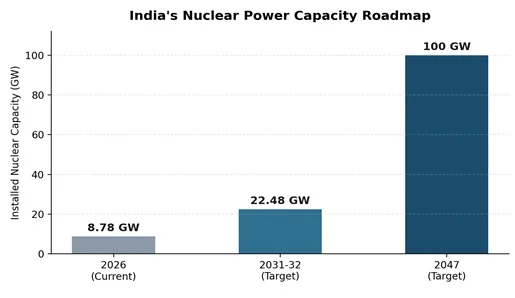
- The Nuclear Energy Mission, announced in the Union Budget 2025-26 with an outlay of ₹20,000 crore, seeks to deploy at least five indigenously designed Small Modular Reactors (SMRs) by 2033 and scale up capacity to 100 GW by 2047.
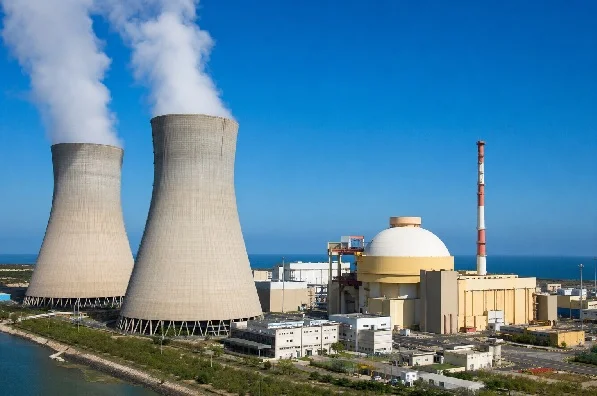
What is Nuclear Power ?
- Nuclear power is the generation of electricity through controlled nuclear reactions. Unlike thermal power plants, nuclear plants produce electricity without burning fossil fuels, resulting in extremely low greenhouse gas emissions during operation.
- Electricity is produced by nuclear fission splits atoms (primarily Uranium-235 or Plutonium-239) ???? heat generated converts water into steam ???? steam rotates turbines ???? turbines generate electricity.
Current Status of Nuclear Power in India
- Installed capacity : India currently operates 24 nuclear reactors with a total installed capacity of about 8.78 GW across seven sites, making nuclear the fifth-largest source of electricity after thermal, renewables, hydro, and other sources.
- Share in generation : Nuclear power contributed roughly 3% of India's total electricity generation in 2024-25, generating about 56,681 million units (MU) of electricity that year.
- Nodal framework : The sector is administered by the Department of Atomic Energy (DAE) under the Prime Minister's charge, with the Nuclear Power Corporation of India Limited (NPCIL) as the principal operator of civilian reactors and the Atomic Energy Regulatory Board (AERB) as the safety regulator.
- First plants : India's nuclear journey began in 1969 with two Boiling Water Reactors (BWRs) at Tarapur, Maharashtra; the mainstay of the programme since has been the indigenous 220 MWe and 700 MWe Pressurised Heavy Water Reactors (PHWRs).
- Near-term target : Capacity is projected to rise to about 22,480 MW by 2031-32 through the completion of projects already under construction, before scaling further toward the 100 GW target by 2047.
India's Three-Stage Nuclear Power Programme
India follows a unique Three-Stage Nuclear Power Programme :
| Stage |
Fuel |
Objective |
| Stage I |
Natural Uranium |
Produce electricity while generating Plutonium |
| Stage II |
Fast Breeder Reactors (FBRs) |
Produce more fissile material than consumed |
| Stage III |
Thorium-based Reactors |
Utilize India's vast thorium reserves (U-233 fuel cycle) |
The Nuclear Energy Mission and Small Modular Reactors (SMRs)
- The Nuclear Energy Mission for Viksit Bharat was announced in the Union Budget 2025-26 with an outlay of ₹20,000 crore for research, development, and deployment of indigenous SMRs, building on the Bharat Small Reactor (BSR) initiative first flagged in the 2024-25 Budget. At least five indigenously designed and operational SMRs by 2033.
- Bharat Small Reactor (BSR), 220 MWe : A re-engineered, compact version of India's proven 220 MWe PHWR technology, fuelled by natural uranium, intended mainly for captive power supply to hard-to-abate industries such as steel and cement.
- Bharat Small Modular Reactor (BSMR-200), 200-220 MWe : Official project layouts also explicitly include the BARC campus at Vizag, Andhra Pradesh for these first-of-a-kind SMR deployments.
- SMR-55 : A 55 MWe reactor intended for flexible power supply to smaller industrial clusters and remote locations, also to be sited at Tarapur.
- High Temperature Gas-Cooled Reactor (HTGR), up to 5 MWth : Not meant for electricity generation — it is designed to supply high-temperature process heat for green hydrogen production via the sulphur-iodine thermochemical cycle, supporting the National Green Hydrogen Mission.
SHANTI Act, 2025: Opening the Sector to Private Participation
For years, the CLND Act, 2010 deterred foreign nuclear suppliers through stringent liability provisions. To address this, Parliament enacted the SHANTI Act, 2025 in December 2025.
|
Aspect
|
Earlier Framework (AE Act 1962 & CLND Act 2010)
|
Reformed Framework (SHANTI Act, 2025)
|
|
Ownership
|
Exclusive public-sector monopoly (NPCIL)
|
Private and limited foreign participation permitted
|
|
Operator liability cap
|
Capped at about ₹1,500 crore
|
Cap roughly doubled to attract investment
|
|
Supplier liability
|
Explicit statutory right of recourse against suppliers
|
Recourse against suppliers now primarily contractual
|
|
Dispute resolution
|
Claims Commissioner/Tribunal under CLND Act
|
Dedicated Nuclear Damage Claims Commission
|
|
Investment climate
|
Deterred major foreign vendors for over a decade
|
Aims to enable partnerships with firms like Westinghouse, GE, Holtec, TerraPower
|
Why Nuclear Power Matters for India
- Reliable base load power : Unlike solar and wind, nuclear plants supply continuous, weather-independent electricity, complementing the variability of renewables in India's grid.
- Climate commitments : Nuclear power produces negligible operational carbon emissions, supporting India's Panchamrit pledges and its target of net-zero emissions by 2070.
- Energy security : Expanding domestic nuclear capacity reduces dependence on imported fossil fuels and volatile global energy markets.
- Industrial decarbonisation : Captive small reactors such as the BSR can supply reliable, low-carbon power to hard-to-abate sectors like steel, cement, and aluminium, helping them stay competitive as carbon border taxes (e.g., the EU's CBAM) come into force globally.
Major Nuclear Power Plants in India
|
Plant
|
State
|
Reactor Type
|
|
Tarapur
|
Maharashtra
|
BWR + PHWR
|
|
Kakrapur
|
Gujarat
|
PHWR
|
|
Rawatbhata
|
Rajasthan
|
PHWR
|
|
Narora
|
Uttar Pradesh
|
PHWR
|
|
Kaiga
|
Karnataka
|
PHWR
|
|
Kudankulam
|
Tamil Nadu
|
VVER (Russia)
|
|
Kalpakkam
|
Tamil Nadu
|
PHWR + PFBR
|
BWR → Boiling Water Reactor
PHWR → Pressurised Heavy Water Reactor
VVER → Russian Pressurised Water Reactor
PFBR → Prototype Fast Breeder Reactor
Key Challenges
- Long project timelines : Indian nuclear projects currently take around 10 years to complete on average, compared with a global best of roughly 6 years, raising execution risk for the 2047 target.
- Massive capital requirement : Independent estimates suggest achieving 100 GW by 2047 will require investments of nearly ₹23-25 lakh crore.
- Limited uranium reserves : India's modest domestic uranium reserves make the sector reliant on imports from Russia, Kazakhstan, France, and Uzbekistan, and on faster progress to Stages II and III of the fuel cycle.
- Land acquisition and public perception : Siting new reactors, including SMRs at brownfield thermal sites, can face local opposition and delays linked to safety perceptions, land acquisition, and rehabilitation.
- Regulatory capacity : Extending licensing, inspection, and safety oversight to a larger number of private and public operators will require significant expansion of AERB's institutional capacity.
Way Forward
- Accelerate project execution by adopting standardised reactor designs, modular and factory-based construction (as with SMRs), and time-bound regulatory clearances to bring construction timelines closer to global benchmarks.
- Diversify and secure fuel supply through long-term international uranium agreements while accelerating the transition to Stage II (fast breeder reactors) and Stage III (thorium-based reactors) to reduce import dependence.
- Mobilise private and foreign capital transparently, with clear, bankable contractual frameworks for liability, insurance, and supplier recourse so that risk allocation is commercially viable.
- Invest in a skilled workforce and R&D — through institutions such as BARC (Bhabha Atomic Research Centre), IGCAR (Indira Gandhi Centre for Atomic Research), and NPCIL (Nuclear Power Corporation of India Limited) — to support indigenous SMR designs, thorium fuel cycle research, and eventual export potential for India's reactor technology.
PRELIMINARY MCQ
Q. Consider the following statements regarding India's nuclear power sector:
1. India's three-stage nuclear power programme was conceived by Dr Homi J. Bhabha to primarily exploit the country's abundant thorium reserves.
2. The Prototype Fast Breeder Reactor (PFBR) at Kalpakkam belongs to the second stage of India's three-stage nuclear power programme.
3. The SHANTI Act, 2025 repealed the Atomic Energy Act, 1962 and the Civil Liability for Nuclear Damage Act, 2010.
4. Small Modular Reactors under India's Nuclear Energy Mission are being developed exclusively for electricity generation.
Which of the statements given above are correct?
A. 1, 2 and 3 only
B. 2, 3 and 4 only
C. 1, 3 and 4 only
D. 1, 2, 3 and 4
MAINS PRACTICE QUESTION
Q. India has set a target of achieving 100 GW of nuclear power capacity by 2047. Discuss the significance of recent policy and legislative reforms, including the Nuclear Energy Mission and the SHANTI Act, 2025, in realising this target.
|
FAQs
1. What is nuclear power ?
Nuclear power is electricity generated by the controlled fission of uranium or plutonium atoms inside a nuclear reactor.
2. What is India's Three-Stage Nuclear Programme ?
It is a long-term strategy to use natural uranium first and ultimately harness India's abundant thorium reserves for power generation.
3. Which organization operates commercial nuclear power plants in India ?
The NPCIL operates India's commercial nuclear power plants.
4. What is the role of BARC ?
BARC is India's premier nuclear research institution responsible for nuclear science, reactor technology, and fuel cycle research.
5. What is the target for India's nuclear power capacity ?
India aims to increase its installed nuclear power capacity from about 8.8 GW to 22 GW by 2032.
|






 Contact Us
  New Batch : 9555124124/ 7428085757
  Tech Support : 9555124124/ 7428085757