Prelims
Polity & Governance | Indian Constitution | Local Self-Government
Mains
GS Paper II — Indian Constitution; Devolution of Powers and Finances to Local Levels; Federalism
|
Why in News ?
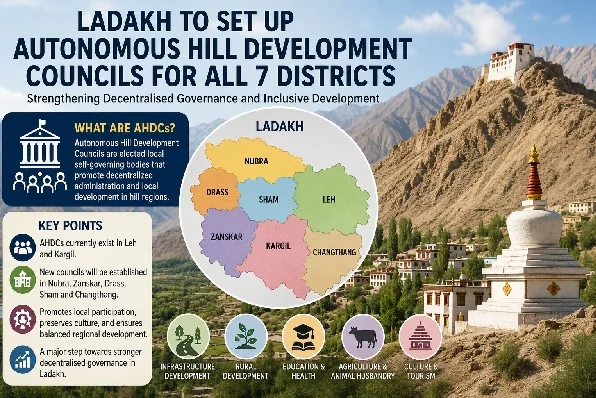
- Ladakh's Chief Secretary Ashish Kundra recently announced that the Union Territory Administration will constitute an Autonomous Hill Development Council (AHDC) in each of Ladakh's seven districts, extending elected local self-governance beyond the existing Leh and Kargil councils.
- The Chief Secretary described the move as a major step towards democratic decentralisation and grassroots governance, and also outlined a proposal for a new Union Territory-level body above the seven councils.
What are Autonomous Hill Development Councils (AHDCs) ?
- AHDCs are democratically elected local self-governing bodies established to promote decentralized administration in geographically remote and culturally distinct hill regions.
- They function as an intermediate tier between the district administration and the Union Territory administration.
- Each Hill Council generally consists of 26 Councillors (22 directly elected and 4 nominated by the Lieutenant Governor).
Background: Ladakh's Governance Journey
- Pre-1995 : Ladakh (then part of Jammu & Kashmir) had no dedicated elected local body; governance concerns and demands for autonomy grew due to the region's distinct cultural, religious, and geographic identity relative to the Kashmir Valley.
- October 1993 agreement : The Union Government and the Jammu & Kashmir State Government agreed to grant each district of Ladakh the status of an Autonomous Hill Council.
- LAHDC Act, 1997 (deemed effective from 1 June 1995) : This Act established the legal framework for Ladakh Autonomous Hill Development Councils (LAHDCs) — the Leh council was constituted in 1995 and the Kargil council in 2003 as part of a 'healing touch policy' following the Kargil conflict.
- August 2019 : Following the abrogation of Article 370 and the Jammu and Kashmir Reorganisation Act, 2019, Ladakh was carved out as a Union Territory without a legislature, governed directly by the Centre through a Lieutenant Governor.
- Post-2019 demands : Groups such as the Leh Apex Body (LAB) and the Kargil Democratic Alliance (KDA) came together to jointly demand statehood, inclusion of Ladakh in the Sixth Schedule of the Constitution, a separate Public Service Commission, and dedicated Lok Sabha seats for Leh and Kargil, citing concerns over land rights, jobs, and cultural identity.
- April 2026 reorganisation : As part of the government's response to demands, Ladakh was reorganised from 2 to 7 districts (Leh, Kargil, Sham, Nubra, Changthang, Zanskar, and Drass), setting the stage for the current announcement extending hill councils to all of them.
What Has Been Announced
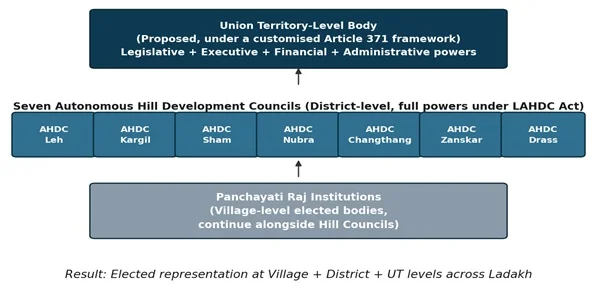
- Council for every district : AHDC will be constituted in each of Ladakh's seven districts, with each council exercising the full powers already provided under the LAHDC Act.
- Existing legal basis : Section 3(1) of the LAHDC Act already provides for a council in every district, to be constituted from a date notified by the government in the Official Gazette — meaning no fresh law is strictly required to create the councils.
- Proposed apex body : Above the seven district councils, the administration has proposed a Union Territory-level institution to be built under a customised Article 371 framework, with legislative, executive, financial, and administrative powers.
- A first-of-its-kind model : The Chief Secretary said this proposed structure has no exact parallel elsewhere in India and would draw on the best features of other constitutional arrangements, including Sixth Schedule councils and Article 371 special provisions used in states like Nagaland, Mizoram, and Sikkim.
- Three-tier representation : Panchayati Raj Institutions will continue to function alongside the Hill Councils, meaning Ladakh will now have elected representation at the village, district, and Union Territory levels.
Existing System vs Proposed System
'Customised Article 371 model' : By proposing an Article 371-based framework rather than Sixth Schedule status, the government appears to be crafting a hybrid, Ladakh-specific arrangement — potentially combining legislative and financial autonomy with the flexibility of a customised, negotiated structure rather than the standard Sixth Schedule template.
|
Aspect
|
Current System (Pre-Announcement)
|
Proposed System
|
|
District-level councils
|
Only 2 (Leh and Kargil)
|
7 (Leh, Kargil, Sham, Nubra, Changthang, Zanskar, Drass)
|
|
Legal basis
|
LAHDC Act, 1997 (extended only to Leh & Kargil)
|
Same Act, extended to all 7 districts under Section 3(1)
|
|
UT-level elected body
|
None — UT administered directly by Lieutenant Governor
|
Proposed apex body under a customised Article 371 framework
|
|
Tiers of representation
|
Village (Panchayat) + District (Leh/Kargil only)
|
Village + District (all 7) + Union Territory level
|
|
Constitutional protection sought
|
Sixth Schedule demand pending since 2019
|
Customised Article 371 model proposed as alternative
|
Significance of Expanding AHDCs
- Strengthening Decentralisation: Decision-making becomes closer to local communities.
- Balanced Regional Development: New districts will receive dedicated planning institutions.
- Better Public Service Delivery: Local bodies understand regional priorities better than centralized administration.
- Greater Political Representation: Residents of remote districts obtain elected institutions to voice local concerns.
- Preservation of Tribal Identity: Councils can promote local languages, culture, traditional institutions, and indigenous livelihoods.
- Improved Participatory Governance: People become directly involved in district-level planning and development.
AHDC VS Sixth Schedule
| Feature |
AHDC |
Sixth Schedule ADC |
| Constitutional Status |
No |
Yes |
| Constitutional Provision |
Created by Act/Regulation |
Articles 244(2) & 275(1) |
| Legislative Powers |
Limited |
Wider |
| Financial Autonomy |
Limited |
Greater |
| Applicable to |
Ladakh |
Tribal Areas of Assam, Meghalaya, Mizoram and Tripura |
Challenges
- Limited Legislative Powers: AHDCs do not enjoy constitutional autonomy similar to Sixth Schedule Autonomous District Councils.
- Financial Dependence: Councils depend heavily on grants from the Union Territory Administration.
- Overlapping Jurisdiction: Administrative powers sometimes overlap with Deputy Commissioners and departmental authorities.
Way Forward
- Clearly define powers of all AHDCs.
- Provide adequate financial devolution.
- Strengthen institutional capacity and ensure transparency and accountability.
- Improve coordination between councils and UT Administration.
PRELIMINARY MCQ
Q. Consider the following statements regarding the Autonomous Hill Development Councils (AHDCs) in Ladakh:
1. The first Autonomous Hill Development Council in Ladakh was established in Leh in 1995.
2. AHDCs are constitutional bodies created under the Sixth Schedule of the Constitution.
3. The Councils primarily promote decentralized planning and local development.
4. Law and Order falls under the jurisdiction of AHDCs.
Which of the statements given above are correct?
A. 1 and 3 only
B. 2 and 4 only
C. 1, 2 and 3 only
D. 1, 3 and 4 only
MAINS PRACTICE QUESTION
Q. The expansion of Autonomous Hill Development Councils in Ladakh reflects India's commitment to democratic decentralisation in strategically important border regions." Discuss the significance of this initiative.
|
FAQs
1. What is an Autonomous Hill Development Council (AHDC) ?
It is an elected local self-governing body that promotes decentralized governance and development in Ladakh's hill districts.
2. Why are new AHDCs being established ?
To extend decentralized governance and balanced development to all seven districts of Ladakh.
3. Why does Ladakh need Autonomous Hill Development Councils in all seven districts ?
To strengthen decentralised governance, ensure balanced regional development, and improve local participation in decision-making.
4. Do AHDCs have legislative powers like State Legislatures ?
No. AHDCs primarily exercise administrative and developmental powers and have limited legislative authority.
5. What is the difference between AHDCs and Sixth Schedule Autonomous District Councils ?
AHDCs are statutory bodies, whereas Sixth Schedule Councils enjoy constitutional status with greater legislative and financial autonomy. |






 Contact Us
  New Batch : 9555124124/ 7428085757
  Tech Support : 9555124124/ 7428085757