New
Hindi Medium: (Delhi) - GS Foundation (P+M) : 6th July 2026, 6:00 PM Hindi Medium: (Prayagraj) - GS Foundation (P+M) : 1st June 2026, 5:30 PM English Medium: (Delhi) - GS Foundation (P+M) : 20th July 2026 Hindi Medium: (Delhi) - GS Foundation (P+M) : 6th July 2026, 6:00 PM Hindi Medium: (Prayagraj) - GS Foundation (P+M) : 1st June 2026, 5:30 PM English Medium: (Delhi) - GS Foundation (P+M) : 20th July 2026

Current Affairs for 16 June 2026

Drop Shipping: A New Business Model in the Digital Age

  • While scrolling through social media, we often come across attractive products.
  • It may be a stylish laptop bag, a set of inexpensive novels, a fast wireless charger, or a beautifully crafted notebook. Within a few moments, we may decide to purchase the product and make the payment. However, do we know whether the website or Instagram page from which we are buying actually possesses the product?
  • In today’s digital economy, it is entirely possible that the individual or company receiving your payment has no warehouse, inventory, or product of its own. Instead, it acts as an intermediary that forwards your order to another manufacturer or supplier. This arrangement is known as Drop Shipping.
  • With the rapid expansion of e-commerce, social media marketing, and Artificial Intelligence (AI), drop shipping has become increasingly popular across the world. This model enables entrepreneurs to start businesses with minimal investment while offering convenience as well as certain risks to consumers.

What is Drop Shipping ?

  • Drop shipping is a retail business model in which the seller does not keep products in stock. When a customer places an order, the seller purchases the product from a manufacturer, wholesaler, or supplier, who then ships it directly to the customer.
  • In other words, the drop shipper does not own the product but acts as an intermediary between the customer and the actual seller.
  • Simply put, the business of drop shipping is not about holding products but about attracting customers and processing their orders.

How Does Drop Shipping Work?

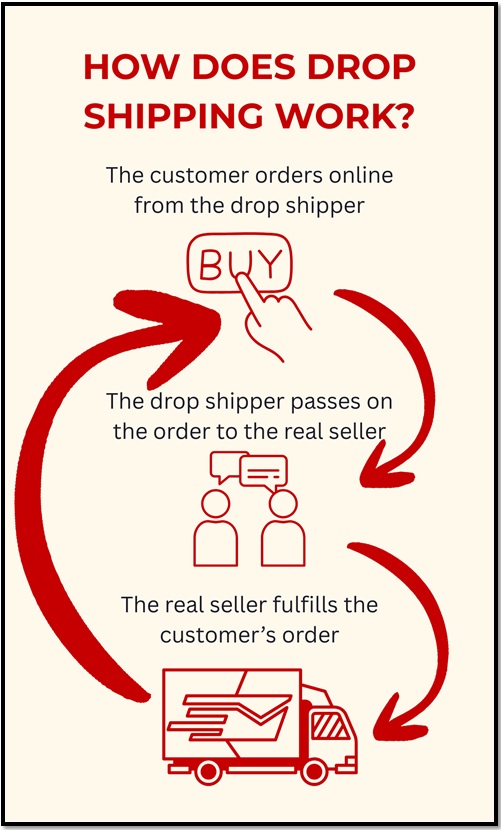
The process of drop shipping is relatively simple.

  • First, an individual or company enters into an agreement with a manufacturer, wholesaler, or supplier. The seller then promotes products through social media platforms, websites, or e-commerce marketplaces.
  • When a customer places an order and makes a payment, the drop shipper forwards the order to the supplier. The supplier then ships the product directly to the customer.
  • In this process, customers often remain unaware of who actually owned or shipped the product.
  • The drop shipper earns a profit from the difference between the selling price and the purchase price.

Example

  • Suppose an individual lists a mobile phone case on their website for ₹500.
  • A customer purchases the product and pays ₹500.
  • The website owner then purchases the same phone case from a supplier for ₹300, and the supplier ships it directly to the customer.
  • Thus :
    • Customer Payment = ₹500
    • Payment to Supplier = ₹300
    • Gross Profit of the Drop Shipper = ₹200
    • This is the basic principle of the drop-shipping model.

Amazon’s Success and Drop Shipping

  • The early success of Amazon, one of the world’s largest e-commerce companies, can partly be attributed to drop-shipping practices.
  • During its initial years, Amazon did not possess the vast warehouses and logistics networks that it has today. Instead, the company primarily received customer orders and sourced books from other sellers before delivering them to customers.
  • Although Amazon’s business model has evolved significantly over time, drop-shipping activities continue to exist on its platform.

How Social Media and AI Have Expanded Drop Shipping

  • In recent years, Instagram, Facebook, WhatsApp, and other digital platforms have accelerated the growth of drop shipping.
  • Today, anyone can create an attractive online store within hours. AI tools can generate product descriptions, customer service chatbots, and marketing content.
  • Many social media influencers convert their followers into customers and generate income through drop shipping.
  • As a result, drop shipping has become not merely a business model but a significant component of the modern digital economy.

A Bookstore Without Books

  • Imagine a parent wishes to purchase a collection of Shakespeare’s plays for a child. A local bookstore sells the book for ₹2,000.
  • Meanwhile, a trendy online bookstore on social media offers the same content for ₹1,000. In reality, this bookstore does not possess any physical inventory.
  • As soon as the customer places an order, the drop shipper uses a Print-on-Demand (PoD) service to print the book.
  • The printing and delivery cost amounts to ₹600, while the customer pays ₹1,000.
  • Consequently, the drop shipper earns a profit of ₹400.

How a Chinese Charger Becomes a Premium Indian Product

  • Through drop shipping, the price of a product can sometimes increase several times above its original cost.
  • Consider a Chinese factory that manufactures a wireless charger for ₹700.
  • An Indian importer purchases thousands of chargers, imports them into India, and sets a selling price of ₹2,000 after accounting for customs duties and other expenses.
  • An Indian gadget company then sells the same product through a drop-shipping arrangement for ₹3,000.
  • Subsequently, popular technology influencers promote the charger for ₹3,999 while claiming that its actual value is ₹5,000.
  • Thus, a charger originally costing ₹700 reaches the customer at a price of ₹3,999.

Is Drop Shipping Legal ?

  • Drop shipping is legal in most countries, provided that participants comply with tax regulations, consumer protection laws, and e-commerce rules.
  • Problems arise when sellers misrepresent themselves as original manufacturers or sell counterfeit products.
  • Due to the growing influence of social media, consumers often find it difficult to determine whether they are purchasing directly from a manufacturer or through an intermediary.

Advantages of Drop Shipping

  • One of the biggest advantages of drop shipping is the low capital investment required to start a business.
  • Sellers do not need to invest in warehouses, inventory, or a large workforce.
  • They can operate businesses from home and access international markets.
  • Social media platforms allow them to reach millions of potential customers.
  • AI-powered customer support and automation have made the model even easier to manage.

Benefits for Consumers

  • Consumers can purchase small quantities of foreign products without buying in bulk.
  • They do not need to communicate directly with overseas sellers.
  • Language barriers can often be avoided.
  • Import procedures and customs-related complexities are usually handled by the drop shipper.

Risks of Drop Shipping

  • Although convenient, the drop-shipping model carries several significant risks.
  • Customers may end up paying much higher prices than the actual value of the product.
  • They may receive counterfeit or low-quality goods.
  • Delivery times can be lengthy.
  • Refund and return procedures may be complicated.
  • Personal and financial information may be shared among multiple parties, increasing cybersecurity risks.
  • In some cases, drop-shipping networks have been associated with counterfeit products, copyright violations, pyramid schemes, and online fraud.

What Precautions Should Consumers Take ?

  • Consumers should always verify the background and credibility of the seller before making a purchase.
  • Customer reviews should be carefully examined.
  • Product prices should be compared across different platforms.
  • Return and refund policies should be understood thoroughly.
  • Whenever possible, consumers should identify the original manufacturer of the product.
  • Purchases should not be based solely on social media advertisements or influencer promotions.

The Future of Drop Shipping in India

  • With the rapid growth of e-commerce, social commerce, digital payments, and AI, drop shipping is becoming increasingly popular in India. Thousands of small entrepreneurs are adopting this model through Instagram, Facebook, WhatsApp, and various e-commerce platforms.
  • However, concerns related to consumer protection, supply-chain transparency, data security, and product authenticity are also growing. Therefore, stronger regulatory oversight and greater consumer awareness will be essential in the future.

Conclusion

  • Drop shipping is an important and rapidly growing business model in the modern digital economy. It has lowered barriers to entry, enabling millions of individuals to become entrepreneurs with minimal investment. At the same time, it has made global markets more accessible than ever before.
  • Nevertheless, challenges such as lack of transparency, price inflation, data security concerns, counterfeit products, and consumer protection issues continue to exist. Therefore, consumers in the digital age must understand where a product is coming from and whom they are actually paying before making a purchase.
  • The next time an influencer promotes an attractive gadget, book, or fashion product, take a few minutes to conduct your own research. You may discover that several layers of drop-shipping intermediaries stand between you and the original manufacturer.

New spider species discovered in Meghalaya

Why in the news?

  • Recently, scientists discovered a new species of spider in Mawlyngot village in the East Khasi Hills district of Meghalaya. This new species has been named Hamataliwa mawlyngot.
  • This discovery was made by researchers from the Zoological Survey of India (ZSI) and the University of Calcutta, and the findings were published in the journal National Academy Science Letters.

Key Points

New Species: Hamataliwa mawlyngot

  • This is a new species of the lynx spider group.
  • It is named after the village of Mawlyngot, the site of its discovery.
  • This species was found on the mountain slopes of the East Khasi Hills.

First Recorded Appearance

  • This is the first recorded appearance of the genus Hamataliwa in Meghalaya.
  • This has expanded knowledge of the geographic distribution of this genus in India.

Characteristics of the Lynx Spider

  • It does not hunt by building a web.
  • It has keen eyesight and pursues prey at high speed.
  • It is an active hunter among bushes and leaves.
  • It preys on a variety of insects.

Ecological Importance

  • Helpful in biological pest control.
  • Beneficial predators in agricultural ecosystems.
  • Important role in maintaining biodiversity balance.

Significance of the Discovery

1. New Evidence of Biodiversity

  • This discovery shows that the biodiversity of Meghalaya and Northeast India is still not fully documented.

2. Indo-Burma Biodiversity Hotspot

  • The East Khasi Hills region is part of the world-renowned Indo-Burma Biodiversity Hotspot.
  • Characteristics of the Indo-Burma Hotspot
  • Among the most biodiverse regions in the world.
  • High levels of endemic species.
  • Many areas are still scientifically understudied.

3. Need for Conservation

  • Many species may become extinct before they are discovered.
  • Regular biodiversity surveys and habitat conservation are essential.

Importance of Biodiversity Conservation in India

  • Discovery of new species enriches scientific knowledge.
  • Indicates the health of an ecosystem.
  • Helps in formulating conservation policies.
  • Strengthens India's global biodiversity status.

India-China joint initiative: Preparations to get UNESCO recognition for the legacy of Xuanzang

Why in the news ?

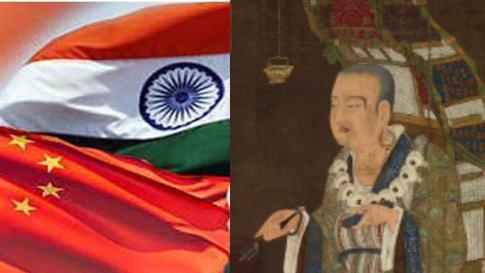
  • Recently, BRICS countries have considered submitting joint nominations to various UNESCO lists to promote the preservation and global recognition of shared cultural heritage. In this regard, India and China are discussing the possibility of a joint nomination for UNESCO recognition of the travelogue "The Great Tang Records on the Western Regions," written by the renowned 7th-century Buddhist monk and scholar Xuanzang.
  • This initiative not only underlines the historical and cultural ties between India and China, but is also considered an important step towards preserving shared heritage.
What is ‘The Great Tang Records on the Western Regions’ ?

  • ‘The Great Tang Records on the Western Regions’ is a famous travelogue written by the 7th century Chinese Buddhist monk Hiuen Tsang. In Hindi it is generally called ‘Si-Yu-Ki’ or ‘Description of Western Regions’.
  • This book gives a detailed description of the political, social, religious and cultural conditions of India and Central Asia.
  • Hiuen Tsang traveled and studied in India for about 15 to 19 years and studied Buddhist philosophy in depth at Nalanda University in Bihar.
  • His accounts are counted among the most important sources of the history of early medieval India.

Joint Nomination Proposal

  • China is leading this proposal, while India is considering its support. The proposal is currently under consideration by India's Ministry of External Affairs. China has suggested through diplomatic channels a joint nomination of this text to the UNESCO list.
  • If this proposal moves forward, it could become an important example of India-China cultural cooperation.

Other joint nomination plans of BRICS countries

  • Several other proposals are also being considered to secure UNESCO recognition of shared cultural heritage among BRICS countries.
  • Prominent among these are :
    • Panchatantra - a joint nomination by India and Iran
    • Philosophy of Satyagraha - a joint nomination by India and South Africa

Why are joint nominations important ?

1. Limited nomination opportunities at UNESCO

  • Each country is allowed to submit only two nominations per two years for UNESCO's heritage lists. However, no such limit applies to joint nominations. Therefore, many countries are prioritizing joint proposals for shared heritage sites.

2. Preservation of shared cultural heritage

  • Many cultural traditions and knowledge systems have developed in more than one country. Joint nominations allow these heritage sites to gain wider recognition globally.
  • Examples :
    • Ramayana tradition - India and Indonesia
    • Buddhist texts - India and China
    • Panchatantra - India and Iran

3. Avoiding conflicts over cultural claims

  • Joint nominations reduce the possibility of parallel claims and disputes between different countries over a heritage site.

Lessons learned from the Sowa-Rigpa dispute

  • In 2017, India submitted a proposal to include the traditional Tibetan medical system, Sowa-Rigpa, on UNESCO's Intangible Cultural Heritage List. At the same time, China also submitted its claim to this heritage.
  • To avoid such disputes, BRICS countries have emphasized increased coordination regarding cultural heritage.

BRICS Culture Working Group meeting

  • The second meeting of the BRICS Culture Working Group was held in Varanasi in June 2026. Representatives from many countries including Brazil, China, South Africa, United Arab Emirates, Indonesia and Iran participated in it.
  • Conservation of shared cultural heritages and promotion of joint nomination were discussed in the meeting. Its recommendations will be sent to the BRICS Culture Ministers' meeting to be held in Bhopal in August 2026.

Who was Xuanzang ?

  • Xuanzang was a renowned 7th-century Chinese Buddhist monk, philosopher, translator, and traveler. He is often called the "Prince of Pilgrims."

Purpose of Journey to India

  • Xuanzang believed that the Buddhist texts available in China were incomplete and flawed. Therefore, he embarked on a journey to India in 629 AD to understand the true nature of Buddhism.

Studies at Nalanda

  • In India, he studied Buddhist philosophy and the Yogachara tradition under the guidance of Acharya Shilabhadra at Nalanda University. He later became a renowned Buddhist scholar himself.

Relationship with Harshavardhana

  • Xuanzang was a contemporary of Emperor Harshavardhana. Harshavardhana honored him specially at a large religious gathering held in Kannauj.

Return to China and Contributions

  • On his return to China in 645 AD, Xuanzang took with him numerous Buddhist texts, statues, and knowledge materials. He translated these texts into Chinese, which gave a new direction to the spread of Buddhism in China.

What is cultural heritage ?

  • Cultural heritage is heritage that reflects a society's identity, history, traditions, knowledge, art, customs, and lifestyle and is passed down from generation to generation.

Types of Cultural Heritage

1. Tangible Heritage

  • Heritage that can be seen and touched.
  • Examples :
    • Taj Mahal
    • Qutub Minar
    • Forts and monuments
    • Ancient manuscripts

2. Intangible Cultural Heritage

  • Heritage that survives in the form of traditions, knowledge, and cultural expressions.
  • Examples :
    • Yoga
    • Ramlila
    • Classical dance
    • Folk songs and folktales
    • Traditional handicrafts

About the BRICS group :

  • It was established in September 2006.
  • Initially, it included Brazil, Russia, India, and China.
  • It was originally named BRIC.
  • South Africa joined in September 2010.
  • It was renamed BRICS. (B-Brazil, R-Russia, I-India, C-China, and S-South Africa)
  • It is headquartered in Shanghai, China.
  • The presidency of the organization rotates annually among the members of the BRICS group in alphabetical order.
  • The six new full members who joined BRICS are:
  • Egypt, Ethiopia, Iran, Saudi Arabia, the United Arab Emirates, and Indonesia.

Conclusion

The joint effort by India and China to secure UNESCO recognition for the legacy of Xuanzang is an important example of cultural diplomacy. This initiative can not only bring global recognition to the shared historical heritage of both countries but also provide a new direction to cultural cooperation among BRICS countries.

Global economic impact of Iran conflict: Growth projected to be 2.5% in 2026

Why in the news ?

  • The impact of the ongoing conflict in West Asia is now clearly visible on the global economy. According to the World Bank Group's latest "Global Economic Prospects" report, global economic growth is projected to decline to 2.5 percent in 2026 due to sharp increases in energy prices, rising inflation, and higher borrowing costs. This would be the lowest level of global growth since the COVID-19 pandemic.

Key Points

  • According to the report, the global economic growth rate is expected to decline to 2.5 percent in 2026 after reaching 2.9 percent in 2025.
  • Although it is expected to improve slightly to 2.8 percent in 2027, it will remain significantly lower than the average growth rate of the 2010s.
  • The World Bank also reported that growth projections for nearly two-thirds of the world's economies have declined since January 2026.

Energy Crisis and Rising Inflation

  • The report states that disruptions in the Strait of Hormuz have impacted global energy markets.
  • This has resulted in a significant increase in oil prices.
  • The average price of Brent crude oil is projected to be $94 per barrel in 2026, approximately 36 percent higher than in 2025.
  • Rising energy costs will also impact the agricultural sector. Rising fertilizer prices could increase food costs, leading to a rise in global inflation from 3.3 percent in 2025 to 4 percent in 2026.

More pressure on developing countries

  • According to the World Bank, developing economies could be the hardest hit by this recession.
  • The growth rate of these countries is projected to decline from 4.4 percent in 2025 to 3.6 percent in 2026, which would be the lowest level since the pandemic.
  • The report warns that it may be more difficult for most developing countries, except China and India, to narrow the per capita income gap with developed economies.
  • The process of income convergence in these countries could be stalled for almost a decade until 2028.

South Asia the Fastest-Growing Region

  • Despite the global recession, South Asia will remain the world's fastest-growing region.
  • However, regional growth is projected to decline from 7 percent in 2025 to 6.3 percent in 2026.
  • It is expected to rebound to 6.9 percent in 2027.
  • On the other hand, the economies of West Asian and Gulf countries, most affected by the conflict, may see a sharp decline.
  • Gulf countries' growth rate may decline from 3.9 percent in 2025 to almost zero in 2026.
  • However, it is expected to pick up again in 2027-28 with reconstruction activities and improved trade.

The situation could worsen as the crisis deepens.

  • The World Bank has warned that if there are further disruptions to energy supplies or a serious crisis in global financial markets, global growth could decline to just 1.3 percent in 2026.
  • In such a scenario, global inflation could rise to 4.4 percent.

World Bank ready to provide up to $100 billion in aid

  • To address the potential economic crisis, the World Bank Group has stated that it is prepared to provide up to $100 billion in financing, guarantees, and private sector assistance over the next 15 months.
  • Currently, the institution is providing immediate assistance of $50 to $60 billion, including $25 billion in pre-approved financial assistance.
  • World Bank Group President Ajay Banga stated that the biggest challenge facing developing countries today is ensuring people's safety, maintaining economic stability, and preserving employment and growth opportunities.
  • He stated that maintaining long-term growth prospects is essential despite the current crisis.

Rising public debt is also a concern

  • The report identifies rising public debt as a significant risk to the global economy.
  • Government debt in developing countries has risen from less than 40 percent of GDP in 2010 to over 70 percent now.
  • This is increasing borrowing costs and impacting governments' ability to invest in health, education, and infrastructure.
  • The World Bank advises countries to adopt stronger fiscal rules, increase domestic revenue collection, diversify their economies, and encourage private investment to better withstand future economic shocks.
« »
  • SUN
  • MON
  • TUE
  • WED
  • THU
  • FRI
  • SAT
Have any Query?

Our support team will be happy to assist you!

OR