- While scrolling through social media, we often come across attractive products.
- It may be a stylish laptop bag, a set of inexpensive novels, a fast wireless charger, or a beautifully crafted notebook. Within a few moments, we may decide to purchase the product and make the payment. However, do we know whether the website or Instagram page from which we are buying actually possesses the product?
- In today’s digital economy, it is entirely possible that the individual or company receiving your payment has no warehouse, inventory, or product of its own. Instead, it acts as an intermediary that forwards your order to another manufacturer or supplier. This arrangement is known as Drop Shipping.
- With the rapid expansion of e-commerce, social media marketing, and Artificial Intelligence (AI), drop shipping has become increasingly popular across the world. This model enables entrepreneurs to start businesses with minimal investment while offering convenience as well as certain risks to consumers.
What is Drop Shipping ?
- Drop shipping is a retail business model in which the seller does not keep products in stock. When a customer places an order, the seller purchases the product from a manufacturer, wholesaler, or supplier, who then ships it directly to the customer.
- In other words, the drop shipper does not own the product but acts as an intermediary between the customer and the actual seller.
- Simply put, the business of drop shipping is not about holding products but about attracting customers and processing their orders.
How Does Drop Shipping Work?
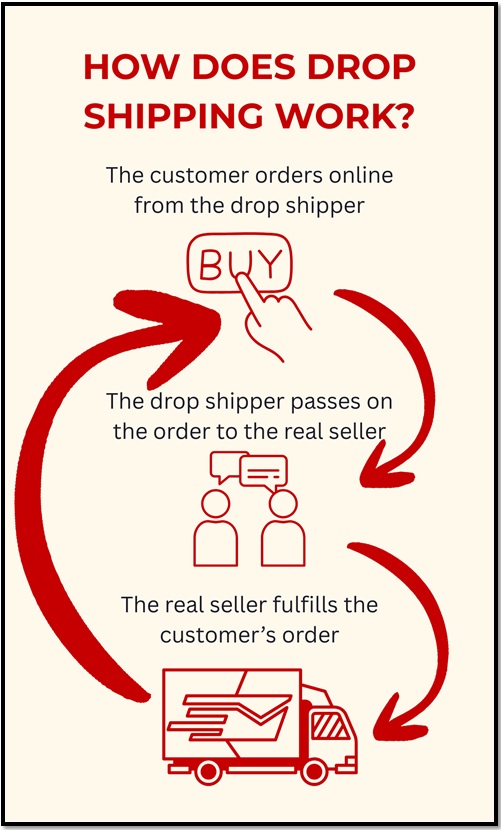
The process of drop shipping is relatively simple.
- First, an individual or company enters into an agreement with a manufacturer, wholesaler, or supplier. The seller then promotes products through social media platforms, websites, or e-commerce marketplaces.
- When a customer places an order and makes a payment, the drop shipper forwards the order to the supplier. The supplier then ships the product directly to the customer.
- In this process, customers often remain unaware of who actually owned or shipped the product.
- The drop shipper earns a profit from the difference between the selling price and the purchase price.
Example
- Suppose an individual lists a mobile phone case on their website for ₹500.
- A customer purchases the product and pays ₹500.
- The website owner then purchases the same phone case from a supplier for ₹300, and the supplier ships it directly to the customer.
- Thus :
- Customer Payment = ₹500
- Payment to Supplier = ₹300
- Gross Profit of the Drop Shipper = ₹200
- This is the basic principle of the drop-shipping model.
Amazon’s Success and Drop Shipping
- The early success of Amazon, one of the world’s largest e-commerce companies, can partly be attributed to drop-shipping practices.
- During its initial years, Amazon did not possess the vast warehouses and logistics networks that it has today. Instead, the company primarily received customer orders and sourced books from other sellers before delivering them to customers.
- Although Amazon’s business model has evolved significantly over time, drop-shipping activities continue to exist on its platform.
How Social Media and AI Have Expanded Drop Shipping
- In recent years, Instagram, Facebook, WhatsApp, and other digital platforms have accelerated the growth of drop shipping.
- Today, anyone can create an attractive online store within hours. AI tools can generate product descriptions, customer service chatbots, and marketing content.
- Many social media influencers convert their followers into customers and generate income through drop shipping.
- As a result, drop shipping has become not merely a business model but a significant component of the modern digital economy.
A Bookstore Without Books
- Imagine a parent wishes to purchase a collection of Shakespeare’s plays for a child. A local bookstore sells the book for ₹2,000.
- Meanwhile, a trendy online bookstore on social media offers the same content for ₹1,000. In reality, this bookstore does not possess any physical inventory.
- As soon as the customer places an order, the drop shipper uses a Print-on-Demand (PoD) service to print the book.
- The printing and delivery cost amounts to ₹600, while the customer pays ₹1,000.
- Consequently, the drop shipper earns a profit of ₹400.
How a Chinese Charger Becomes a Premium Indian Product
- Through drop shipping, the price of a product can sometimes increase several times above its original cost.
- Consider a Chinese factory that manufactures a wireless charger for ₹700.
- An Indian importer purchases thousands of chargers, imports them into India, and sets a selling price of ₹2,000 after accounting for customs duties and other expenses.
- An Indian gadget company then sells the same product through a drop-shipping arrangement for ₹3,000.
- Subsequently, popular technology influencers promote the charger for ₹3,999 while claiming that its actual value is ₹5,000.
- Thus, a charger originally costing ₹700 reaches the customer at a price of ₹3,999.
Is Drop Shipping Legal ?
- Drop shipping is legal in most countries, provided that participants comply with tax regulations, consumer protection laws, and e-commerce rules.
- Problems arise when sellers misrepresent themselves as original manufacturers or sell counterfeit products.
- Due to the growing influence of social media, consumers often find it difficult to determine whether they are purchasing directly from a manufacturer or through an intermediary.
Advantages of Drop Shipping
- One of the biggest advantages of drop shipping is the low capital investment required to start a business.
- Sellers do not need to invest in warehouses, inventory, or a large workforce.
- They can operate businesses from home and access international markets.
- Social media platforms allow them to reach millions of potential customers.
- AI-powered customer support and automation have made the model even easier to manage.
Benefits for Consumers
- Consumers can purchase small quantities of foreign products without buying in bulk.
- They do not need to communicate directly with overseas sellers.
- Language barriers can often be avoided.
- Import procedures and customs-related complexities are usually handled by the drop shipper.
Risks of Drop Shipping
- Although convenient, the drop-shipping model carries several significant risks.
- Customers may end up paying much higher prices than the actual value of the product.
- They may receive counterfeit or low-quality goods.
- Delivery times can be lengthy.
- Refund and return procedures may be complicated.
- Personal and financial information may be shared among multiple parties, increasing cybersecurity risks.
- In some cases, drop-shipping networks have been associated with counterfeit products, copyright violations, pyramid schemes, and online fraud.
What Precautions Should Consumers Take ?
- Consumers should always verify the background and credibility of the seller before making a purchase.
- Customer reviews should be carefully examined.
- Product prices should be compared across different platforms.
- Return and refund policies should be understood thoroughly.
- Whenever possible, consumers should identify the original manufacturer of the product.
- Purchases should not be based solely on social media advertisements or influencer promotions.
The Future of Drop Shipping in India
- With the rapid growth of e-commerce, social commerce, digital payments, and AI, drop shipping is becoming increasingly popular in India. Thousands of small entrepreneurs are adopting this model through Instagram, Facebook, WhatsApp, and various e-commerce platforms.
- However, concerns related to consumer protection, supply-chain transparency, data security, and product authenticity are also growing. Therefore, stronger regulatory oversight and greater consumer awareness will be essential in the future.
Conclusion
- Drop shipping is an important and rapidly growing business model in the modern digital economy. It has lowered barriers to entry, enabling millions of individuals to become entrepreneurs with minimal investment. At the same time, it has made global markets more accessible than ever before.
- Nevertheless, challenges such as lack of transparency, price inflation, data security concerns, counterfeit products, and consumer protection issues continue to exist. Therefore, consumers in the digital age must understand where a product is coming from and whom they are actually paying before making a purchase.
- The next time an influencer promotes an attractive gadget, book, or fashion product, take a few minutes to conduct your own research. You may discover that several layers of drop-shipping intermediaries stand between you and the original manufacturer.






 Contact Us
  New Batch : 9555124124/ 7428085757
  Tech Support : 9555124124/ 7428085757