New
Civil Services Day Offer - Valid Till : 23rd April GS Foundation (P+M) - Delhi : 4th May 2026, 11:30 AM GS Foundation (P+M) - Prayagraj : 4th May 2026, 5:30PM Civil Services Day Offer - Valid Till : 23rd April GS Foundation (P+M) - Delhi : 4th May 2026, 11:30 AM GS Foundation (P+M) - Prayagraj : 4th May 2026, 5:30PM

Current Affairs for 18 April 2026

Why Was Bank Nationalisation in 1969 a Turning Point in India’s Economic Development?

Prelims : Economy + CA
Mains : GS Paper 1 – Post-Independence India; GS Paper 3 – Indian Economy; Financial Inclusion

Why in News ?

The policy of Bank Nationalisation in 1969 continues to be revisited in discussions on the role of the state in economic management, financial inclusion, and banking sector reforms in India.

More than five decades later, it is widely regarded as a landmark decision that fundamentally transformed the structure, reach, and purpose of the Indian banking system. It marked a decisive shift from a profit-oriented private banking model to a development-oriented public banking system aligned with national priorities.
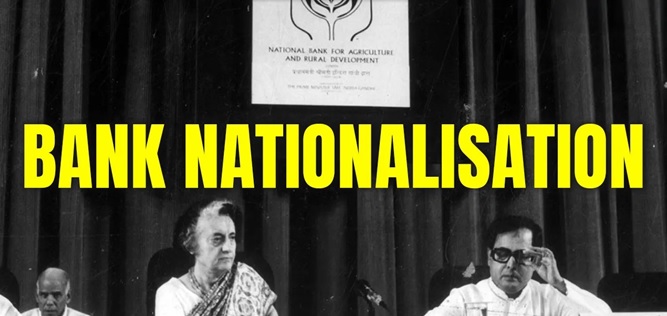
What Was Bank Nationalisation (1969) ?

Bank nationalisation refers to the process through which the Government of India took ownership and control of major private commercial banks in order to align their functioning with broader socio-economic objectives.

  • On 19 July 1969, the government nationalised 14 major commercial banks that each had deposits exceeding ₹50 crore, thereby bringing a substantial portion of the banking sector under state control.
  • These banks accounted for a dominant share of deposits and credit in the economy, which meant that their nationalisation had far-reaching implications for financial resource allocation.
  • The move reflected a broader ideological commitment towards a state-led model of development, where financial institutions were expected to act as instruments of planned economic growth and social justice rather than purely profit-making entities.

Background and Need for Nationalisation

1. Urban-Centric and Elitist Banking Structure

Before nationalisation, the Indian banking system was heavily skewed in favour of urban and industrial regions :

  • The vast majority of bank branches were concentrated in metropolitan and urban areas, leaving rural and semi-urban regions severely underserved.
  • A large segment of the population, especially farmers and small traders, remained outside the formal banking system and lacked access to institutional credit.
  • This exclusion forced rural populations to depend on informal sources of finance such as moneylenders, who often charged exorbitant interest rates and perpetuated cycles of debt and poverty.

This created a situation where banking services were limited to a privileged section of society, undermining inclusive growth.

2. Concentration of Credit in the Hands of Big Business

Private banks tended to favour large industrial houses and established business groups :

  • Credit allocation was biased towards sectors and clients that offered higher returns and lower perceived risk.
  • Small-scale industries, agriculture, and weaker sections of society received minimal attention due to their perceived lack of profitability and higher risk profile.
  • This led to a concentration of financial resources in a few hands, reinforcing economic inequality and limiting opportunities for broader economic participation.

Thus, the banking system functioned in a manner that deepened structural inequalities rather than correcting them.

3. Inadequate Support for Planned Economic Development

India had adopted a planned economic model, where the state played a central role in directing resources toward priority sectors :

  • However, private banks did not adequately align their lending practices with the goals of Five-Year Plans.
  • Critical sectors such as agriculture, rural development, and small industries did not receive sufficient institutional support.
  • This created a mismatch between national development objectives and the functioning of the financial system.

As a result, there was a growing recognition that the state needed to directly control banking resources to achieve developmental goals.

4. Ideological Shift Towards Socialism

The late 1960s witnessed a stronger push towards a socialist pattern of development :

  • The government sought to ensure equitable distribution of resources and reduce socio-economic disparities.
  • Control over key sectors such as banking was seen as essential for implementing redistributive policies.
  • Bank nationalisation was therefore viewed as a necessary step to democratise access to credit and align financial institutions with social objectives.

Objectives of Bank Nationalisation

1. Expanding Financial Inclusion

A major objective was to make banking accessible to all sections of society :

  • The aim was to extend banking services to rural and remote areas where formal financial institutions were absent.
  • This included opening new bank branches, promoting savings among the rural population, and integrating them into the formal financial system.
  • The shift from “class banking” to “mass banking” was central to this objective.

2. Promoting Priority Sector Lending

Banks were directed to allocate a significant portion of their credit to priority sectors :

  • Agriculture, small-scale industries, and exports were identified as critical sectors requiring institutional support.
  • Special emphasis was placed on providing credit to weaker sections of society, including small farmers and marginal entrepreneurs.
  • This ensured that financial resources were channelled towards sectors that contributed to inclusive and sustainable growth.

3. Reducing Regional Imbalances

Another important objective was to promote balanced regional development :

  • Banking infrastructure was expanded to underdeveloped and backward regions.
  • Credit availability in these areas helped stimulate economic activity and reduce regional disparities.

4. Supporting Government Policies and Development Programmes

Nationalised banks were expected to act as instruments for implementing government policies :

  • They played a key role in financing development projects and welfare schemes.
  • Banking resources were aligned with national priorities such as poverty alleviation and employment generation.

Impact of Bank Nationalisation

1. Rapid Expansion of Banking Network

One of the most visible impacts was the dramatic increase in the number of bank branches :

  • Thousands of new branches were opened in rural and semi-urban areas, significantly improving access to banking services.
  • This expansion helped integrate previously excluded populations into the formal financial system.

2. Increase in Agricultural and Priority Sector Credit

Institutional credit to agriculture and small industries increased substantially :

  • Farmers gained access to affordable credit, which supported agricultural productivity and the Green Revolution.
  • Small businesses and entrepreneurs were able to access funding, contributing to economic diversification and growth.

3. Mobilisation of Savings

Bank nationalisation facilitated the mobilisation of savings from a wider population base :

  • Rural and semi-urban households began depositing their savings in banks.
  • This increased the pool of financial resources available for investment in the economy.

4. Reduction in Financial Inequality

By expanding access to credit and banking services :

  • Economic opportunities became more widely distributed.
  • The gap between urban and rural financial access was reduced.

5. Strengthening of Public Sector Banks

Public sector banks emerged as the dominant players in the banking sector :

  • They became key instruments for implementing government schemes and policies.
  • Their extensive network allowed for large-scale outreach and service delivery.

Criticism and Limitations

1. Decline in Operational Efficiency

Public ownership often led to inefficiencies :

  • Bureaucratic procedures slowed decision-making processes.
  • Lack of competition reduced incentives for innovation and performance improvement.

2. Political Interference in Lending

Government control sometimes resulted in :

  • Directed lending based on political considerations rather than economic viability.
  • Loan waivers and populist measures that affected financial discipline.

3. Rise in Non-Performing Assets (NPAs)

  • Lending without adequate risk assessment led to accumulation of bad loans.
  • Weak accountability mechanisms contributed to poor asset quality.

4. Fiscal Burden on the Government

Public sector banks often required recapitalisation :

  • This placed a financial burden on the government and taxpayers.

Long-Term Significance

1. Foundation for Financial Inclusion Initiatives

Bank nationalisation laid the groundwork for later initiatives such as :

  • Expansion of rural banking
  • Direct benefit transfers
  • Financial inclusion programmes

2. Strengthening the Developmental Role of the State

It established the state as a central actor in directing financial resources for development.

3. Evolution Towards Reforms

While nationalisation expanded access, later reforms focused on improving efficiency, governance, and competitiveness in the banking sector.

Challenges in the Present Context

  • Balancing social objectives with financial sustainability
  • Addressing the issue of NPAs
  • Enhancing governance and autonomy of public sector banks
  • Managing the debate between privatisation and state control

Way Forward

1. Improving Governance and Accountability

  • Strengthen institutional frameworks
  • Reduce political interference

2. Enhancing Efficiency and Competitiveness

  • Adopt modern banking technologies
  • Improve risk management practices

3. Maintaining Focus on Inclusion

  • Continue expanding access to banking services
  • Strengthen rural and digital banking

4. Balanced Banking Model

  • Combine the strengths of public sector banks with private sector efficiency

Practice Questions

Prelims

Q. Bank nationalisation in India in 1969 was primarily aimed at :
(a) Promoting foreign investment
(b) Expanding financial inclusion and priority sector lending
(c) Reducing inflation
(d) Increasing exports

Mains

“Bank nationalisation in 1969 transformed India’s financial system by aligning it with developmental goals, but also created long-term structural challenges.” Critically examine.

FAQs

Q1. What was bank nationalisation in 1969 ?

It was the takeover of major private banks by the government.

Q2. Why was it implemented ?

To promote financial inclusion and support development.

Q3. What was its biggest achievement ?

Expansion of banking services to rural areas.

Q4. What were its drawbacks ?

Inefficiency, political interference, and rising NPAs.

Q5. Is it still relevant today ?

Yes, it continues to influence India’s banking structure and policies.

India’s Economic Ranking Decline – IMF World Economic Outlook 2026

Prelims : Economy + International Organisations + CA
Mains : GS Paper 3 – Indian Economy; Growth & Development; External Sector

Why in News ?

According to the latest estimates in the International Monetary Fund (IMF) World Economic Outlook (WEO) 2026, India has slipped to the 6th position among the world’s largest economies in terms of nominal GDP.

This development has sparked debate because India continues to remain one of the fastest-growing major economies globally. The decline in ranking is not due to any major slowdown in real economic activity, but rather due to statistical and external factors such as exchange rate movements and GDP revisions, which affect how economies are compared internationally.

How Global Economic Rankings are Measured

1. Nominal GDP in US Dollar Terms

Global economic rankings are determined based on nominal GDP expressed in US dollars, rather than GDP measured in domestic currency.

  • Even if a country’s economy grows significantly in real or domestic terms, its global position depends on how its currency performs against the US dollar.
  • Conversion into dollar terms makes rankings sensitive to international financial conditions and exchange rate volatility.

2. Role of Exchange Rates

Exchange rates play a crucial role in determining rankings :

  • A depreciating currency reduces the dollar value of GDP, even when actual output within the country is rising.
  • Countries with relatively stable or appreciating currencies may improve their rankings even without strong real growth.

Thus, global rankings reflect a combination of economic performance and currency valuation, not just real production levels.

India’s Position in IMF WEO 2026

  • India’s economy is estimated to be in the range of $4.1–4.2 trillion, placing it behind the United States, China, Germany, Japan, and the United Kingdom.
  • This marks a shift from earlier years when India had overtaken the United Kingdom to become the 5th largest economy.
  • The change highlights how closely ranked economies can interchange positions quickly, especially when differences in GDP size are relatively small.

Key Reasons for India’s Ranking Decline

1. Depreciation of the Indian Rupee

One of the primary reasons for the decline is the weakening of the Indian rupee against the US dollar.

  • A weaker rupee directly reduces the international (dollar) value of India’s GDP, even if domestic economic activity remains strong.
  • Currency fluctuations therefore play a disproportionate role in shaping global rankings.

Key Insight :
The decline is largely a currency-driven phenomenon rather than a reflection of economic slowdown.

2. Revision in GDP Estimates

India has undertaken revisions in its GDP estimation methodology and base year, leading to a more accurate but relatively lower nominal GDP figure.

  • Such revisions are part of improving statistical transparency and reliability.
  • However, they can temporarily reduce a country’s apparent economic size in global comparisons.

Key Insight :
Improved data accuracy may sometimes result in short-term ranking declines without affecting real growth.

3. Sensitivity of Dollar-Based Comparisons

Global rankings are highly sensitive when countries are closely grouped in terms of GDP size.

  • Even small changes in exchange rates or growth rates can lead to significant shifts in ranking.
  • Economies like India, Japan, and the UK are relatively close in size, making their positions more volatile.

4. External Economic Pressures

Global economic conditions have indirectly contributed to India’s ranking shift :

  • Rising crude oil prices increase import bills and weaken the currency
  • Global geopolitical tensions disrupt trade and capital flows
  • Inflationary pressures and external imbalances affect macroeconomic stability

Key Insight :
External shocks influence rankings indirectly by affecting exchange rates and overall macroeconomic stability.

5. Combined Effect of Multiple Factors

The decline is best understood as a result of a combination of :

  • Currency depreciation
  • Statistical revisions
  • External economic pressures

Importantly, these are largely temporary and external factors, rather than indicators of structural weakness.

Global Economic Context

1. Slowing Global Growth

The global economy is currently experiencing a slowdown due to :

  • Geopolitical conflicts
  • Inflationary pressures
  • Supply chain disruptions

This creates an uncertain environment affecting all major economies.

2. India’s Growth Performance

Despite the ranking decline, India remains among the fastest-growing major economies, with growth projected in the range of 6–6.5%.

  • Strong domestic demand
  • Expanding digital economy
  • Infrastructure development

continue to support growth momentum.

Significance of the Issue

1. Misleading Nature of Rankings

A decline in ranking may be misinterpreted as economic weakness, whereas :

  • India’s underlying growth fundamentals remain strong
  • The economy continues to expand steadily

Thus, rankings alone do not provide a complete picture of economic health.

2. Importance of Exchange Rate Stability

The episode highlights the importance of :

  • Maintaining currency stability
  • Managing external sector risks

as these directly affect global economic comparisons.

3. Policy Implications

The development underscores the need for :

  • Strengthening macroeconomic fundamentals
  • Reducing dependence on volatile external factors
  • Ensuring stable inflation and fiscal management

4. Long-Term Economic Potential

Despite short-term fluctuations :

  • India is expected to regain higher rankings in the future
  • Strong demographics, urbanisation, and economic reforms support long-term growth

Challenges

1. Dependence on External Variables

India’s global ranking is influenced by factors such as exchange rates and global economic conditions, which are not entirely within domestic control.

2. High Import Dependence

Reliance on imported energy increases vulnerability to :

  • Currency depreciation
  • External shocks

3. Limitations of Nominal GDP

Nominal GDP does not fully capture :

  • Purchasing power
  • Income distribution
  • Overall welfare

Thus, it is an incomplete measure of economic strength.

Way Forward

1. Strengthening External Sector

  • Boost exports
  • Build foreign exchange reserves
  • Reduce import dependence

2. Sustaining High Growth

  • Continue structural reforms
  • Invest in infrastructure and manufacturing

3. Managing Exchange Rate Volatility

  • Maintain macroeconomic stability
  • Ensure prudent fiscal and monetary policies

4. Focus on Holistic Indicators

Policymakers should prioritise :

  • Per capita income
  • Employment generation
  • Human development indices

rather than focusing solely on global rankings.

 Practice Questions

Prelims

Q. Global economic rankings by international organisations are primarily based on :
(a) Purchasing Power Parity
(b) Nominal GDP in US dollars
(c) Per capita income
(d) Fiscal deficit

Mains

“Global economic rankings based on nominal GDP do not always reflect the true strength of an economy.” Discuss in the context of India’s ranking in IMF WEO 2026.

FAQs

Q1. Why did India’s ranking decline ?

Due to rupee depreciation and statistical revisions, not due to economic slowdown.

Q2. How are global rankings determined ?

Based on nominal GDP in US dollar terms.

Q3. Is India’s economy weakening ?

No, it remains one of the fastest-growing major economies.

Q4. What is the key factor affecting ranking ?

Exchange rate fluctuations.

Q5. What is India’s future outlook ?

Strong growth prospects with potential to regain a higher ranking.


What is Astra Mk-2 Missile and How Does it Enhance India’s Air Combat Capability?

Prelims : Science & Technology + Defence + CA
Mains : GS Paper 3 – Defence Technology; Indigenisation of Technology; Security

Why in News?

The Astra Mk-2 missile, an advanced Beyond Visual Range (BVR) air-to-air missile being developed by the Defence Research and Development Organisation, has gained attention due to:

  • Plans to extend its operational range beyond 200 km
  • Progress toward production and induction into the Indian Air Force
  • Its growing importance in strengthening India’s indigenous defence capabilities

The missile represents a major advancement in India’s efforts to achieve self-reliance in advanced aerial warfare systems and reduce dependence on foreign defence imports.

What is Astra Mk-2 Missile ?

The Astra Mk-2 is an indigenously developed Beyond Visual Range (BVR) air-to-air missile designed to engage enemy aircraft at long distances without requiring visual contact.

  • It is the successor to Astra Mk-1, which has a range of around 100 km and is already integrated into fighter aircraft.
  • The missile is designed to be deployed on multiple platforms such as Su-30 MKI, LCA Tejas, and future aircraft like the Advanced Medium Combat Aircraft.

Astra Mk-2 significantly enhances India’s ability to detect, track, and destroy enemy aircraft before they come within striking distance, thereby improving overall air superiority.

Key Features of Astra Mk-2 Missile

1. Extended Operational Range

  • The missile has an operational range of approximately 150–200 km, with upgraded versions targeting even longer distances.
  • This extended range allows fighter aircraft to engage enemy targets from a safe distance, reducing exposure to counterattacks.

This capability places India among a limited group of countries possessing advanced long-range BVR missile technology.

2. High Speed and Kinetic Advantage

  • Astra Mk-2 can achieve speeds of around Mach 4.5, making it extremely fast and difficult to evade.
  • High velocity reduces the reaction time available to enemy aircraft and increases the probability of successful interception.

The combination of speed and range ensures that the missile can effectively neutralise fast-moving and manoeuvrable targets.

3. Dual-Pulse Rocket Motor Technology

  • The missile incorporates a dual-pulse solid rocket motor, which is a significant upgrade over earlier systems.

This technology enables :

  • Sustained propulsion during different phases of flight
  • Better energy retention in the terminal phase
  • Enhanced manoeuvrability and accuracy

The dual-pulse system allows the missile to maintain effectiveness even during complex combat scenarios.

4. Advanced Guidance and Seeker System

  • Astra Mk-2 is equipped with an indigenous Radio Frequency seeker and advanced radar-based guidance systems.
  • It supports mid-course guidance updates through data links and incorporates electronic counter-countermeasure capabilities.

These features enable the missile to track and engage highly manoeuvrable targets even in environments with electronic interference or jamming.

5. Fire-and-Forget Capability

  • The missile has fire-and-forget functionality, meaning it does not require continuous guidance after launch.

This allows pilots to :

  • Focus on evasive manoeuvres
  • Engage multiple targets simultaneously
  • Operate more efficiently in high-threat environments

6. All-Weather and High Agility Performance

  • Astra Mk-2 can operate effectively in all weather conditions, including day and night missions.
  • It is designed for high agility, allowing engagement of targets at different angles and trajectories.

This ensures operational reliability across varied combat scenarios.

7. Reduced Detectability

  • The missile uses smokeless propulsion, which reduces its visibility during launch and flight.

This enhances stealth and reduces the likelihood of early detection by enemy defence systems.

Technical Specifications (Summary)

  • Type : Beyond Visual Range Air-to-Air Missile
  • Range : 150–200+ km
  • Speed : Approximately Mach 4.5
  • Propulsion : Dual-pulse solid rocket motor
  • Guidance : RF seeker with data link support
  • Weight : Around 170–175 kg

Strategic Significance

1. Enhancing Air Superiority

Astra Mk-2 allows Indian fighter aircraft to engage enemy targets at long distances, creating a decisive advantage in aerial combat.

  • It enables early engagement and destruction of threats
  • Reduces vulnerability of Indian aircraft

This contributes to maintaining dominance in contested airspace.

2. Boost to Indigenous Defence Capability

  • The missile is developed domestically, reducing reliance on imported systems.
  • It strengthens India’s defence manufacturing ecosystem and technological self-sufficiency.

This aligns with national initiatives aimed at promoting indigenous defence production.

3. Strengthening Strategic Deterrence

  • The missile’s capabilities are comparable to advanced systems deployed by other major powers.
  • It enhances India’s ability to deter potential adversaries in the region.

This contributes to maintaining a stable strategic balance.

4. Multi-Platform Compatibility

  • Astra Mk-2 is designed to be integrated with multiple aircraft platforms, including current and future fighter jets.

This ensures long-term operational flexibility and adaptability.

Challenges and Limitations

1. Dependence on Supporting Systems

  • The effectiveness of the missile depends on advanced radar systems and airborne early warning systems.
  • Without strong sensor support, its full potential may not be realised.

2. Development and Deployment Timeline

  • The missile is still undergoing testing and refinement.
  • Full-scale deployment across all platforms may take time.

3. Rapid Technological Evolution

  • Missile technology is evolving rapidly worldwide.
  • Continuous upgrades are necessary to remain competitive.

Way Forward

1. Accelerating Induction

  • Speed up testing and production processes
  • Ensure timely integration with frontline aircraft

2. Strengthening Supporting Infrastructure

  • Enhance radar, sensor, and surveillance systems
  • Improve network-centric warfare capabilities

3. Continued Research and Development

  • Invest in next-generation missile technologies
  • Focus on extended range and advanced propulsion systems

4. Expanding Platform Integration

  • Integrate the missile with more aircraft platforms
  • Ensure compatibility with future defence systems

 Practice Questions

Prelims

Q. Astra Mk-2 missile is best described as :
(a) Surface-to-air missile
(b) Ballistic missile
(c) Beyond Visual Range air-to-air missile
(d) Cruise missile

Mains

“Indigenous missile systems such as Astra Mk-2 are crucial for achieving strategic autonomy and strengthening national security.” Discuss.

FAQs

Q1. What is Astra Mk-2 missile ?

It is an indigenously developed beyond visual range air-to-air missile.

Q2. What is its range ?

Around 150–200 km, with future upgrades expected to exceed this.

Q3. What is its speed ?

Approximately Mach 4.5.

Q4. Why is it important ?

It enhances India’s air combat capability and reduces dependence on imports.

Q5. What is its key technological feature ?

Dual-pulse propulsion combined with advanced radar guidance systems.

Who are the Chenchu Tribe and What are Their Key Socio-Cultural Features in India?

Prelims : Art & Culture + CA
Mains : GS Paper 1 – Indian Society; Tribal Issues; Diversity

Why in News ?

The Chenchu tribe has been in the news due to :

  • Government initiatives focused on housing, livelihood, and welfare of Particularly Vulnerable Tribal Groups (PVTGs)
  • Increasing attention to tribal rights, forest-based livelihoods, and inclusive development
  • Recognition of members of the community in local governance and social empowerment efforts

These developments highlight the need to balance development with preservation of tribal identity and culture.

Who are the Chenchu Tribe?

The Chenchu tribe is an indigenous tribal community of southern India, classified as a Scheduled Tribe and identified as a Particularly Vulnerable Tribal Group (PVTG).

  • They are considered one of the oldest forest-dwelling communities in India
  • Traditionally followed a hunter-gatherer lifestyle, relying on forest resources
  • Many have gradually shifted towards agriculture and wage labour due to socio-economic changes

State / Distribution

The Chenchu tribe is primarily found in :

  • Andhra Pradesh (major concentration)
  • Telangana, particularly in the Nallamala forest region
  • Smaller populations in Karnataka and Odisha

Their concentration in forested and hilly regions has helped preserve their traditional lifestyle but has also limited access to modern infrastructure and services.

Language

  • The Chenchu people speak the Chenchu language, which belongs to the Dravidian language family
  • It is closely related to Telugu, and many Chenchus are bilingual
  • The language is considered vulnerable due to increasing interaction with mainstream society

Religion and Belief System

The religious practices of the Chenchu tribe reflect a blend of traditional and mainstream influences:

1. Indigenous Beliefs

  • Worship of nature, forests, and local deities
  • Belief in spirits associated with natural elements

2. Influence of Hinduism

  • Adoption of Hindu customs and practices over time
  • Participation in festivals such as Ugadi, Sankranti, and Shivaratri
  • Cultural association with deities like Lord Narasimha

Their belief system represents a syncretic blend of tribal traditions and Hindu practices.

Socio-Cultural Features

1. Traditional Livelihood

  • Historically dependent on hunting and gathering
  • Collection of forest produce such as honey, fruits, and tubers
  • Increasing shift towards agricultural labour and wage employment

2. Settlement Pattern

  • Settlements are known as “Penta,” consisting of small clusters of huts
  • Houses are simple, made from locally available materials like wood and thatch

3. Social Structure

  • Society is relatively egalitarian with flexible social norms
  • Women generally enjoy a better status compared to many other traditional communities
  • Marriage practices are often based on mutual consent

4. Cultural Simplicity

  • Rituals and customs are simple and closely linked to nature
  • Minimal material possessions and strong community bonds

Latest Developments

1. Welfare Measures

  • Government programmes aim to improve housing, healthcare, and education
  • Focus on livelihood generation and poverty reduction

2. Social and Political Inclusion

  • Increasing participation in local governance institutions
  • Greater awareness of rights and entitlements

3. Cultural Preservation Efforts

  • Initiatives to document language and traditions
  • Efforts to protect their unique cultural identity

Significance of the Chenchu Tribe

1. Insight into Primitive Lifestyles

  • One of the few communities retaining elements of a hunter-gatherer way of life

2. Ecological Knowledge

  • Deep understanding of forest ecosystems and biodiversity
  • Practice sustainable use of natural resources

3. Policy Importance

  • As a PVTG, they are a focus of targeted welfare and development programmes

Challenges

1. Loss of Traditional Livelihood

  • Restrictions on forest access and environmental changes impact their way of life

2. Cultural Erosion

  • Increasing assimilation leads to decline in language and traditional practices

3. Socio-Economic Marginalisation

  • Limited access to education, healthcare, and employment opportunities

4. Development vs Conservation Conflict

  • Balancing forest conservation with tribal rights remains a major challenge

Way Forward

1. Targeted Welfare Implementation

  • Strengthen delivery of schemes for PVTGs

2. Sustainable Livelihood Promotion

  • Encourage forest-based and eco-friendly economic activities

3. Cultural Preservation

  • Protect language, traditions, and indigenous knowledge

4. Inclusive Development

  • Improve access to basic services without disrupting cultural identity

Practice Questions

Prelims

Q. The Chenchu tribe is primarily found in which region of India ?
(a) Western Himalayas
(b) Nallamala forests
(c) Thar Desert
(d) North-East hills

Mains

“Particularly Vulnerable Tribal Groups require a balanced approach between development and cultural preservation.” Discuss with reference to the Chenchu tribe.

FAQs

Q1. Where is the Chenchu tribe mainly found ?

In Andhra Pradesh and Telangana, especially in forest regions.

Q2. What language do they speak ?

Chenchu language and Telugu.

Q3. What is their religion ?

A mix of indigenous tribal beliefs and Hindu practices.

Q4. What is their traditional occupation ?

Hunting and gathering forest produce.

Q5. Why are they important for UPSC ?

They are a Particularly Vulnerable Tribal Group with distinct socio-cultural characteristics.

What is the River Basin Management Scheme and How Does it Improve Water Governance in India?

Prelims : Geography + Environment + CA
Mains : GS Paper 3 – Water Resources; Environmental Management; Infrastructure

Why in News ?

The River Basin Management (RBM) Scheme has gained renewed attention as the Government of India has decided to continue and strengthen it for the period 2026–27 to 2030–31, with a sharper focus on scientific planning and sustainable water governance.

The scheme has become increasingly significant in the context of growing water stress, uneven spatial distribution of water resources, rising frequency of floods and droughts, and the impact of climate change, all of which demand a basin-level, integrated approach rather than fragmented water management practices.
What is the River Basin Management Scheme ?

The River Basin Management Scheme is a Central Sector Scheme implemented under the Ministry of Jal Shakti, aimed at ensuring integrated and sustainable management of river basins across the country.

  • It adopts a holistic basin-level approach, treating the entire river system, including tributaries, groundwater, and ecological components, as a single planning and management unit.
  • The scheme focuses on scientific assessment, optimal utilisation, and long-term sustainability of water resources.
  • It is implemented through key technical organisations such as : 
    • Central Water Commission
    • National Water Development Agency
    • Brahmaputra Board

Aim of the Scheme

The primary aim of the scheme is to ensure the sustainable development, efficient utilisation, and scientific management of water resources at the river basin level.

  • It seeks to replace fragmented, project-specific approaches with a comprehensive and integrated water governance framework.
  • The scheme emphasises balancing economic development, social needs, and ecological sustainability, ensuring that rivers continue to function as vital natural systems.

Objectives of the Scheme

1. Integrated Water Resource Management

The scheme promotes a coordinated approach where :

  • Surface water and groundwater are managed in conjunction
  • Competing demands across sectors such as agriculture, industry, and domestic use are balanced
  • Ecological flows of rivers are maintained

This integrated framework is essential to address complex and interlinked water challenges.

2. Preparation of River Basin Master Plans

  • Comprehensive master plans are developed for each river basin, incorporating detailed assessments of water availability, demand projections, environmental considerations, and infrastructure requirements.
  • These plans are periodically updated to reflect changing climatic conditions and developmental needs.

3. Survey, Investigation, and Project Planning

The scheme supports :

  • Preparation of feasibility studies and Detailed Project Reports (DPRs)
  • Scientific evaluation of multipurpose projects such as dams, irrigation systems, and hydropower installations

This ensures that projects are technically viable, economically feasible, and environmentally sustainable.

4. Flood and Erosion Management

  • Basin-level planning helps identify flood-prone zones and develop mitigation strategies such as embankments, river training works, and drainage improvements.
  • It also addresses issues of riverbank erosion, especially in vulnerable regions.

5. Promotion of Sustainable Water Use

  • Encourages efficient utilisation of water across sectors
  • Promotes conservation practices and minimisation of wastage

This is crucial for ensuring long-term water security in a water-stressed country.

6. Capacity Building of States

  • Provides technical and financial assistance to states, particularly those with limited resources or challenging geographical conditions
  • Enhances institutional capacity for scientific water planning and management

7. Support for Interlinking of Rivers

  • Facilitates planning and studies related to inter-basin water transfer
  • Helps in addressing regional imbalances by diverting water from surplus to deficit regions

Key Features of the Scheme

1. Basin-Level Approach

  • Treats each river basin as a single hydrological unit
  • Ensures coordination among multiple states and stakeholders sharing the basin

2. Use of Advanced Technology

  • Utilises modern tools such as Geographic Information Systems (GIS), remote sensing, LiDAR, and satellite-based monitoring

  • Enhances accuracy in planning, monitoring, and decision-making

3. Focus on Major River Basins

The scheme prioritises critical river systems such as :

  • Brahmaputra basin
  • Barak basin
  • Teesta basin
  • Indus basin

These basins are vital for national water security and are often located in ecologically sensitive areas.

4. Multipurpose Development Approach

  • Supports projects with multiple benefits, including irrigation, hydropower, drinking water supply, and flood control
  • Ensures optimal utilisation of available water resources

Budget and Financial Allocation

  • The scheme is planned for implementation during 2026–27 to 2030–31.
  • It has an estimated financial outlay of approximately ₹2,183 crore.

The funds are allocated for :

  • Basin master planning
  • Project investigations and DPR preparation
  • Technological interventions
  • Capacity building initiatives

Significance of the Scheme

1. Addressing Water Scarcity

  • Facilitates efficient allocation and management of water resources
  • Helps mitigate water stress in vulnerable regions

2. Flood and Drought Management

  • Improves forecasting and mitigation of floods
  • Enhances resilience against drought conditions

3. Promoting Cooperative Federalism

  • Encourages collaboration among states sharing river basins
  • Helps reduce inter-state water disputes through scientific planning

4. Supporting Economic Growth

  • Ensures water availability for agriculture, industry, and energy production
  • Facilitates infrastructure development and economic activities

5. Environmental Sustainability

  • Protects river ecosystems and biodiversity
  • Promotes sustainable utilisation of natural resources

Challenges

1. Inter-State Coordination Issues

  • Conflicts over water sharing among states
  • Need for strong institutional mechanisms

2. Data and Technical Limitations

  • Lack of real-time and reliable hydrological data
  • Variations in technical capacity across states

3. Climate Change Uncertainty

  • Changing rainfall patterns and extreme weather events
  • Increased unpredictability in water availability

4. Implementation Constraints

  • Difficult terrain in many river basins
  • Delays in project execution and approvals

Way Forward

1. Strengthening Institutional Mechanisms

  • Develop robust governance frameworks for basin-level management
  • Enhance coordination between central and state agencies

2. Improving Data Systems

  • Invest in real-time monitoring and data sharing
  • Use advanced technologies for better decision-making

3. Participatory Water Governance

  • Involve local communities and stakeholders in planning and implementation

4. Climate-Resilient Planning

  • Integrate climate adaptation strategies into basin management plans

5. Efficient Implementation

  • Streamline project approval processes
  • Improve fund utilisation and execution capacity

Practice Questions

Prelims

Q. The River Basin Management Scheme primarily focuses on :
(a) River cleaning only
(b) Integrated management of water resources at basin level
(c) Construction of dams only
(d) Urban water supply

Mains

“Integrated river basin management is essential for sustainable water governance in India.” Discuss with reference to the River Basin Management Scheme.

FAQs

Q1. What is the River Basin Management Scheme ?

It is a central sector scheme for integrated management of river basins.

Q2. What is its main objective ?

Sustainable and efficient utilisation of water resources.

Q3. What is the budget of the scheme ?

Approximately ₹2,183 crore for 2026–2031.

Q4. Why is it important ?

It helps address water scarcity, floods, and inter-state disputes.

Q5. Which ministry implements it ?

The Ministry of Jal Shakti.

« »
  • SUN
  • MON
  • TUE
  • WED
  • THU
  • FRI
  • SAT
Have any Query?

Our support team will be happy to assist you!

OR