Prelims : Science & Technology + Defence + CA
Mains : GS Paper 3 – Defence Technology; Indigenisation of Technology; Security |
Why in News?
The Astra Mk-2 missile, an advanced Beyond Visual Range (BVR) air-to-air missile being developed by the Defence Research and Development Organisation, has gained attention due to:
- Plans to extend its operational range beyond 200 km
- Progress toward production and induction into the Indian Air Force
- Its growing importance in strengthening India’s indigenous defence capabilities
The missile represents a major advancement in India’s efforts to achieve self-reliance in advanced aerial warfare systems and reduce dependence on foreign defence imports.
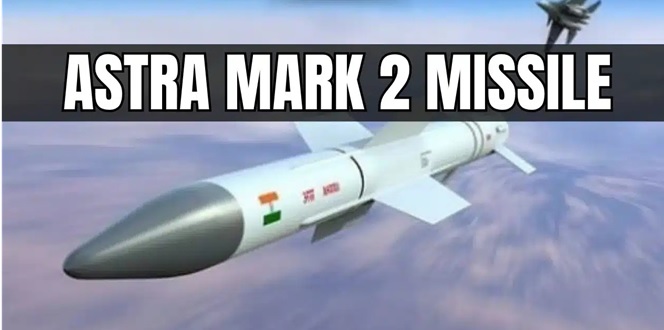
What is Astra Mk-2 Missile ?
The Astra Mk-2 is an indigenously developed Beyond Visual Range (BVR) air-to-air missile designed to engage enemy aircraft at long distances without requiring visual contact.
- It is the successor to Astra Mk-1, which has a range of around 100 km and is already integrated into fighter aircraft.
- The missile is designed to be deployed on multiple platforms such as Su-30 MKI, LCA Tejas, and future aircraft like the Advanced Medium Combat Aircraft.
Astra Mk-2 significantly enhances India’s ability to detect, track, and destroy enemy aircraft before they come within striking distance, thereby improving overall air superiority.
Key Features of Astra Mk-2 Missile
1. Extended Operational Range
- The missile has an operational range of approximately 150–200 km, with upgraded versions targeting even longer distances.
- This extended range allows fighter aircraft to engage enemy targets from a safe distance, reducing exposure to counterattacks.
This capability places India among a limited group of countries possessing advanced long-range BVR missile technology.
2. High Speed and Kinetic Advantage
- Astra Mk-2 can achieve speeds of around Mach 4.5, making it extremely fast and difficult to evade.
- High velocity reduces the reaction time available to enemy aircraft and increases the probability of successful interception.
The combination of speed and range ensures that the missile can effectively neutralise fast-moving and manoeuvrable targets.
3. Dual-Pulse Rocket Motor Technology
- The missile incorporates a dual-pulse solid rocket motor, which is a significant upgrade over earlier systems.
This technology enables :
- Sustained propulsion during different phases of flight
- Better energy retention in the terminal phase
- Enhanced manoeuvrability and accuracy
The dual-pulse system allows the missile to maintain effectiveness even during complex combat scenarios.
4. Advanced Guidance and Seeker System
- Astra Mk-2 is equipped with an indigenous Radio Frequency seeker and advanced radar-based guidance systems.
- It supports mid-course guidance updates through data links and incorporates electronic counter-countermeasure capabilities.
These features enable the missile to track and engage highly manoeuvrable targets even in environments with electronic interference or jamming.
5. Fire-and-Forget Capability
- The missile has fire-and-forget functionality, meaning it does not require continuous guidance after launch.
This allows pilots to :
- Focus on evasive manoeuvres
- Engage multiple targets simultaneously
- Operate more efficiently in high-threat environments
6. All-Weather and High Agility Performance
- Astra Mk-2 can operate effectively in all weather conditions, including day and night missions.
- It is designed for high agility, allowing engagement of targets at different angles and trajectories.
This ensures operational reliability across varied combat scenarios.
7. Reduced Detectability
- The missile uses smokeless propulsion, which reduces its visibility during launch and flight.
This enhances stealth and reduces the likelihood of early detection by enemy defence systems.
Technical Specifications (Summary)
- Type : Beyond Visual Range Air-to-Air Missile
- Range : 150–200+ km
- Speed : Approximately Mach 4.5
- Propulsion : Dual-pulse solid rocket motor
- Guidance : RF seeker with data link support
- Weight : Around 170–175 kg
Strategic Significance
1. Enhancing Air Superiority
Astra Mk-2 allows Indian fighter aircraft to engage enemy targets at long distances, creating a decisive advantage in aerial combat.
- It enables early engagement and destruction of threats
- Reduces vulnerability of Indian aircraft
This contributes to maintaining dominance in contested airspace.
2. Boost to Indigenous Defence Capability
- The missile is developed domestically, reducing reliance on imported systems.
- It strengthens India’s defence manufacturing ecosystem and technological self-sufficiency.
This aligns with national initiatives aimed at promoting indigenous defence production.
3. Strengthening Strategic Deterrence
- The missile’s capabilities are comparable to advanced systems deployed by other major powers.
- It enhances India’s ability to deter potential adversaries in the region.
This contributes to maintaining a stable strategic balance.
4. Multi-Platform Compatibility
- Astra Mk-2 is designed to be integrated with multiple aircraft platforms, including current and future fighter jets.
This ensures long-term operational flexibility and adaptability.
Challenges and Limitations
1. Dependence on Supporting Systems
- The effectiveness of the missile depends on advanced radar systems and airborne early warning systems.
- Without strong sensor support, its full potential may not be realised.
2. Development and Deployment Timeline
- The missile is still undergoing testing and refinement.
- Full-scale deployment across all platforms may take time.
3. Rapid Technological Evolution
- Missile technology is evolving rapidly worldwide.
- Continuous upgrades are necessary to remain competitive.
Way Forward
1. Accelerating Induction
- Speed up testing and production processes
- Ensure timely integration with frontline aircraft
2. Strengthening Supporting Infrastructure
- Enhance radar, sensor, and surveillance systems
- Improve network-centric warfare capabilities
3. Continued Research and Development
- Invest in next-generation missile technologies
- Focus on extended range and advanced propulsion systems
4. Expanding Platform Integration
- Integrate the missile with more aircraft platforms
- Ensure compatibility with future defence systems
Practice Questions
Prelims
Q. Astra Mk-2 missile is best described as :
(a) Surface-to-air missile
(b) Ballistic missile
(c) Beyond Visual Range air-to-air missile
(d) Cruise missile
Mains
“Indigenous missile systems such as Astra Mk-2 are crucial for achieving strategic autonomy and strengthening national security.” Discuss.
FAQs
Q1. What is Astra Mk-2 missile ?
It is an indigenously developed beyond visual range air-to-air missile.
Q2. What is its range ?
Around 150–200 km, with future upgrades expected to exceed this.
Q3. What is its speed ?
Approximately Mach 4.5.
Q4. Why is it important ?
It enhances India’s air combat capability and reduces dependence on imports.
Q5. What is its key technological feature ?
Dual-pulse propulsion combined with advanced radar guidance systems.
|






 Contact Us
  New Batch : 9555124124/ 7428085757
  Tech Support : 9555124124/ 7428085757