Prelims : Geography + Environment + CA
Mains : GS Paper 3 – Water Resources; Environmental Management; Infrastructure |
Why in News ?
The River Basin Management (RBM) Scheme has gained renewed attention as the Government of India has decided to continue and strengthen it for the period 2026–27 to 2030–31, with a sharper focus on scientific planning and sustainable water governance.
The scheme has become increasingly significant in the context of growing water stress, uneven spatial distribution of water resources, rising frequency of floods and droughts, and the impact of climate change, all of which demand a basin-level, integrated approach rather than fragmented water management practices.
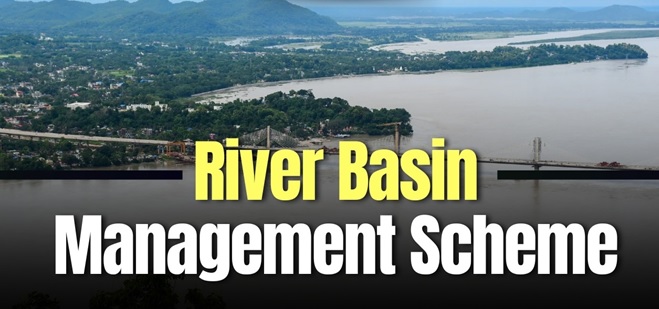
What is the River Basin Management Scheme ?
The River Basin Management Scheme is a Central Sector Scheme implemented under the Ministry of Jal Shakti, aimed at ensuring integrated and sustainable management of river basins across the country.
- It adopts a holistic basin-level approach, treating the entire river system, including tributaries, groundwater, and ecological components, as a single planning and management unit.
- The scheme focuses on scientific assessment, optimal utilisation, and long-term sustainability of water resources.
- It is implemented through key technical organisations such as :
- Central Water Commission
- National Water Development Agency
- Brahmaputra Board
Aim of the Scheme
The primary aim of the scheme is to ensure the sustainable development, efficient utilisation, and scientific management of water resources at the river basin level.
- It seeks to replace fragmented, project-specific approaches with a comprehensive and integrated water governance framework.
- The scheme emphasises balancing economic development, social needs, and ecological sustainability, ensuring that rivers continue to function as vital natural systems.
Objectives of the Scheme
1. Integrated Water Resource Management
The scheme promotes a coordinated approach where :
- Surface water and groundwater are managed in conjunction
- Competing demands across sectors such as agriculture, industry, and domestic use are balanced
- Ecological flows of rivers are maintained
This integrated framework is essential to address complex and interlinked water challenges.
2. Preparation of River Basin Master Plans
- Comprehensive master plans are developed for each river basin, incorporating detailed assessments of water availability, demand projections, environmental considerations, and infrastructure requirements.
- These plans are periodically updated to reflect changing climatic conditions and developmental needs.
3. Survey, Investigation, and Project Planning
The scheme supports :
- Preparation of feasibility studies and Detailed Project Reports (DPRs)
- Scientific evaluation of multipurpose projects such as dams, irrigation systems, and hydropower installations
This ensures that projects are technically viable, economically feasible, and environmentally sustainable.
4. Flood and Erosion Management
- Basin-level planning helps identify flood-prone zones and develop mitigation strategies such as embankments, river training works, and drainage improvements.
- It also addresses issues of riverbank erosion, especially in vulnerable regions.
5. Promotion of Sustainable Water Use
- Encourages efficient utilisation of water across sectors
- Promotes conservation practices and minimisation of wastage
This is crucial for ensuring long-term water security in a water-stressed country.
6. Capacity Building of States
- Provides technical and financial assistance to states, particularly those with limited resources or challenging geographical conditions
- Enhances institutional capacity for scientific water planning and management
7. Support for Interlinking of Rivers
- Facilitates planning and studies related to inter-basin water transfer
- Helps in addressing regional imbalances by diverting water from surplus to deficit regions
Key Features of the Scheme
1. Basin-Level Approach
- Treats each river basin as a single hydrological unit
- Ensures coordination among multiple states and stakeholders sharing the basin
2. Use of Advanced Technology
-
Utilises modern tools such as Geographic Information Systems (GIS), remote sensing, LiDAR, and satellite-based monitoring
-
Enhances accuracy in planning, monitoring, and decision-making
3. Focus on Major River Basins
The scheme prioritises critical river systems such as :
- Brahmaputra basin
- Barak basin
- Teesta basin
- Indus basin
These basins are vital for national water security and are often located in ecologically sensitive areas.
4. Multipurpose Development Approach
- Supports projects with multiple benefits, including irrigation, hydropower, drinking water supply, and flood control
- Ensures optimal utilisation of available water resources
Budget and Financial Allocation
- The scheme is planned for implementation during 2026–27 to 2030–31.
- It has an estimated financial outlay of approximately ₹2,183 crore.
The funds are allocated for :
- Basin master planning
- Project investigations and DPR preparation
- Technological interventions
- Capacity building initiatives
Significance of the Scheme
1. Addressing Water Scarcity
- Facilitates efficient allocation and management of water resources
- Helps mitigate water stress in vulnerable regions
2. Flood and Drought Management
- Improves forecasting and mitigation of floods
- Enhances resilience against drought conditions
3. Promoting Cooperative Federalism
- Encourages collaboration among states sharing river basins
- Helps reduce inter-state water disputes through scientific planning
4. Supporting Economic Growth
- Ensures water availability for agriculture, industry, and energy production
- Facilitates infrastructure development and economic activities
5. Environmental Sustainability
- Protects river ecosystems and biodiversity
- Promotes sustainable utilisation of natural resources
Challenges
1. Inter-State Coordination Issues
- Conflicts over water sharing among states
- Need for strong institutional mechanisms
2. Data and Technical Limitations
- Lack of real-time and reliable hydrological data
- Variations in technical capacity across states
3. Climate Change Uncertainty
- Changing rainfall patterns and extreme weather events
- Increased unpredictability in water availability
4. Implementation Constraints
- Difficult terrain in many river basins
- Delays in project execution and approvals
Way Forward
1. Strengthening Institutional Mechanisms
- Develop robust governance frameworks for basin-level management
- Enhance coordination between central and state agencies
2. Improving Data Systems
- Invest in real-time monitoring and data sharing
- Use advanced technologies for better decision-making
3. Participatory Water Governance
- Involve local communities and stakeholders in planning and implementation
4. Climate-Resilient Planning
- Integrate climate adaptation strategies into basin management plans
5. Efficient Implementation
- Streamline project approval processes
- Improve fund utilisation and execution capacity
Practice Questions
Prelims
Q. The River Basin Management Scheme primarily focuses on :
(a) River cleaning only
(b) Integrated management of water resources at basin level
(c) Construction of dams only
(d) Urban water supply
Mains
“Integrated river basin management is essential for sustainable water governance in India.” Discuss with reference to the River Basin Management Scheme.
FAQs
Q1. What is the River Basin Management Scheme ?
It is a central sector scheme for integrated management of river basins.
Q2. What is its main objective ?
Sustainable and efficient utilisation of water resources.
Q3. What is the budget of the scheme ?
Approximately ₹2,183 crore for 2026–2031.
Q4. Why is it important ?
It helps address water scarcity, floods, and inter-state disputes.
Q5. Which ministry implements it ?
The Ministry of Jal Shakti.
|






 Contact Us
  New Batch : 9555124124/ 7428085757
  Tech Support : 9555124124/ 7428085757