| Prelims: (Economics + CA) Mains: (GS 3 – Science & Technology, IT & Innovation; GS 2 – Governance, Global Groupings & Agreements; GS 3 – Economy, Skilling & Inclusive Growth) |
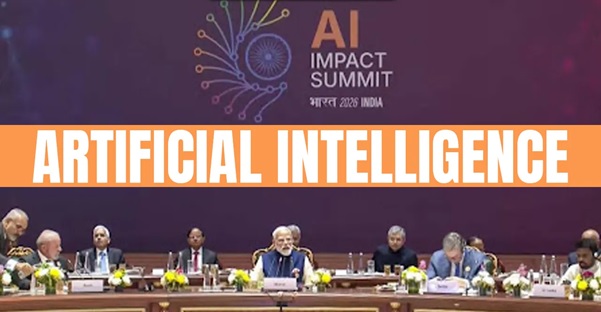
Prime Minister Narendra Modi articulated India’s Artificial Intelligence (AI) vision at the AI Impact Summit 2026 held in New Delhi. During the summit, India unveiled the “New Delhi Frontier AI Impact Commitments”, positioning AI as a global common good rather than a restricted strategic asset.
The summit witnessed participation from major global AI firms and policymakers, reflecting India’s effort to shape emerging global norms on AI governance, inclusion, and responsible innovation.
Global AI Acceleration
The rapid expansion of generative AI, large language models, and automation technologies has transformed AI into a central pillar of economic and strategic competition.
Strategic Competition
Several advanced economies treat AI as a strategic and proprietary technology, building closed innovation ecosystems to preserve technological advantage.
India’s Alternative Model
India has proposed a collaborative and open approach, advocating AI development as a shared global resource that promotes innovation, inclusion, and equitable growth.
Digital Public Infrastructure Foundation
India’s experience with scalable digital systems such as BHASHINI has provided a foundation for inclusive AI deployment, especially in linguistically diverse settings.
Global Governance Leadership: India seeks to position itself as a voice for the Global South in shaping inclusive AI norms.
Balancing Innovation and Regulation: The vision attempts to reconcile technological advancement with ethical oversight.
Economic Transformation: AI is projected to significantly impact productivity, employment patterns, and industrial competitiveness.
Technological Sovereignty: Open collaboration must coexist with protection of data ownership and national interests.
Digital Inclusion: Multilingual AI can expand access to digital services beyond English-dominated systems.
1. India’s Approach to Artificial Intelligence
AI as Opportunity, Not Threat
The Prime Minister stated that India does not view AI with fear but sees “fortune and the future” in it.
AI as a Global Common Good
India proposed that AI systems should benefit humanity when shared openly rather than confined within corporate or national silos.
Open-Source and Collaborative Innovation
Encouraging open ecosystems can enable wider scrutiny, improved safety standards, and faster innovation.
2. The MANAV Framework
Central to India’s AI governance philosophy is the “MANAV” framework:
M – Moral and Ethical Systems: AI development must adhere to ethical principles.
A – Accountable Governance: Transparent oversight and regulatory clarity are essential.
N – National Sovereignty: Data ownership must remain with those who generate it.
A – Accessible and Inclusive: AI should empower society rather than concentrate power.
V – Valid and Legitimate: Applications must comply with laws and verifiable standards.
The framework reflects a human-centric approach to AI governance.
3. New Delhi Frontier AI Impact Commitments
The summit saw voluntary commitments from major global firms including Google, OpenAI, Meta, Microsoft, and Anthropic.
Focus Areas
These commitments aim to promote transparency and evidence-based policymaking.
4. Multilingual AI and Digital Public Infrastructure
Language Inclusion
The Prime Minister’s address was livestreamed in seven Indian languages using AI-powered translation.
Role of BHASHINI
India’s language AI ecosystem, anchored in digital public infrastructure, seeks to bridge linguistic divides and democratise access to AI tools.
Strategic Importance
Multilingual AI enhances governance delivery, education access, and digital inclusion across diverse populations.
5. AI Governance: Deepfakes and Authenticity Standards
Emerging Risks
Deepfakes and synthetic content pose risks to democratic institutions and public trust.
Authenticity Labelling Proposal
Drawing an analogy with food nutrition labels, the Prime Minister proposed digital authenticity markers for AI-generated content.
Watermarking and Source Verification
Establishing standards for traceability and transparency aligns with global debates on responsible AI regulation.
6. Economic Transformation and Skilling
AI as Growth Catalyst
AI can create higher-value roles in design, analytics, and innovation.
Workforce Transition
The government emphasised skilling, reskilling, and upskilling initiatives to manage labour market shifts.
Ecosystem Development
India is investing in semiconductor manufacturing, secure data centres, quantum research, and digital infrastructure to build a resilient AI ecosystem.
Scalability Advantage
An AI model that succeeds in India’s diverse and large-scale environment can potentially scale globally.
7. Strategic Context and Global Debate
The summit occurred amid intensifying global competition over AI dominance.
While some countries favour closed technological stacks, India advocates openness combined with sovereignty safeguards.
India’s AI vision seeks to balance:
Norm-Setting Opportunity: India can influence emerging global AI governance frameworks.
Inclusive Growth Model: AI deployment can accelerate service delivery and digital inclusion.
Geopolitical Positioning: India strengthens its role as a bridge between advanced economies and the Global South.
Regulatory Complexity: Balancing openness with sovereignty requires careful institutional design.
Skill Transformation Imperative: Labour markets must adapt to automation-driven shifts.
Institutionalise the MANAV Framework: Translate principles into binding regulatory guidelines.
Develop Robust Authenticity Standards: Adopt watermarking and traceability mechanisms for AI-generated content.
Scale Multilingual AI Ecosystems: Strengthen digital public infrastructure to reach underserved communities.
Invest in Human Capital: Expand skilling initiatives aligned with AI-driven economic transitions.
Promote Global AI Cooperation: Leverage multilateral platforms to shape equitable AI governance norms.
FAQs1. What is India’s core vision for Artificial Intelligence? India envisions AI as a global common good that promotes inclusion, innovation, and shared prosperity. 2. What is the MANAV framework? It is India’s AI governance model emphasising ethical, accountable, sovereign, inclusive, and legitimate AI development. 3. What are the New Delhi Frontier AI Impact Commitments? They are voluntary pledges by major AI companies to enhance transparency, multilingual capacity, and social impact evaluation. 4. Why is multilingual AI important for India? India’s linguistic diversity requires AI tools that function effectively across languages to ensure inclusive digital access. 5. How does AI impact employment in India? AI can create higher-value opportunities but requires large-scale skilling and reskilling to manage workforce transitions. |
| Prelims: (Economy + CA) Mains: (GS 3 – Infrastructure: Energy; Environment & Disaster Management; GS 1 – Geography: River Systems) |
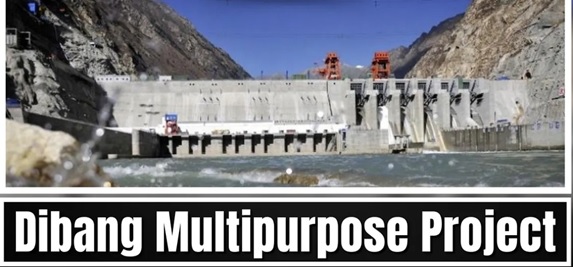
The under-construction 2,880 MW Dibang Multipurpose Project in Arunachal Pradesh recently achieved a major milestone with the successful daylighting of Diversion Tunnel-3 (DT-3), marking significant progress in river diversion works essential for dam construction.
The project, once completed, will become India’s largest hydropower facility and the highest concrete gravity dam in the country.
Strategic River Basin : The project is being developed on the Dibang River, a tributary of the Brahmaputra River system, in Arunachal Pradesh.
The Brahmaputra River is one of India’s major river systems, prone to seasonal flooding, especially in Assam and downstream regions.
Project Origin : Conceived as a multipurpose infrastructure initiative, the Dibang project integrates flood control, hydroelectric power generation, and water storage functions.
Developer : The project is being implemented by National Hydroelectric Power Corporation (NHPC), a state-run enterprise specialising in hydropower development.
Regional Significance : Arunachal Pradesh possesses immense hydropower potential due to its mountainous terrain and river gradients, making it central to India’s renewable energy expansion.
Energy Security: At 2,880 MW installed capacity, it will be India’s largest hydropower plant, strengthening renewable energy generation.
Flood Moderation: The project aims to regulate water flow and mitigate downstream flooding in the Brahmaputra basin.
Strategic Infrastructure in the Northeast: Large infrastructure projects enhance connectivity and economic integration of the region.
Energy Storage Capability: Designed as an energy storage project, it supports grid stability amid rising renewable energy penetration.
Climate Transition: Hydropower contributes to India’s non-fossil fuel energy targets and decarbonisation goals.
1. Project Overview
Installed Capacity
The Dibang Multipurpose Project will generate 2,880 MW of electricity, making it India’s largest hydropower facility upon completion.
Multipurpose Objectives
2. Engineering Features
Concrete Gravity Dam : The project involves constructing India’s highest concrete gravity dam.
A gravity dam resists water pressure through its own weight, ensuring structural stability.
Roller Compacted Concrete (RCC) Technique : The dam will be built using Roller Compacted Concrete technology, enabling faster construction and enhanced structural durability.
It is expected to become the highest RCC dam in the world.
3. Diversion Tunnels and Construction Milestones
Purpose of Diversion Tunnels : Before constructing the main dam, the river flow must be diverted through tunnels.
The successful daylighting of Diversion Tunnel-3 (DT-3) marks a critical step in enabling further structural work.
Engineering Importance : River diversion ensures safe construction of the dam foundation and spillway systems.
4. Flood Control and Disaster Mitigation
Brahmaputra Basin Flooding : The Brahmaputra basin is highly flood-prone, especially during monsoon seasons.
Moderation Function : The reservoir will help regulate peak discharge, potentially reducing flood intensity downstream.
Climate Resilience : Increased rainfall variability due to climate change enhances the importance of regulated water storage.
5. Energy Storage and Grid Stability
Balancing Renewable Energy : Hydropower provides peaking power and grid balancing support for intermittent solar and wind generation.
Energy Storage Role : The project is designed to function as an energy storage asset, releasing power during peak demand.
6. Environmental and Social Considerations
Ecological Sensitivity : The Northeast region is ecologically fragile, with rich biodiversity.
Resettlement and Rehabilitation : Large dams require land acquisition and rehabilitation planning, necessitating careful implementation.
Balancing Development and Conservation : The project highlights the broader debate between renewable energy expansion and ecological preservation.
Renewable Energy Expansion: Strengthens India’s clean energy portfolio.
Regional Economic Development: Boosts employment and infrastructure growth in Arunachal Pradesh.
Strategic Water Management: Improves basin-level flood control mechanisms.
Inter-State and Transboundary Sensitivity: Projects in the Brahmaputra basin hold geopolitical relevance due to upstream-downstream dynamics.
Long-Term Infrastructure Asset: Positions India as a leader in large-scale hydropower engineering.
Ensure Environmental Safeguards: Strict compliance with ecological impact mitigation measures.
Strengthen Rehabilitation Policies: Provide fair compensation and livelihood support to affected communities.
Enhance Basin-Level Planning: Integrate flood management with broader Brahmaputra basin strategies.
Adopt Advanced Monitoring Systems: Deploy real-time hydrological monitoring for disaster preparedness.
Promote Sustainable Hydropower Practices: Balance renewable energy expansion with biodiversity conservation.
FAQs1. Where is the Dibang Multipurpose Project located? It is being developed on the Dibang River, a tributary of the Brahmaputra, in Arunachal Pradesh. 2. What is the installed capacity of the project? The project will generate 2,880 MW, making it India’s largest hydropower facility. 3. What is unique about the dam design? It will be India’s highest concrete gravity dam and the highest Roller Compacted Concrete (RCC) dam globally. 4. What are the main objectives of the project? Hydropower generation, flood moderation, energy storage, and water resource management. 5. Why is the project strategically important? It enhances renewable energy capacity, supports grid stability, mitigates flooding, and strengthens infrastructure in the Northeast region. |
| Prelims: (Polity & Governance + CA) Mains: (GS 2 – Welfare Schemes, Women Empowerment; GS 3 – Inclusive Growth, Rural Economy, Poverty Alleviation) |
The Union Minister for Rural Development and Agriculture & Farmers’ Welfare recently directed officials to adopt a focused and time-bound strategy to achieve the revised target of creating 6 crore ‘Lakhpati Didis’ by March 2029.
The directive signals an intensified push to accelerate women-led income generation under rural livelihood missions.

Origin of the Initiative : The Lakhpati Didi Initiative operates under the Deendayal Antyodaya Yojana – National Rural Livelihoods Mission (DAY-NRLM), implemented by the Ministry of Rural Development.
Concept of Lakhpati Didi : A ‘Lakhpati Didi’ refers to a woman member of a Self-Help Group (SHG) earning an annual household income of ₹1,00,000 or more, sustained over at least four agricultural seasons or business cycles.
The benchmark implies an average monthly income exceeding ₹10,000, ensuring income stability rather than short-term gains.
Focus on Individual Empowerment : Unlike traditional SHG-based metrics, the initiative focuses on enabling individual women members to cross the income threshold.
Revised Target : The target has been revised to create 6 crore Lakhpati Didis by March 2029, reflecting the scale of ambition in rural transformation.
Significance of the Issue : Women’s Economic Empowerment: Enhances financial independence and decision-making power among rural women.
Inclusive Growth: Directly addresses rural poverty through sustainable livelihood diversification.
Grassroots Entrepreneurship: Encourages micro-enterprise development within villages.
Convergence-Based Governance: Integrates efforts across government departments, private sector, and market players.
Social Transformation: Economic empowerment of women has multiplier effects on health, education, and community development.
1. Core Objectives of the Initiative
Promote Sustainable Income : Ensure that SHG households achieve consistent annual income above ₹1 lakh.
Encourage Micro-Entrepreneurship : Facilitate women to establish enterprises in agriculture, livestock, food processing, handicrafts, and services.
Diversify Livelihood Activities : Each SHG household is encouraged to adopt multiple income-generating activities.
2. Strategic Framework of Lakhpati Didi
(i) Deepen, Strengthen and Expand Livelihood Options : Support diversified income streams, including farm and non-farm activities, along with value chain integration.
(ii) Capacity Building Through Cascade Training : Adopt a cascading model to train and mentor potential Lakhpati Didis across States and Union Territories.
(iii) Financial Assistance and Credit Linkages : DAY-NRLM facilitates access to institutional credit, revolving funds, and community investment funds.
3. Convergence Model
The initiative emphasises coordination across:
This convergence approach enhances access to technology, markets, and financial services.
4. Role of Self-Help Groups (SHGs)
SHGs as Institutional Platforms : SHGs provide collective bargaining power and peer support mechanisms.
Transition to Individual Prosperity : While SHGs remain the foundation, the focus shifts towards ensuring that individual women cross the income benchmark.
5. Economic and Social Impact Pathways
Poverty Reduction : Sustained income growth improves household consumption and asset formation.
Financial Inclusion : Strengthens linkages with formal banking and credit systems.
Rural Demand Expansion : Increased incomes stimulate local markets and economic activity.
Gender Equality : Economic independence enhances women’s participation in governance and decision-making.
Rural Economic Resilience: Diversified livelihoods reduce vulnerability to agricultural shocks.
Human Development Gains: Higher incomes correlate with improved nutrition, education, and health outcomes.
Entrepreneurial Ecosystem Development: Encourages value chain integration and local enterprise growth.
Achievement of SDGs: Aligns with Sustainable Development Goals on poverty eradication and gender equality.
Large-Scale Implementation Challenge: The ambitious 6 crore target requires administrative efficiency and financial mobilisation.
Strengthen Market Linkages: Ensure sustainable demand for products and services generated by Lakhpati Didis.
Enhance Skill Development: Integrate advanced skilling programmes aligned with local economic opportunities.
Improve Access to Affordable Credit: Expand credit guarantee mechanisms and interest subvention schemes.
Robust Monitoring and Evaluation: Adopt real-time tracking of income benchmarks to ensure genuine sustainability.
Promote Value Chain Integration: Move beyond primary production towards processing, branding, and market expansion.
FAQs1. Who is considered a Lakhpati Didi? A Self-Help Group member earning at least ₹1 lakh annual household income sustained over multiple agricultural seasons or business cycles. 2. Which ministry implements the initiative? The Ministry of Rural Development through DAY-NRLM. 3. What is the revised target of the scheme? To create 6 crore Lakhpati Didis by March 2029. 4. How does the initiative promote sustainable income? By encouraging diversified livelihood activities, providing training, and facilitating financial support. 5. Why is the initiative significant for inclusive growth? It empowers rural women economically, reduces poverty, and strengthens grassroots entrepreneurship. |
| Prelims: (Economy + CA) Mains: (GS 3 – Indian Economy, External Sector, Capital Flows; GS 3 – Fiscal Policy & Macroeconomic Stability; GS 2 – Government Schemes & Interventions) |
Indian households are increasingly diversifying their savings into equities and mutual funds, with their share in financial assets rising from 7% in 2022–23 to 15% in 2024–25. Despite this shift, the traditional preference for gold remains robust.
Gold imports surged to $12.07 billion in January, nearly tripling compared to December. A major contributor to this spike has been record inflows into gold exchange-traded funds (ETFs), signalling deeper financialisation of savings while simultaneously heightening pressure on India’s trade deficit and current account balance.

India’s Historical Affinity for Gold
India has consistently been among the world’s largest consumers of gold. Beyond investment, gold carries deep cultural and social significance, especially during weddings and festivals.
Post-2008 Gold Surge : Following the global financial crisis, high inflation, currency depreciation, and economic uncertainty drove households toward gold as a safe-haven asset. This resulted in sharp increases in imports, widening the current account deficit.
Policy Response : To curb rising imports, the government raised customs duties and introduced alternative instruments such as Sovereign Gold Bonds (SGBs) to channel savings away from physical gold.
Structural Import Dependence : India imports the bulk of its gold requirements, making domestic demand directly linked to foreign exchange outflows and trade imbalances.
External Sector Stability: Gold imports contribute significantly to the current account deficit (CAD), increasing vulnerability to global capital flow volatility.
Capital Allocation Efficiency: High household investment in gold diverts resources from productive sectors like infrastructure, manufacturing, and entrepreneurship.
Fiscal Sustainability: Schemes designed to reduce physical imports, such as SGBs, create contingent fiscal liabilities.
Currency and Exchange Rate Pressures: Persistent gold imports increase demand for dollars, potentially exerting depreciation pressure on the rupee.
Behavioural Economics Dimension: Gold remains a preferred hedge against uncertainty despite expanding financial markets.
1. Gold ETFs: From Niche Product to Investment Wave
What Are Gold ETFs?
Gold ETFs operate like mutual funds that invest in physical gold. Investors gain exposure without concerns over storage, purity, or security.
Record Inflows
According to the World Gold Council, Indian gold ETFs purchased a record 15.52 tonnes of gold in January — nearly matching the previous three months combined.
Data from the Association of Mutual Funds in India (AMFI) show net gold ETF inflows rose to ₹24,040 crore, exceeding equity mutual fund inflows for the first time.
Share in Imports : Gold ETF inflows accounted for 22% of total gold imports (₹1.1 lakh crore) in January. For silver, ETF-linked purchases formed 52% of total imports.
Structural Implication : While ETFs formalise savings, they still necessitate physical gold procurement, sustaining import pressures.
2. Sovereign Gold Bonds: A Policy Experiment
Scheme Design : Launched in 2015, Sovereign Gold Bonds offered returns linked to gold prices plus 2.5% annual interest.
Import Substitution : Investments equivalent to 147 tonnes of gold (₹72,274 crore) helped reduce the need for physical imports.
Rising Fiscal Burden : With increasing gold prices, annual payout liabilities reportedly approached ₹18,000 crore.
Discontinuation : Fresh issuances were discontinued in early 2024 due to mounting fiscal pressures.
3. Renewed Concerns Over Gold Investments
Safe-Haven Demand : Geopolitical tensions, global policy uncertainty, and uneven equity market performance have renewed gold’s appeal.
Trade Deficit Impact : The January import surge pushed India’s goods trade deficit close to $35 billion, underscoring macroeconomic risks.
Speculative Component : Analysts suggest a portion of ETF inflows may represent speculative positioning rather than purely defensive savings.
Macroeconomic Opportunity Cost : Excessive gold allocation limits domestic capital formation and long-term growth potential.
4. Lessons from the Past
2008–2013 Experience : Rising gold imports during this period worsened the current account deficit, prompting corrective measures.
Regulatory Intervention : The government and the Reserve Bank of India introduced import curbs and macroprudential steps to stabilise the external sector.
Policy Dilemma Today : Balancing household savings preferences with macroeconomic stability remains a key governance challenge.
Widening Current Account Deficit: Higher imports increase reliance on external financing.
Exchange Rate Vulnerability: Sustained dollar outflows can weaken currency stability.
Fiscal Trade-offs: Reviving bond-based alternatives reduces imports but raises fiscal liabilities.
Investment Pattern Shift: Gold ETF inflows surpassing equity inflows signal rising risk aversion among investors.
Long-Term Growth Concerns: Savings locked in non-productive assets constrain capital formation.
Redesign Gold Investment Instruments: Develop fiscally sustainable alternatives to SGBs with calibrated returns.
Promote Gold Monetisation Schemes: Mobilise idle domestic gold holdings to reduce import dependence.
Strengthen Financial Literacy: Encourage diversified portfolios aligned with long-term wealth creation.
Calibrated Import Duty Policy: Balance revenue needs with smuggling risks.
Enhance External Sector Monitoring: Closely track precious metal-driven trade imbalances to maintain macroeconomic stability.
FAQs1. Why are rising gold imports a concern for India? They widen the trade and current account deficit, increasing pressure on foreign exchange reserves and currency stability. 2. What role do Gold ETFs play in imports? Although financial instruments, ETFs require physical gold backing, thereby contributing to import demand. 3. How did Sovereign Gold Bonds help the economy? They provided a paper alternative to physical gold, reducing import demand while offering returns linked to gold prices. 4. Why were Sovereign Gold Bonds discontinued? Rising gold prices increased government payout obligations, creating fiscal strain. 5. Can financialization of gold fully solve import pressures? No. Unless linked to domestic gold recycling or alternative instruments, financial gold investments still rely on imported bullion. |
| Prelims: (Economics + CA) Mains: (GS 3 – Science & Technology, IT & AI; GS 3 – Energy & Infrastructure; GS 2 – Digital Economy & Governance) |
In 1999, Nvidia introduced the GeForce 256, branding it as the world’s first Graphics Processing Unit (GPU). Over the past 25 years, GPUs have evolved from gaming-focused chips into foundational infrastructure for artificial intelligence (AI), machine learning, data centres, and large-scale computing.
With rapid advances in generative AI, high-performance computing (HPC), and semiconductor geopolitics, GPUs have emerged as critical strategic assets in the digital economy.

Technological Sovereignty: Control over advanced GPUs determines leadership in AI research, defence simulations, and quantum-era computing.
Digital Economy Backbone: Cloud services, AI startups, fintech platforms, and e-governance systems rely heavily on GPU-accelerated computation.
Energy and Infrastructure Implications: AI training clusters consume significant electricity, raising sustainability and energy-security concerns.
Geopolitical Relevance: Advanced GPU exports are increasingly subject to strategic restrictions, reflecting their dual-use nature in civilian and defence domains.
1. Background: Evolution of GPUs
Early Development : Initially designed to accelerate video game graphics, GPUs handled rendering tasks that were too repetitive and data-intensive for traditional CPUs.
Transition Beyond Gaming : With the rise of AI and deep learning in the 2010s, GPUs became indispensable for neural network training due to their parallel computing capabilities.
Strategic Inflection Point : The AI boom has transformed GPUs into high-value semiconductor assets central to innovation ecosystems and national technology strategies.
2. GPU: Understanding the Basics
A Graphics Processing Unit (GPU) is a specialised processor built to perform thousands of simple calculations simultaneously.
GPU vs CPU: Core Difference
Why GPUs Are Ideal for Graphics
Rendering a 1920×1080 resolution screen involves over 2 million pixels per frame.
At 60 frames per second, this requires more than 120 million pixel updates per second.
Each pixel’s colour depends on:
Since identical mathematical operations repeat across millions of pixels, GPUs outperform CPUs in such workloads.
3. How a GPU Works: The Rendering Pipeline
When a game or software application sends 3D objects to the GPU, it processes them through a structured pipeline:
(i) Vertex Processing : Transforms object coordinates using matrix mathematics to determine screen placement.
(ii) Rasterisation : Converts geometric shapes (triangles) into pixel fragments.
(iii) Fragment (Pixel) Shading : Calculates final pixel colours using small programs called shaders, applying:
(iv) Frame Buffer Output : Stores computed pixels in memory (frame buffer) for display rendering.
4. Parallel Processing and Memory Architecture
Massive Core Architecture : GPUs contain hundreds or thousands of smaller cores designed for simultaneous execution.
High-Bandwidth Memory (VRAM) : Dedicated video memory (VRAM) enables rapid data access for textures, models, and computation.
AI and Scientific Applications : Because AI models involve matrix multiplications across large datasets, GPUs are ideal for:
5. Location and Physical Architecture of GPUs
As a Silicon Chip : A GPU is fabricated on a silicon die similar to a CPU.
Dedicated Graphics Card : In desktops, it sits beneath a heat sink and cooling system, surrounded by VRAM chips.
Integrated GPUs : In laptops and smartphones, GPUs are integrated within System-on-Chip (SoC) designs, combining CPU, GPU, and memory controllers into one compact unit.
6. GPUs vs CPUs: Microarchitectural Distinction
|
Feature |
CPU |
GPU |
|
Task Type |
Complex, sequential |
Repetitive, parallel |
|
Core Design |
Few powerful cores |
Thousands of simpler cores |
|
Cache Size |
Large |
Smaller but high-throughput |
|
Use Case |
Operating systems, logic |
Graphics, AI, simulations |
The distinction lies not in transistor size (both use advanced fabrication nodes such as 3–5 nm), but in internal architecture and workload design.
7. Energy Consumption and Sustainability Concerns
AI Training Phase : Example: Four Nvidia A100 GPUs (250W each) running 12 hours consume approximately 12 kWh.
AI Inference Phase : Inference (model deployment) requires lower energy — roughly 2 kWh for similar duration.
Total Data Centre Consumption
Including:
Total daily power use may reach 6 kWh with 30–60% overhead.
Real-World Comparison
Comparable to:
This highlights growing concerns about AI’s environmental footprint.
8. Broader Implications
FAQs1. What is a GPU and how is it different from a CPU? A GPU is a processor optimised for parallel computing, handling thousands of repetitive calculations simultaneously, whereas a CPU focuses on complex, sequential tasks. 2. Why are GPUs essential for AI? AI models rely heavily on matrix multiplications and parallel computations, making GPUs far more efficient than CPUs for training and inference. 3. How much electricity do AI GPUs consume? Four high-end GPUs running for 12 hours can consume around 12 kWh, with total system consumption rising due to cooling and server overhead. 4. Are GPUs only used for gaming? No. While originally developed for graphics, GPUs now power AI research, scientific simulations, financial modelling, and cloud computing. 5. Why are GPUs considered strategically important? Advanced GPUs underpin AI leadership, defence simulations, and digital infrastructure, making them critical assets in global technology competition. |

Our support team will be happy to assist you!


 Contact Us
  New Batch : 9555124124/ 7428085757
  Tech Support : 9555124124/ 7428085757