New
Hindi Medium: (Delhi) - GS Foundation (P+M) : 6th July 2026, 6:00 PM Hindi Medium: (Prayagraj) - GS Foundation (P+M) : 5th July 2026, 8:00 AM English Medium: (Delhi) - GS Foundation (P+M) : 20th July 2026 English Medium: (Prayagraj) - GS Foundation (P+M) : 15th July 2026, 8:00 AM Hindi Medium: (Delhi) - GS Foundation (P+M) : 6th July 2026, 6:00 PM Hindi Medium: (Prayagraj) - GS Foundation (P+M) : 5th July 2026, 8:00 AM English Medium: (Delhi) - GS Foundation (P+M) : 20th July 2026 English Medium: (Prayagraj) - GS Foundation (P+M) : 15th July 2026, 8:00 AM

Current Affairs for 23 June 2026

New wasp species discovered in Kerala: Could become a useful weapon in agricultural pest management

Why in the News ?

Indian scientists have achieved a significant milestone in the field of biodiversity by discovering a new species of wasp. This new species, named Spilomena malabarica, was found in the Kozhikode district of Kerala. This discovery not only highlights India's rich biodiversity but also strengthens the potential for biological pest control in agriculture.
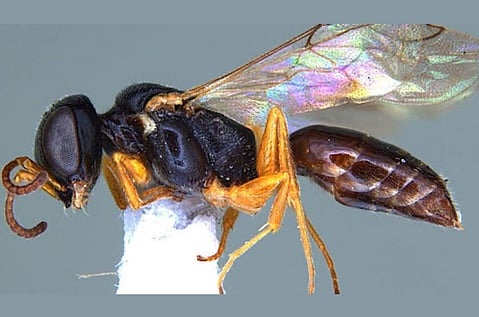
Significant achievement by Indian scientists

  • This new species has been identified by scientists from the Zoological Survey of India (ZSI).
  • During their research, scientists obtained a specimen of this rare insect in a special yellow pan trap.
  • Later, its structure was studied in detail using modern microscopes and 3-D imaging technology.

Extremely Small but Special Wasp

  • Spilomena malabarica is extremely small in size. Its length is approximately 3.5 millimeters and its body is black and brown.
  • It is difficult to identify it with the naked eye, so scientists conducted a thorough study of its microscopic anatomy.
  • Scientists found that its forewings have only one submarginal cell, which distinguishes it from other related species. This unique wing structure is a key basis for its identification.

Why is it important for agriculture ?

  • This wasp preys on small plant-damaging insects such as aphids.
  • Aphids are known to cause significant damage to agricultural crops, horticultural plants, and other vegetation.
  • In such a situation, this new species can help in naturally controlling the number of these pests.
  • Experts believe that in the future, it can be used in the field of biological pest control, which can reduce dependence on chemical pesticides.

How is it different from other species ?

  • Researchers have found that this species shares some similarities with its closest relative, Spilomena unus, but significant differences have been found in its head and facial structure.
  • Its head is relatively shorter.
  • The ratio between the eyes and the crown is different.
  • The clypeus is relatively flatter.
  • These features distinguish it from other known species.

Named in honor of the Malabar region

  • The new species is named 'malabarica' in honor of the historic Malabar region of Kerala, where the specimen was discovered. According to scientists, naming new species is an important way to honor local geographical and natural heritage.

New Scientific Questions Raised in Taxonomy

  • This discovery has also presented a new challenge for scientists.
  • Spilomena malabarica has been found to possess characteristics that blur the boundaries between two distinct groups of wasps.
  • This suggests that the current classification system may require revision in the future.
  • Researchers believe that DNA analysis and detailed life cycle studies will better understand the evolution and classification of this species.

Important Step Toward Biodiversity Conservation

According to experts, this discovery is proof that many species still exist in India's forests and natural ecosystems that remain to be identified. This discovery of a tiny insect not only enriches the country's biodiversity but also advances scientific understanding related to ecological balance, biological evolution and conservation of natural resources.

Indian Navy's strength increased with three new warships

Why in the news ?

  • India further strengthened its maritime security capabilities by commissioning three state-of-the-art indigenous warships-INS Dunagiri, INS Sanshodhan, and INS Agray-into the Indian Navy in June 2026. Prime Minister Narendra Modi dedicated these three ships to the Navy at a ceremony held in Kolkata.
  • These ships were built by Garden Reach Shipbuilders and Engineers (GRSE), Kolkata. According to the Ministry of Defence, more than 75 percent indigenous material has been used in all three ships and more than 200 MSMEs have been involved in their construction.

Why is this 'triple commissioning' special ?

  • The most important feature of these three ships is that they provide the Indian Navy with three distinct strategic capabilities:
  • Deep-sea warfare operations
  • Maritime reconnaissance and surveillance
  • Anti-submarine defense in coastal areas
  • This is why it is considered a significant milestone in the Indian Navy's capability-building journey.

About the 3 Indigenous Warships

INS Dunagiri: A Powerful Deep-Sea Warrior

  • INS Dunagiri is the largest and most heavily armed of the three ships. It is a state-of-the-art stealth guided-missile frigate built under Project 17A.

Key Features

  • Equipped with the BrahMos supersonic cruise missile
  • Medium-Range Air Defense System (MRSAM)
  • MFSTAR multi-function radar
  • Advanced sonar and electronic warfare systems
  • Equipped with anti-submarine weapons
  • This warship is capable of conducting long-range operations in deep water (blue water) and facing a variety of threats.

INS Modifier: Scientific Cartographer of the Ocean

  • INS Modhik is a Survey Vessel Large (SVL), whose main function is to study the sea depth, seabed, shipping routes and ocean conditions.

Key Features

  • Autonomous Underwater Vehicle (AUV)
  • Remotely Operated Vehicle (ROV)
  • Multi-beam echo sounder
  • Modern Hydrographic Survey System
  • Apart from naval operations, this ship will also play an important role in safe navigation, marine research, coastal development and disaster management.

INS Agraya: A Submarine Hunter for Littoral Areas

  • INS Agraya is an Anti-Submarine Warfare Shallow Water Craft (ASW-SWC). It has been specifically developed to detect and destroy enemy submarines around coastal areas, ports, and naval bases.

Key Features

  • State-of-the-art sonar system
  • Lightweight torpedoe
  • Indigenous anti-submarine rocket launchers
  • Effective operation capability in shallow waters
  • Detecting submarines in coastal waters is extremely challenging, as maritime traffic, fishing boats, and oceanographic features complicate surveillance. INS Agraya has been designed to address this challenge.

What benefits will the Indian Navy gain ?

The induction of the three ships will strengthen the Indian Navy's capabilities on three fronts:

1. Blue-Water Operations

  • INS Dunagiri will strengthen India's military presence and project power in the high seas.

2. Maritime Domain Awareness

  • INS Sandhodha will provide accurate information on maritime geography and navigation.

3. Coastal Security

  • INS Agraya will protect India's coastal areas from submarine threats.

The Indian Navy's Growing Maritime Power

  • The Indian Navy currently has approximately 140-145 active warships.
  • The Navy aims to increase the number of warships to 150-160 by 2030, further strengthening India's strategic presence in the Indian Ocean region.

Deployment and Strategic Importance

  • Warships of the Eastern Naval Command (Visakhapatnam) patrol the Bay of Bengal, the Andaman Sea, and the Malacca Strait, strengthening India's strategic presence in the Indo-Pacific.
  • Ships of the Western Naval Command (Mumbai and Karwar) are responsible for maritime security in the Arabian Sea, monitoring Pakistani activities, and protecting merchant ships from piracy.
  • The Andaman and Nicobar Command is India's only tri-service command, and its location near the Malacca Strait makes it a vital strategic force.

Why are warships important ?

  • Nearly 90% of global trade is conducted through sea routes.
  • Warships ensure the security of maritime trade routes, energy supplies, and national interests.
  • Modern warships are equipped with missiles, radar, helicopters, drones, and advanced communication systems.
  • They are considered "floating military bases" at sea, capable of performing a variety of tasks, including combat, surveillance, humanitarian assistance, and disaster relief.

India's Nuclear Deterrence at Sea Enhances

  • India's naval nuclear power is steadily strengthening. In particular, nuclear-powered ballistic missile submarines like INS Arihant have become a key pillar of the country's "second strike capability."
  • Second strike capability means that even if an enemy country launches a nuclear attack first, India will still be able to launch an effective retaliatory nuclear strike.
  • The maritime component of India's nuclear triad is steadily strengthening.
  • Nuclear submarines can remain stealthily deployed at sea for long periods, making them difficult to detect.
  • According to the Stockholm International Peace Research Institute (SIPRI), India is now deploying a limited number of nuclear weapons on ballistic missile submarines even during peacetime.
  • This strengthens India's Credible Minimum Deterrence and nuclear security.
  • Sea-based nuclear weapons provide effective support to India's 'No First Use' policy.

A Major Success for Self-Reliant India

  • The indigenous construction of these three ships demonstrates the growing capabilities of India's defense production sector. The indigenous construction of ships equipped with diverse technologies for a variety of missions proves that India is rapidly moving towards self-reliance in developing advanced naval platforms.

Conclusion

  • Amidst the increasing naval activities of China and Pakistan in the Indian Ocean region, the induction of INS Dunagiri, INS Sanshodhan, and INS Agray into the Navy is crucial for India's maritime security. Together, these three ships will provide the Indian Navy with a robust and multi-layered security shield from the high seas to the coastal areas.

Kalamkari Painting: Process, Styles and Significance

  • Prime Minister Narendra Modi presented an exquisite hand-crafted Mahabharata-themed Kalamkari painting to Emmanuel Macron. 
  • This traditional artwork from Andhra Pradesh beautifully showcases India's rich cultural and artistic heritage. 

What is Kalamkari Painting ?

  • Kalamkari is a renowned tradition of hand-painted and block-printed cotton textile art originating from Andhra Pradesh. 
  • It flourished during the 16th–17th centuries under the rule of the Qutb Shahi Dynasty. 
  • The term Kalamkari is derived from two Persian words: 
    • Kalam = Pen 
    • Kari = Craftsmanship or Artistry 

Process of Making Kalamkari Paintings

  • The fabric is first soaked in a mixture of astringents and buffalo milk and then dried in sunlight. 
  • Outlines in red, black, brown, and violet are drawn using a mordant
  • The cloth is then dipped in an Alizarin solution. 
  • Areas that are not to be colored are covered with wax, after which the fabric is immersed in indigo dye
  • Once the wax is removed, the remaining sections are painted by hand. 
  • Artists use a bamboo or date-palm wood pen with a fine hair tip. 
  • Natural dyes are prepared from roots, leaves, seeds, and minerals such as iron and copper. 

Major Styles of Kalamkari

1. Srikalahasti Kalamkari

  • Practiced in Srikalahasti. 
  • Created entirely by hand using a pen (kalam). 
  • Known for its freehand drawing and intricate detailing. 

Themes:

  • Mythological stories 
  • Depictions of Hindu deities 
  • Religious symbols 
  • Temple architecture 
  • Episodes from the Mahabharata and Ramayana 

2. Machilipatnam Kalamkari

  • Also known as Pedana Kalamkari
  • Developed in Pedana near Machilipatnam. 
  • Strongly influenced by Persian art, patronized by Mughal rulers and the Golconda Sultanate. 
  • Primarily uses the block-printing technique

Themes:

  • Floral motifs 
  • Geometric designs 
  • Decorative patterns 

Significance of Kalamkari

  • Kalamkari is an important part of India's traditional textile and handicraft heritage
  • It exemplifies the use of natural dyes and eco-friendly artistic techniques
  • The art form plays a vital role in preserving India's cultural, religious, and artistic traditions. 
  • Both Srikalahasti Kalamkari and Machilipatnam Kalamkari have been awarded the Geographical Indication (GI) Tag, recognizing their uniqueness and cultural value.
« »
  • SUN
  • MON
  • TUE
  • WED
  • THU
  • FRI
  • SAT
Have any Query?

Our support team will be happy to assist you!

OR