Kalamkari Painting: Process, Styles and Significance
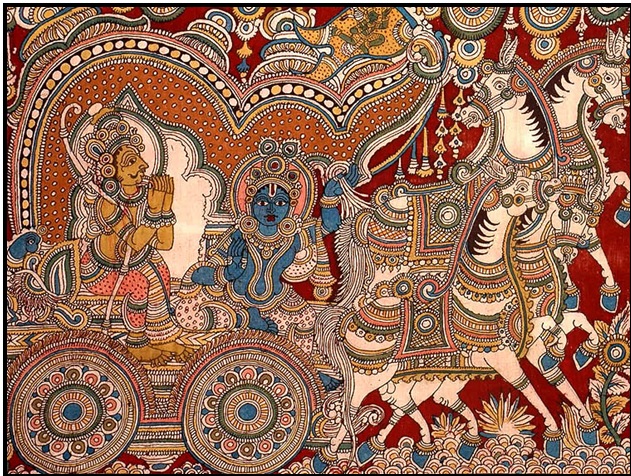
Prime Minister Narendra Modi presented an exquisite hand-crafted Mahabharata-themed Kalamkari painting to Emmanuel Macron.
This traditional artwork from Andhra Pradesh beautifully showcases India's rich cultural and artistic heritage.
What is Kalamkari Painting ?
Kalamkari is a renowned tradition of hand-painted and block-printed cotton textile art originating from Andhra Pradesh.
It flourished during the 16th–17th centuries under the rule of the Qutb Shahi Dynasty.
The term Kalamkari is derived from two Persian words:
Kalam = Pen
Kari = Craftsmanship or Artistry
Process of Making Kalamkari Paintings
The fabric is first soaked in a mixture of astringents and buffalo milk and then dried in sunlight.
Outlines in red, black, brown, and violet are drawn using a mordant.
The cloth is then dipped in an Alizarin solution.
Areas that are not to be colored are covered with wax, after which the fabric is immersed in indigo dye.
Once the wax is removed, the remaining sections are painted by hand.
Artists use a bamboo or date-palm wood pen with a fine hair tip.
Natural dyes are prepared from roots, leaves, seeds, and minerals such as iron and copper.
Major Styles of Kalamkari
1. Srikalahasti Kalamkari
Practiced in Srikalahasti.
Created entirely by hand using a pen (kalam).
Known for its freehand drawing and intricate detailing.
Themes:
Mythological stories
Depictions of Hindu deities
Religious symbols
Temple architecture
Episodes from the Mahabharata and Ramayana
2. Machilipatnam Kalamkari
Also known as Pedana Kalamkari.
Developed in Pedana near Machilipatnam.
Strongly influenced by Persian art, patronized by Mughal rulers and the Golconda Sultanate.
Primarily uses the block-printing technique.
Themes:
Floral motifs
Geometric designs
Decorative patterns
Significance of Kalamkari
Kalamkari is an important part of India's traditional textile and handicraft heritage.
It exemplifies the use of natural dyes and eco-friendly artistic techniques.
The art form plays a vital role in preserving India's cultural, religious, and artistic traditions.
Both Srikalahasti Kalamkari and Machilipatnam Kalamkari have been awarded the Geographical Indication (GI) Tag, recognizing their uniqueness and cultural value.






 Contact Us
  New Batch : 9555124124/ 7428085757
  Tech Support : 9555124124/ 7428085757