Why in the news ?
- India further strengthened its maritime security capabilities by commissioning three state-of-the-art indigenous warships-INS Dunagiri, INS Sanshodhan, and INS Agray-into the Indian Navy in June 2026. Prime Minister Narendra Modi dedicated these three ships to the Navy at a ceremony held in Kolkata.
- These ships were built by Garden Reach Shipbuilders and Engineers (GRSE), Kolkata. According to the Ministry of Defence, more than 75 percent indigenous material has been used in all three ships and more than 200 MSMEs have been involved in their construction.
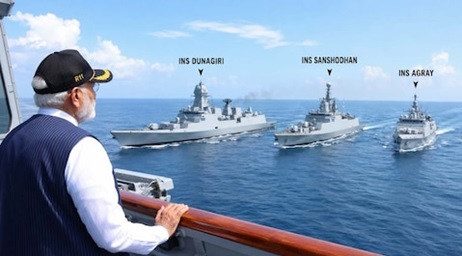
Why is this 'triple commissioning' special ?
- The most important feature of these three ships is that they provide the Indian Navy with three distinct strategic capabilities:
- Deep-sea warfare operations
- Maritime reconnaissance and surveillance
- Anti-submarine defense in coastal areas
- This is why it is considered a significant milestone in the Indian Navy's capability-building journey.
About the 3 Indigenous Warships
INS Dunagiri: A Powerful Deep-Sea Warrior
- INS Dunagiri is the largest and most heavily armed of the three ships. It is a state-of-the-art stealth guided-missile frigate built under Project 17A.
Key Features
- Equipped with the BrahMos supersonic cruise missile
- Medium-Range Air Defense System (MRSAM)
- MFSTAR multi-function radar
- Advanced sonar and electronic warfare systems
- Equipped with anti-submarine weapons
- This warship is capable of conducting long-range operations in deep water (blue water) and facing a variety of threats.
INS Modifier: Scientific Cartographer of the Ocean
- INS Modhik is a Survey Vessel Large (SVL), whose main function is to study the sea depth, seabed, shipping routes and ocean conditions.
Key Features
- Autonomous Underwater Vehicle (AUV)
- Remotely Operated Vehicle (ROV)
- Multi-beam echo sounder
- Modern Hydrographic Survey System
- Apart from naval operations, this ship will also play an important role in safe navigation, marine research, coastal development and disaster management.
INS Agraya: A Submarine Hunter for Littoral Areas
- INS Agraya is an Anti-Submarine Warfare Shallow Water Craft (ASW-SWC). It has been specifically developed to detect and destroy enemy submarines around coastal areas, ports, and naval bases.
Key Features
- State-of-the-art sonar system
- Lightweight torpedoe
- Indigenous anti-submarine rocket launchers
- Effective operation capability in shallow waters
- Detecting submarines in coastal waters is extremely challenging, as maritime traffic, fishing boats, and oceanographic features complicate surveillance. INS Agraya has been designed to address this challenge.
What benefits will the Indian Navy gain ?
The induction of the three ships will strengthen the Indian Navy's capabilities on three fronts:
1. Blue-Water Operations
- INS Dunagiri will strengthen India's military presence and project power in the high seas.
2. Maritime Domain Awareness
- INS Sandhodha will provide accurate information on maritime geography and navigation.
3. Coastal Security
- INS Agraya will protect India's coastal areas from submarine threats.
The Indian Navy's Growing Maritime Power
- The Indian Navy currently has approximately 140-145 active warships.
- The Navy aims to increase the number of warships to 150-160 by 2030, further strengthening India's strategic presence in the Indian Ocean region.
Deployment and Strategic Importance
- Warships of the Eastern Naval Command (Visakhapatnam) patrol the Bay of Bengal, the Andaman Sea, and the Malacca Strait, strengthening India's strategic presence in the Indo-Pacific.
- Ships of the Western Naval Command (Mumbai and Karwar) are responsible for maritime security in the Arabian Sea, monitoring Pakistani activities, and protecting merchant ships from piracy.
- The Andaman and Nicobar Command is India's only tri-service command, and its location near the Malacca Strait makes it a vital strategic force.
Why are warships important ?
- Nearly 90% of global trade is conducted through sea routes.
- Warships ensure the security of maritime trade routes, energy supplies, and national interests.
- Modern warships are equipped with missiles, radar, helicopters, drones, and advanced communication systems.
- They are considered "floating military bases" at sea, capable of performing a variety of tasks, including combat, surveillance, humanitarian assistance, and disaster relief.
India's Nuclear Deterrence at Sea Enhances
- India's naval nuclear power is steadily strengthening. In particular, nuclear-powered ballistic missile submarines like INS Arihant have become a key pillar of the country's "second strike capability."
- Second strike capability means that even if an enemy country launches a nuclear attack first, India will still be able to launch an effective retaliatory nuclear strike.
- The maritime component of India's nuclear triad is steadily strengthening.
- Nuclear submarines can remain stealthily deployed at sea for long periods, making them difficult to detect.
- According to the Stockholm International Peace Research Institute (SIPRI), India is now deploying a limited number of nuclear weapons on ballistic missile submarines even during peacetime.
- This strengthens India's Credible Minimum Deterrence and nuclear security.
- Sea-based nuclear weapons provide effective support to India's 'No First Use' policy.
A Major Success for Self-Reliant India
- The indigenous construction of these three ships demonstrates the growing capabilities of India's defense production sector. The indigenous construction of ships equipped with diverse technologies for a variety of missions proves that India is rapidly moving towards self-reliance in developing advanced naval platforms.
Conclusion
- Amidst the increasing naval activities of China and Pakistan in the Indian Ocean region, the induction of INS Dunagiri, INS Sanshodhan, and INS Agray into the Navy is crucial for India's maritime security. Together, these three ships will provide the Indian Navy with a robust and multi-layered security shield from the high seas to the coastal areas.






 Contact Us
  New Batch : 9555124124/ 7428085757
  Tech Support : 9555124124/ 7428085757