- UPSC Exam
- State PCS
- One Day Exam
- Current Affairs
- PT Quiz
- Downlaods
- About Coaching
- Blog
- Videos

| Prelims: Indian Polity - Judiciary (Current Affairs) Mains: GS Paper II - Polity & Governance (Judiciary, Judicial Reforms & Justice Delivery System) |
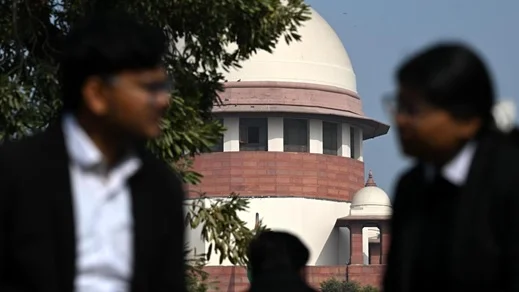
The Supreme Court has directed all States and Union Territories to consider increasing the retirement age of judicial officers from 60 to 61 years as an interim measure. The Court is also examining whether the retirement age should be uniformly enhanced to 62 years across the country.
Different States and High Courts have adopted different positions.
The Madhya Pradesh High Court has passed a Full Court resolution recommending an increase in the retirement age from 60 to 62 years.
Prelims QuestionQ. Consider the following statements regarding the Supreme Court's interim order on the retirement age of judicial officers:
Which of the statements given above is/are correct?
Mains QuestionQ. "A uniform retirement age for judicial officers is closely linked to judicial reforms and the efficiency of the justice delivery system." Discuss in the light of the recent Supreme Court directions on increasing the retirement age of judicial officers |
Q1. Why is the retirement age of judicial officers in the news?Answer: The Supreme Court has directed all States and Union Territories to consider increasing the retirement age of judicial officers from 60 to 61 years as an interim measure while deciding whether it should be uniformly raised to 62 years across India. Q2. Has the Supreme Court increased the retirement age to 62 years?Answer: No. The Court has not taken a final decision. It has only proposed an interim increase to 61 years, while the issue of a uniform retirement age of 62 years is still under consideration. Q3. Who will decide whether judicial officers can continue up to 61 years?Answer: The decision will be taken by the State Government in consultation with the concerned High Court. If both agree, judicial officers in that State or UT may continue in service up to 61 years, subject to the Supreme Court's final verdict. Q4. Which commission first recommended raising the retirement age of judicial officers to 62 years?Answer: The Justice K. Jagannatha Shetty Commission recommended increasing the retirement age of district and subordinate judicial officers from 60 to 62 years. |
| Prelims: QS Best Student Cities Ranking 2027, QS Quacquarelli Symonds (QS), Seoul, Mumbai, Delhi, Bengaluru, Affordability, Employer Activity Mains: GS Paper Education, Human Resource Development, Government Policies & Interventions (NEP 2020, Study in India, Higher Education Reforms) Keywords: QS Best Student Cities Ranking 2027 • QS Quacquarelli Symonds (QS) • Seoul • Mumbai • Delhi • Bengaluru • Affordability • Employer Activity • University Rankings • Student Mobility • Higher Education • NEP 2020. |
The QS Best Student Cities Ranking 2027, released in July 2026, ranked Seoul as the world's best student city. Mumbai became India's highest-ranked city (91st), Delhi entered the global top 100 for the first time (99th) and was recognised as the world's most affordable student city, while Bengaluru slipped to joint 114th due to relatively higher tuition fees.
|
City |
Global Rank |
Highlights |
|---|---|---|
|
Seoul |
1 |
World's best student city |
|
Mumbai |
91 |
India's highest-ranked city |
|
Delhi |
99 |
Entered Top 100; World's most affordable student city |
|
Bengaluru |
Joint 114 |
Dropped 6 places due to higher tuition costs |
|
Chennai |
123 |
Improved by 5 places |
The QS Best Student Cities Ranking is an annual global ranking published by QS Quacquarelli Symonds, evaluating 150 cities based on their attractiveness for domestic and international students.
Prelims MCQWith reference to the QS Best Student Cities Ranking, consider the following statements:
Which of the statements given above is/are correct? A. 1 only Mains Practice Question"India's aspiration to become a global education hub requires not only affordable education but also world-class universities, employability, and urban livability." Discuss in the context of the QS Best Student Cities Ranking 2027. |
1. What is the QS Best Student Cities Ranking?It is an annual global ranking by QS Quacquarelli Symonds that evaluates cities based on higher education quality, affordability, employability, and student experience. 2. Which city topped the QS Best Student Cities Ranking 2027?Seoul (South Korea) ranked first globally. 3. Which Indian city performed the best in the QS Ranking 2027?Mumbai ranked 91st, making it the highest-ranked Indian city. 4. Why was Delhi recognised in the QS Ranking 2027?Delhi entered the global Top 100 for the first time and was recognised as the world's most affordable student city due to its comparatively low tuition fees. 5. Why is the QS Best Student Cities Ranking important for UPSC?It is important because it covers higher education reforms, employability, urban development, internationalisation of education, NEP 2020, Skill India, NIRF, and India's knowledge economy, making it relevant for Prelims, GS-II, GS-III, Essay, and Interview. |
|
Year |
EVENT |
|
1923 |
First experimental radio broadcasts by the Radio Club of Bombay |
|
23 July 1927 |
Indian Broadcasting Company (IBC) started regular broadcasting from Bombay |
|
26 August 1927 |
IBC launched broadcasting services in Calcutta |
|
1930 |
IBC went into liquidation; Government took over broadcasting and created the Indian State Broadcasting Service (ISBS) |
|
8 June 1936 |
ISBS was renamed All India Radio (AIR) |
|
1957 |
AIR adopted the popular name Akashvani |
|
1959 |
Experimental television service began in Delhi |
|
1965 |
Regular television broadcasting started |
|
1976 |
Doordarshan separated from All India Radio as an independent department |
|
1997 |
Prasar Bharati became India's autonomous public broadcasting corporation under the Prasar Bharati Act, 1990 |
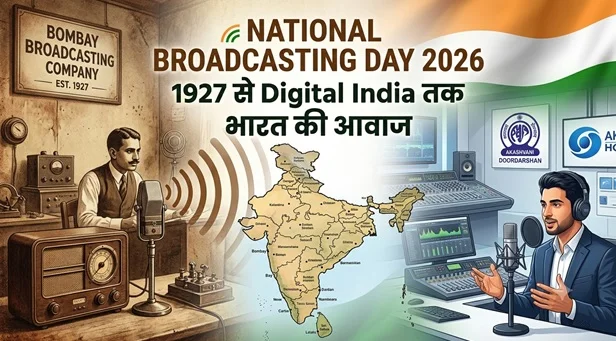
Prelims MCQQ. Consider the following statements regarding National Broadcasting Day:
Which of the above statements are correct? A. Only 1 and 2 B. Only 1 and 3 C. Only 2 and 3 D. 1, 2 and 3 Mains Practice QuestionQ. "Public broadcasting continues to remain an important pillar of democracy despite the rise of digital media." Discuss. |
1. Why is National Broadcasting Day observed on 23 July?It marks the first organised radio broadcast in India started by the Indian Broadcasting Company (IBC) in 1927. 2. Where was India's first radio broadcast started?The first radio broadcast started from Bombay (now Mumbai) in 1927. 3. What was the first broadcasting organisation of India?The Indian Broadcasting Company (IBC) was India's first broadcasting organisation. 4. When was All India Radio renamed Akashvani?AIR adopted the name Akashvani in 1957. 5. Which organisation controls All India Radio and Doordarshan?Prasar Bharati controls both AIR and Doordarshan. |
|
Prelims: Current Affairs | Health & Nutrition | Government Policies | Food Safety & Standards | International Organisations (WHO) | Sustainable Development Goals (SDGs) Mains: GS Paper II – Issues Relating to Health, Nutrition, Child Welfare, and Government Policies & Interventions |

The government should strengthen regulations on HFSS foods, implement clear front-of-pack nutrition labels, improve school food policies, promote nutrition education, encourage healthier food choices through fiscal measures, and enhance collaboration among policymakers, industry, schools, parents, and healthcare professionals. Continuous monitoring and research should guide evidence-based nutrition policies.
Prelims MCQQ. Which of the following measures has been recommended by the consortium?
Select the correct answer: A. 1 only B. 1 and 2 only C. 2 and 3 only D. 1, 2 and 3 Mains Practice QuestionQ. India is witnessing a growing burden of childhood obesity and diet-related non-communicable diseases. Discuss the significance of the ICMR-NIN-led "Let's Fix Our Food" Consortium. How can its policy recommendations help create healthier food environments for children and adolescents? |
What is the 'Let's Fix Our Food' Consortium?It is an ICMR-NIN-led multi-stakeholder initiative that promotes evidence-based policies to improve food environments and encourage healthier diets among children and adolescents. Why was this consortium launched?It was launched to address rising childhood obesity, unhealthy eating habits, and diet-related non-communicable diseases by promoting healthier food systems and policy reforms. What are HFSS foods?HFSS foods are products high in fat, sugar, and salt, increasing the risk of obesity, diabetes, hypertension, and other non-communicable diseases among children. What is Front-of-Pack Nutrition Labelling (FOPNL)?FOPNL provides simple nutrition information on packaged foods, helping consumers quickly identify products high in sugar, salt, or unhealthy fats. Which government programmes does this initiative support?It complements POSHAN Abhiyaan, PM POSHAN, Eat Right India, Anaemia Mukt Bharat, and the National Programme for Prevention and Control of NCDs. |

Our support team will be happy to assist you!

 Contact Us
  New Batch : 9555124124/ 7428085757
  Tech Support : 9555124124/ 7428085757