
- UPSC Exam
- State PCS
- One Day Exam
- Current Affairs
- PT Quiz
- Downlaods
- About Coaching
- Blog
- Videos

|
Year |
EVENT |
|
1923 |
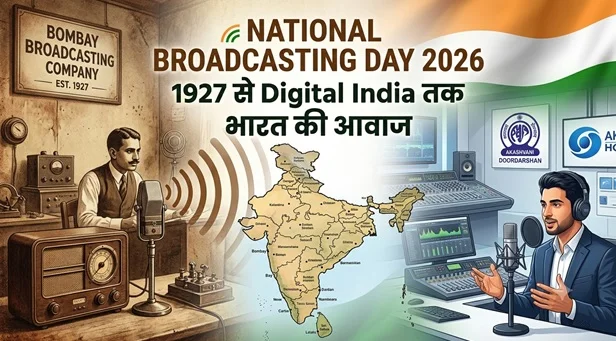
First experimental radio broadcasts by the Radio Club of Bombay |
|
23 July 1927 |
Indian Broadcasting Company (IBC) started regular broadcasting from Bombay |
|
26 August 1927 |
IBC launched broadcasting services in Calcutta |
|
1930 |
IBC went into liquidation; Government took over broadcasting and created the Indian State Broadcasting Service (ISBS) |
|
8 June 1936 |
ISBS was renamed All India Radio (AIR) |
|
1957 |
AIR adopted the popular name Akashvani |
|
1959 |
Experimental television service began in Delhi |
|
1965 |
Regular television broadcasting started |
|
1976 |
Doordarshan separated from All India Radio as an independent department |
|
1997 |
Prasar Bharati became India's autonomous public broadcasting corporation under the Prasar Bharati Act, 1990 |
Prelims MCQQ. Consider the following statements regarding National Broadcasting Day:
Which of the above statements are correct? A. Only 1 and 2 B. Only 1 and 3 C. Only 2 and 3 D. 1, 2 and 3 Mains Practice QuestionQ. "Public broadcasting continues to remain an important pillar of democracy despite the rise of digital media." Discuss. |
1. Why is National Broadcasting Day observed on 23 July?It marks the first organised radio broadcast in India started by the Indian Broadcasting Company (IBC) in 1927. 2. Where was India's first radio broadcast started?The first radio broadcast started from Bombay (now Mumbai) in 1927. 3. What was the first broadcasting organisation of India?The Indian Broadcasting Company (IBC) was India's first broadcasting organisation. 4. When was All India Radio renamed Akashvani?AIR adopted the name Akashvani in 1957. 5. Which organisation controls All India Radio and Doordarshan?Prasar Bharati controls both AIR and Doordarshan. |



Our support team will be happy to assist you!

 Contact Us
  New Batch : 9555124124/ 7428085757
  Tech Support : 9555124124/ 7428085757