Prelims: Indian Polity - Judiciary (Current Affairs)
Mains: GS Paper II - Polity & Governance (Judiciary, Judicial Reforms & Justice Delivery System) |
Why in News?
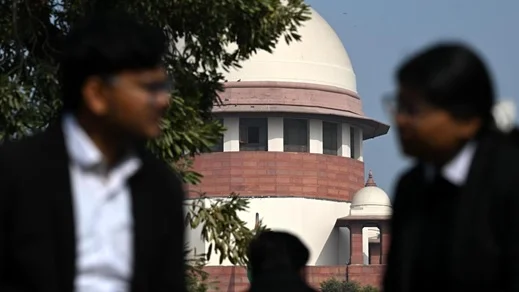
The Supreme Court has directed all States and Union Territories to consider increasing the retirement age of judicial officers from 60 to 61 years as an interim measure. The Court is also examining whether the retirement age should be uniformly enhanced to 62 years across the country.
Why Is the Issue Before the Supreme Court ?
- The matter has been pending before the Supreme Court for several years and concerns the service conditions of the subordinate judiciary.
- The petition highlights key issues such as:
- Lack of a uniform retirement age across States.
- Career stagnation among judicial officers.
- Disparities in pay scales and promotional opportunities.
- Increasing vacancies and shortage of experienced judges in district courts.
- The need to strengthen judicial efficiency and reduce case pendency.
- The Court is examining whether a uniform retirement age can improve the functioning of the subordinate judiciary.
What Has the Supreme Court Directed?
- As an interim arrangement, the Supreme Court has directed all State Governments and Union Territories, in consultation with their respective High Courts, to decide whether the retirement age of judicial officers should be increased from 60 to 61 years.
- If both the State Government and the High Court agree, judicial officers in that State or UT will be allowed to continue in service until the age of 61 years.
- However, the Court made it clear that:
- This is only an interim arrangement.
- It does not determine the final legal position.
- The Supreme Court will independently decide whether the retirement age should be uniformly increased to 62 years across the country.
- The Court has also directed all States, UTs and High Courts to submit their views within two weeks.
Why Is There No Uniformity?
Supporting the Proposal
Opposing the Proposal
- Some High Courts, including the Punjab and Haryana High Court, have opposed the proposal.
- They argue that the retirement age of State government employees in their respective States is 60 years or below, and judicial officers should not be treated differently.
- Because of these differing views, the Supreme Court has introduced an interim mechanism allowing retirement at 61 years wherever both the State Government and the High Court agree.
Background of the Issue
- This is not the first time the Supreme Court has considered the issue.
- Earlier, a Bench headed by former Chief Justice of India B. R. Gavai permitted judicial officers in Madhya Pradesh to continue in service up to 61 years. The Bench referred to a similar decision taken in Telangana.
- The Court had also observed that judicial officers and other State government employees are paid from the same public exchequer, while many States already allow their government employees to retire at 62 years.
Historical Background
- The dispute dates back to the Supreme Court's 2002 judgment, which declined to accept the recommendations of the Justice K. Jagannatha Shetty Commission.
- The Commission had recommended:
- Raising the retirement age of district and subordinate judicial officers from 60 years to 62 years.
- Introducing uniform service conditions for the subordinate judiciary across India.
- Improving judicial administration by retaining experienced judges.
- Although the recommendation was not accepted at the time, several States—including Telangana and Madhya Pradesh-have since moved towards increasing the retirement age.
Significance of the Proposal
- If implemented nationwide, increasing the retirement age could:
- Retain experienced judicial officers for a longer period.
- Reduce vacancies in district and subordinate courts.
- Improve judicial continuity and institutional memory.
- Enhance the efficiency of the justice delivery system.
- Help address the growing backlog of pending cases.
- However, critics argue that extending the retirement age could delay promotions and reduce career advancement opportunities for younger judicial officers.
Way Forward
- The Supreme Court will examine the responses of the States, Union Territories and High Courts before delivering its final verdict on whether the retirement age of judicial officers should be uniformly enhanced to 62 years across India.
- The decision is expected to have far-reaching implications for judicial reforms, human resource management in the judiciary, and the efficiency of India's justice delivery system.
Prelims Question
Q. Consider the following statements regarding the Supreme Court's interim order on the retirement age of judicial officers:
- The increase to 61 years is subject to consultation between the State Government and the concerned High Court.
- The interim arrangement will automatically apply to all States and Union Territories.
- The Supreme Court has sought the views of States, UTs and High Courts within two weeks.
Which of the statements given above is/are correct?
-
1 and 3 only
-
2 only
-
1, 2 and 3
-
3 only
Mains Question
Q. "A uniform retirement age for judicial officers is closely linked to judicial reforms and the efficiency of the justice delivery system." Discuss in the light of the recent Supreme Court directions on increasing the retirement age of judicial officers
|
FAQs: Supreme Court on Retirement Age of Judicial Officers
Q1. Why is the retirement age of judicial officers in the news?
Answer: The Supreme Court has directed all States and Union Territories to consider increasing the retirement age of judicial officers from 60 to 61 years as an interim measure while deciding whether it should be uniformly raised to 62 years across India.
Q2. Has the Supreme Court increased the retirement age to 62 years?
Answer: No. The Court has not taken a final decision. It has only proposed an interim increase to 61 years, while the issue of a uniform retirement age of 62 years is still under consideration.
Q3. Who will decide whether judicial officers can continue up to 61 years?
Answer: The decision will be taken by the State Government in consultation with the concerned High Court. If both agree, judicial officers in that State or UT may continue in service up to 61 years, subject to the Supreme Court's final verdict.
Q4. Which commission first recommended raising the retirement age of judicial officers to 62 years?
Answer: The Justice K. Jagannatha Shetty Commission recommended increasing the retirement age of district and subordinate judicial officers from 60 to 62 years.
|






 Contact Us
  New Batch : 9555124124/ 7428085757
  Tech Support : 9555124124/ 7428085757