|
Prelims: Current Affairs | Health & Nutrition | Government Policies | Food Safety & Standards | International Organisations (WHO) | Sustainable Development Goals (SDGs)
Mains: GS Paper II – Issues Relating to Health, Nutrition, Child Welfare, and Government Policies & Interventions
GS Paper III – Food Security, Human Resource Development, Public Health, Sustainable Development, and Non-Communicable Diseases (NCDs)
|
Why in News
- Recently, the ICMR-NIN-led 'Let's Fix Our Food' (LFOF) Consortium released a policy document titled 'Priority Policy Actions to Promote Healthier Diets and Food Environments for Children and Adolescents in India.'
- The document was launched by Dr M. Srinivas, Member (Health), NITI Aayog, at a workshop held at the India Habitat Centre, New Delhi. It was attended by Dr Bharati Kulkarni, Director of ICMR-NIN, Prof. K. Srinath Reddy of the Public Health Foundation of India, and senior representatives from the Ministry of Health and Family Welfare, FSSAI, UNICEF India, and other partner organisations.
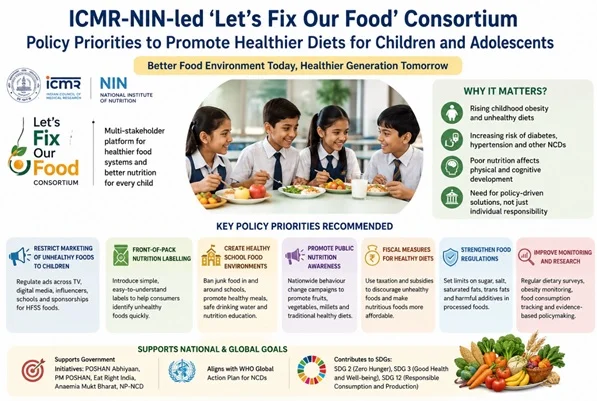
What Is the 'Let's Fix Our Food' Consortium
- The Let's Fix Our Food Consortium is a multi-institutional national platform led by ICMR-NIN. It was set up to generate scientific evidence and push for policy action on healthier food environments in India, with special attention to children and adolescents.
- Its partners include Resolve to Save Lives (RTSL) India, UNICEF India, the Global Health Advocacy Incubator (GHAI), the Public Health Foundation of India (PHFI), the World Health Organization (WHO), the Food Safety and Standards Authority of India (FSSAI), the Institute of Economic Growth (IEG), the World Food Programme (WFP), Lady Irwin College, the International Food Policy Research Institute (IFPRI), Deakin University, and several other national and international bodies.
- The Consortium aims to help prevent diet-related non-communicable diseases by reshaping the food environment children grow up in. The Consortium also launched a few practical tools — the LFOF website, a Nutrition Environment Assessment Toolkit for Schools (NEAT-S) along with its report, an e-learning module to help people understand food labels, and a set of ICMR-NIN educational resources on fats, sugars, and salt.
Why Does India's Food Environment for Children Need Fixing
- India is facing what nutrition experts call a 'double burden of malnutrition' — under nutrition and overweight/obesity existing side by side, sometimes even within the same household.
- According to the National Family Health Survey (NFHS), overweight among children under five rose by about 127 percent, from 1.5 per cent in NFHS-3 (2005-06) to 3.4 per cent in NFHS-5 (2019-21). Among adolescents aged 10 to 19, overweight also rose sharply, with increases of over 100 per cent for girls and nearly 300 percent for boys over the last decade.
- The Economic Survey has noted that more than 33 million children in India were obese in 2020, and this number could rise to about 83 million by 2035 if current trends continue. UNICEF's Child Nutrition Report 2025 shows that obesity has overtaken underweight as the most common form of malnutrition among school-age children worldwide.
- A major reason behind this shift is the rapid rise of ultra-processed food (UPF) consumption. As per the Economic Survey 2024-25, spending on ultra-processed foods in India jumped from about USD 900 million in 2006 to USD 37.9 billion in 2019, growing at more than 33 per cent every year.
What Are the Key Policy Priorities?
- Healthy School Food Environments: Ensuring canteens, vendors, and food sold in and around schools support healthy eating, building on FSSAI's 2020 regulations restricting HFSS foods near schools.
- Nutrition Literacy: Teaching children and adolescents to understand food labels, ingredients, and the difference between healthy and unhealthy choices from an early age.
- Front-of-Pack Nutrition Labelling (FOPL): Introducing clear, easy-to-understand warning-style labels on packaged food so families can quickly identify products high in fat, sugar, or salt.
- Regulation of Marketing to Children: Restricting advertisements and promotional tactics used by food companies to target children, across television, digital media, and packaging.
- Taxation of HFSS Foods: Using fiscal measures, such as higher taxes on unhealthy packaged foods and sugar-sweetened beverages, to discourage consumption — an approach already used for tobacco control.
- Healthier Dietary Fats: Encouraging a shift away from foods high in saturated and trans fats towards healthier fat sources.
- Salt Reduction: Reducing the high sodium content found in packaged and processed foods commonly consumed by children.
- Low-Sodium Salt Substitutes: Promoting accessible alternatives to regular salt that can help reduce overall sodium intake at the population level.
- Social and Behaviour Change Communication (SBCC): Running public awareness campaigns to shift family and community food habits over time.
- Youth Engagement and Fiscal Measures: Involving young people directly in shaping food policy, alongside broader financial measures that make healthy food more affordable and accessible.
What India Already Has in Place
- FSSAI introduced regulations in 2020 restricting the sale of HFSS foods in and around school premises. The government also runs the Ayushman Bharat School Health Programme (AB-SHP) and the PM POSHAN scheme, which provides mid-day meals to strengthen child nutrition. There is also relatively higher taxation on sugar-sweetened beverages compared to many other food items. However, gaps remain.
- India's front-of-pack labelling system, the star-based 'Indian Nutrition Rating,' has been criticised by public health experts for being too lenient — some studies suggest it gives high ratings even to fairly unhealthy products. A stricter, warning-label-based system, similar to models used in Chile and other countries, has been proposed by FSSAI but is still pending final approval, partly due to push back from the food industry.
Why Does This Matter
- It consolidates nearly three years of Indian research and evidence into one actionable roadmap, rather than leaving policymakers to rely only on global recommendations that may not fit India's context.
- It directly targets the food environment — meaning the schools, markets, advertisements, and family settings that shape what children eat — instead of only asking individual families to make better choices on their own.
- It aligns with India's larger public health goals, including Sustainable Development Goal 2.2, which calls for ending all forms of malnutrition, including childhood overweight and obesity, and with the broader national effort to reduce non-communicable.
Way Forward
The government should strengthen regulations on HFSS foods, implement clear front-of-pack nutrition labels, improve school food policies, promote nutrition education, encourage healthier food choices through fiscal measures, and enhance collaboration among policymakers, industry, schools, parents, and healthcare professionals. Continuous monitoring and research should guide evidence-based nutrition policies.
Prelims MCQ
Q. Which of the following measures has been recommended by the consortium?
- Front-of-pack nutrition labelling
- Restricting marketing of HFSS foods to children
- Promoting healthy school food environments
Select the correct answer:
A. 1 only
B. 1 and 2 only
C. 2 and 3 only
D. 1, 2 and 3
Mains Practice Question
Q. India is witnessing a growing burden of childhood obesity and diet-related non-communicable diseases. Discuss the significance of the ICMR-NIN-led "Let's Fix Our Food" Consortium. How can its policy recommendations help create healthier food environments for children and adolescents?
|
FAQs
What is the 'Let's Fix Our Food' Consortium?
It is an ICMR-NIN-led multi-stakeholder initiative that promotes evidence-based policies to improve food environments and encourage healthier diets among children and adolescents.
Why was this consortium launched?
It was launched to address rising childhood obesity, unhealthy eating habits, and diet-related non-communicable diseases by promoting healthier food systems and policy reforms.
What are HFSS foods?
HFSS foods are products high in fat, sugar, and salt, increasing the risk of obesity, diabetes, hypertension, and other non-communicable diseases among children.
What is Front-of-Pack Nutrition Labelling (FOPNL)?
FOPNL provides simple nutrition information on packaged foods, helping consumers quickly identify products high in sugar, salt, or unhealthy fats.
Which government programmes does this initiative support?
It complements POSHAN Abhiyaan, PM POSHAN, Eat Right India, Anaemia Mukt Bharat, and the National Programme for Prevention and Control of NCDs.
|






 Contact Us
  New Batch : 9555124124/ 7428085757
  Tech Support : 9555124124/ 7428085757