
- UPSC Exam
- State PCS
- One Day Exam
- Current Affairs
- PT Quiz
- Downlaods
- About Coaching
- Blog
- Videos

| Prelims: QUAD, ICG, Mission, ICG Ship, Route, Sea Riders, MAHASAGAR Keywords: QUAD, QUAD-at-Sea Ship Observer Mission, Indian Coast Guard, ICG Ship Shaunak, Sea Riders, India Australia maritime cooperation, Indo-Pacific, maritime security, India Japan Australia US, MAHASAGAR, maritime interoperability, rules-based maritime order, QUAD maritime cooperation. |

The QUAD-at-Sea Ship Observer Mission is designed to facilitate practical maritime cooperation among the four QUAD members.
Six officers have embarked on ICG ship Shaunak as ‘Sea Riders’. The group includes:
During the voyage, these officers will participate in shipboard activities and professional exchanges.
The mission provides an opportunity for officers from the four countries to understand each other's maritime procedures and operational practices.
It can contribute to:
Despite growing maritime cooperation, several challenges remain:
MCQQ. With reference to the QUAD-at-Sea Ship Observer Mission, consider the following statements:
Which of the statements given above is/are correct? A. 1 only Mains QuestionQ. Maritime cooperation among QUAD countries is becoming an important component of India's Indo-Pacific strategy. Discuss the significance of initiatives such as the QUAD-at-Sea Ship Observer Mission for regional maritime security. |
1. What is the QUAD-at-Sea Ship Observer Mission?It is a maritime cooperation initiative involving India, Australia, Japan and the United States, aimed at promoting professional exchanges and maritime interoperability. 2. Which Indian Coast Guard ship participated in the mission?Indian Coast Guard ship Shaunak sailed from Chennai to Perth, Australia, as part of the mission. 3. Who are the ‘Sea Riders’?The ‘Sea Riders’ are six officers from the four QUAD countries who embarked on Shaunak to participate in shipboard activities and professional exchanges. 4. Which countries are members of the QUAD?The QUAD comprises India, Australia, Japan and the United States. 5. What is MAHASAGAR?MAHASAGAR stands for Mutual and Holistic Advancement for Security and Growth Across Regions and reflects India's approach towards cooperation with partner countries for maritime security and regional growth. |
World Tourism Day is observed worldwide every year on 27 September.

|
Particular |
Fact |
|
Observed on |
27 September |
|
First celebrated |
1980 |
|
Associated organisation |
UN Tourism |
|
Historical significance |
UNWTO Statutes adopted on 27 September 1970 |
|
2026 Theme |
Digital Agenda and Artificial Intelligence to Redesign Tourism |
|
Major focus in 2026 |
AI, digitalisation, inclusion and sustainable tourism |
|
Indicator |
2025 |
|
Foreign Tourist Arrivals (FTAs) |
9.15 million |
|
International Tourist Arrivals (ITAs) |
20.22 million |
|
NRI Arrivals |
11.07 million |
|
Domestic Tourist Visits |
~4.287 billion |
|
Foreign Tourist Visits |
25.27 million |
|
Foreign Exchange Earnings |
~₹2.7 lakh crore |
|
Indian National Departures |
32.83 million |
Prelims MCQQ. With reference to World Tourism Day, consider the following statements:
Which of the statements given above are correct? (a) 1 and 2 only (b) 2 and 3 only (c) 1 and 3 only (d) 1, 2 and 3 Mains Practice QuestionQ. “Digital technologies and Artificial Intelligence can transform tourism, but their benefits must remain inclusive and sustainable.” Discuss. |
When is World Tourism Day observed?World Tourism Day is observed every year on 27 September. When was World Tourism Day first celebrated?It was first celebrated in 1980. What is the theme of World Tourism Day 2026?Digital Agenda and Artificial Intelligence to Redesign Tourism. Which organisation is associated with World Tourism Day?UN Tourism. What is PRASHAD?It is an Indian government initiative focused on pilgrimage and spiritual heritage tourism infrastructure. |

The DCR framework assesses digital connectivity using several parameters, including:
The parameters are given different weights based on the availability and strength of digital connectivity.
The Digital Connectivity Rating framework can:
Despite its potential benefits, the framework may face some challenges:
The Digital Connectivity Rating Platform provides a standardised mechanism to assess digital connectivity in buildings. By making connectivity information available to consumers, the framework aims to encourage better digital infrastructure and greater transparency in the property sector.
Prelims Practice QuestionQ. With reference to the Digital Connectivity Rating (DCR) Platform, consider the following statements:
Which of the statements given above are correct? A. 1 and 2 only Mains Practice QuestionQ. How can TRAI’s Digital Connectivity Rating (DCR) Platform improve digital infrastructure and consumer awareness? |
What is the Digital Connectivity Rating Platform?It is a TRAI platform for rating digital connectivity in residential, commercial and government properties. What does the DCR rating measure?It considers fibre readiness, mobile network availability, in-building connectivity solutions, Wi-Fi infrastructure and the availability and strength of multiple telecom service providers. Can consumers verify a property's DCR certificate?Yes. Consumers can verify digitally signed rating certificates using a QR code. Is the Digital Connectivity Rating framework mandatory?The framework will initially operate on a voluntary basis. Which body regulates the Digital Connectivity Rating framework?The framework is prescribed by the Telecom Regulatory Authority of India (TRAI). |
| Prelims: Subansiri River, Brahmaputra River System, Subansiri Upper Hydroelectric Project, NHPC, Environmental Clearance, Expert Appraisal Committee (EAC), Compensatory Afforestation and Himalayan Ecology. Mains: GS Paper III: Environmental Conservation, Biodiversity, Environmental Impact Assessment, Renewable Energy, Infrastructure, Himalayan Ecosystem and Disaster Management. |
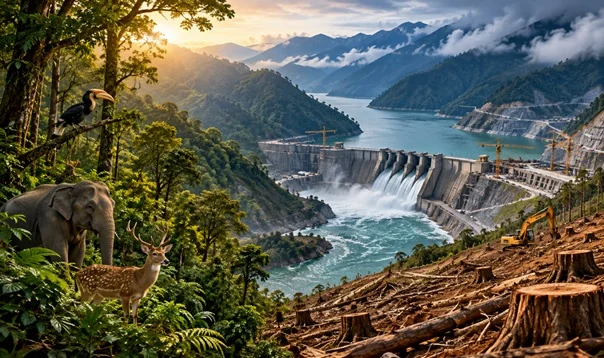
|
Feature |
Details |
|
Project |
Subansiri Upper Hydroelectric Project |
|
Location |
Upper Subansiri district, Arunachal Pradesh |
|
River |
Subansiri River |
|
Capacity |
1,605 MW |
|
Developer |
NHPC Limited |
|
Dam Height |
237 metres from deepest foundation level |
|
Reservoir Surface Area at FRL |
22.2 sq km |
|
Reservoir Length at FRL |
Around 50 km |
|
Forest Land Diversion |
Around 2,733 hectares |
|
Trees likely to be felled |
1,35,733 |
|
Main Objectives |
Power generation and flood moderation |
Prelims MCQQ. With reference to the Subansiri River, consider the following statements:
Which of the statements given above is/are correct? (a) 1 only Mains Practice QuestionQ. “Large hydropower projects in the Himalayan region highlight the conflict between energy security and ecological sustainability.” Discuss. |
What is the Subansiri Upper Hydroelectric Project?It is a proposed 1,605 MW hydropower project on the Subansiri River in Arunachal Pradesh. Which river is the project being constructed on?It is proposed on the Subansiri River. Who is developing the Subansiri Upper Hydroelectric Project?The project is developed by NHPC Limited. How many trees could be affected by the project?Approximately 1,35,733 trees may need to be felled. What are the main objectives of the project?Its key objectives are hydroelectric power generation and flood moderation. |
| Keywords: World Rabies Day 2026, Stronger Together, Rabies, One Health Approach, Zero by 30, Rabies Elimination, National Rabies Control Programme, NRCP, NAPRE, Dog-mediated Rabies, Louis Pasteur, Rabies Vaccine, Post-Exposure Prophylaxis, Zoonotic Disease, Public Health, Animal Vaccination, Rabies in India, WHO, ICMR, NCDC. |
The theme “Stronger Together” underlines the fact that rabies elimination requires coordinated action across multiple sectors. Rabies cannot be addressed only through human healthcare. Effective elimination requires cooperation among:
The theme therefore reflects the importance of the One Health Approach, which recognises the interconnectedness of human, animal and environmental health.
A major international objective is the “Zero by 30” goal. It aims to achieve zero human deaths from dog-mediated rabies by 2030.
The initiative is based on coordinated action among international organisations and national governments, with a strong emphasis on:
The goal demonstrates that rabies elimination requires action not only after exposure but also at the source of transmission.
The National Rabies Control Programme (NRCP) focuses on strengthening rabies prevention and control in India.
Its major objectives include:
Rabies is highly preventable when appropriate measures are taken immediately after exposure.
Mass vaccination of dogs is one of the most important measures for preventing dog-mediated rabies transmission.
Vaccinating dogs helps control the disease at its primary source.
After an animal bite or suspected exposure, the wound should be immediately and thoroughly washed with soap and running water.
The affected person should seek medical attention without delay.
Depending on the nature of exposure, healthcare professionals may recommend rabies vaccination and, where indicated, rabies immunoglobulin.
Timely PEP can prevent the disease from developing after exposure.
Awareness is essential because delays in seeking medical care can increase the risk of death. Communities should understand that an apparently minor animal bite should not automatically be ignored.
Managing and vaccinating large populations of free-roaming dogs remains a major challenge in many countries.
Remote and vulnerable communities may face difficulties in accessing vaccines and other essential medical interventions.
Misconceptions about animal bites and delays in seeking medical care can increase the risk of fatal outcomes.
Weak surveillance and inadequate reporting can make it difficult to determine the actual burden of rabies.
Effective rabies control requires coordination between health departments, veterinary authorities, municipalities and local communities.
Rabies elimination requires long-term investment in animal vaccination, surveillance, healthcare infrastructure and public awareness.
India and other rabies-endemic countries need to strengthen a coordinated One Health strategy to achieve the Zero by 30 goal.
Key priorities include:
MCQQ. With reference to World Rabies Day, consider the following statements:
Which of the statements given above are correct? A. 1 and 2 only |
1. When is World Rabies Day observed?World Rabies Day is observed every year on 28 September. 2. What is the theme of World Rabies Day 2026?The theme of World Rabies Day 2026 is “Stronger Together.” 3. What is the Zero by 30 goal?Zero by 30 is the global objective of achieving zero human deaths from dog-mediated rabies by 2030. 4. What is India’s National Rabies Control Programme?The National Rabies Control Programme (NRCP) is an Indian government programme aimed at strengthening rabies prevention, treatment, surveillance and awareness. 5. Why is the One Health approach important for rabies?Rabies affects both humans and animals. Therefore, effective control requires coordinated action involving human healthcare, veterinary services, animal vaccination, surveillance and community participation. |

Our support team will be happy to assist you!

 Contact Us
  New Batch : 9555124124/ 7428085757
  Tech Support : 9555124124/ 7428085757

