Why in News?
Cotton cultivation is declining sharply across the traditional cotton belt of Punjab, Haryana and Rajasthan. Farmers are increasingly shifting from cotton to paddy and other crops because of assured procurement, relatively stable returns, rising cultivation costs and recurring pest attacks. The decline is particularly significant because these three states form India’s Northern Cotton Zone.
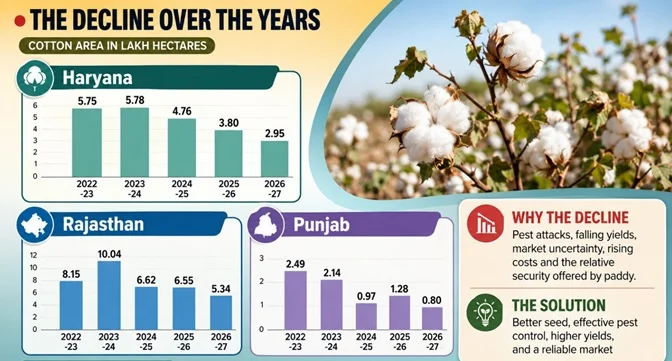
Key Data
|
State
|
Cotton Area: Previous Year
|
Cotton Area: Current Year
|
Decline
|
|
Punjab
|
1.28 lakh ha
|
0.80 lakh ha
|
37.5%
|
|
Haryana
|
3.80 lakh ha
|
2.95 lakh ha
|
~85,000 ha
|
|
Rajasthan
|
6.55 lakh ha
|
5.34 lakh ha
|
18.5%
|
|
Total
|
11.83 lakh ha
|
9.09 lakh ha
|
23.2%
|
Punjab: Long-term Decline
- Punjab had nearly 7 lakh hectares under cotton in the late 1980s. The area remained above 4–5 lakh hectares in several years but has now fallen to around 80,000 hectares.
- The decline accelerated after the 2015 whitefly attack, followed by repeated pink bollworm infestations since 2021.
Why Are Farmers Moving Away from Cotton?
1. Assured Procurement of Paddy
- Farmers prefer paddy because of:
- Assured government procurement
- MSP support
- Extensive mandi network
- Relatively predictable returns
- Timely payments
- Cotton, in comparison, involves greater production and market risks.
2. Recurring Pest Attacks
- Cotton farmers face serious losses from pests such as:Whitefly ,Pink Bollworm These pests reduce both yield and fibre quality.
3. Declining Effectiveness of Bt Cotton
- Bt cotton initially provided effective protection against several bollworm pests. However, prolonged exposure has resulted in the evolution of insect resistance, particularly in pink bollworm populations.
4. Rising Cultivation Costs
- Farmers increasingly spend on : Pesticides ,Pest management, Seeds, Irrigation ,Other farm inputs. If yields remain low, cultivation becomes economically unattractive.
5. Increasing Irrigation Availability
- In parts of Punjab, particularly the Malwa region, the expansion of tubewell irrigation has made paddy cultivation possible in areas where farmers earlier depended on cotton because groundwater was less accessible.
What Is Pink Bollworm?
- Pink bollworm (Pectinophora gossypiella) is a major insect pest of cotton.
- Its larvae enter the cotton boll and feed on developing seeds and lint.
Impact
- Reduction in cotton yield
- Damage to seeds
- Discolouration of lint
- Deterioration of fibre quality
- Higher pesticide expenditure
- Economic losses to farmers
Why Has Bt Cotton Become Vulnerable to Pink Bollworm?
What is Bt Cotton?
- Bt cotton is a genetically modified (GM) cotton containing genes derived from the soil bacterium Bacillus thuringiensis.
- Major Bt cotton hybrids in India contain genes such as:cry1Ac ,cry2Ab These genes produce Bt proteins that are toxic to certain bollworm pests.
The Resistance Problem
- The important concept here is evolutionary resistance.
- Pink bollworm is a monophagous pest, meaning it primarily feeds on cotton.
- As a result, the pest population is continuously exposed to Bt cotton during the cotton-growing season.
- Over successive generations: Continuous Bt exposure → Selection of resistant insects → Resistant population increases → Effectiveness of Bt cotton declines
- A relatively short life cycle of around 25–35 days allows several generations to occur during a cotton season, accelerating the evolution of resistance.
Important distinction
- Pink bollworm → Monophagous
- American bollworm → Polyphagous
A polyphagous pest can feed on several host crops, including crops such as maize, sorghum, tomato, okra, chickpea and cowpea.
Is Bt Cotton a Failure?
- Bt cotton played a major role in increasing India's cotton production and reducing losses from several bollworm pests during its initial adoption.
- However, its effectiveness has been reduced in some areas because of:
- Evolution of pest resistance
- Repeated use of similar Bt traits
- Changing pest populations
- Inadequate pest-management practices
Therefore, the solution is not simply to abandon Bt cotton but to combine improved varieties with Integrated Pest Management (IPM), pest surveillance and better agricultural practices.
Optimal Conditions for Cotton Cultivation
Cotton is a tropical and subtropical crop and is often described as a semi-xerophyte.
Temperature
- Minimum temperature for good germination: around 15°C
- Optimum temperature for vegetative growth: 21–27°C
- Can tolerate temperatures up to around 43°C
- Warm days and cool nights during fruiting favour boll and fibre development.
Soil
Cotton requires well-drained soils and is sensitive to waterlogging.
Suitable soils include:
- Northern India: Well-drained alluvial soils
- Central India: Black clayey soils
- Southern India: Black and mixed black-red soils
Major Cotton-Growing Zones of India
India's major cotton-producing states are divided into three agro-ecological zones.
|
Zone
|
States
|
|
Northern Zone
|
Punjab, Haryana, Rajasthan
|
|
Central Zone
|
Gujarat, Maharashtra, Madhya Pradesh
|
|
Southern Zone
|
Telangana, Andhra Pradesh, Karnataka
|
Species of Cotton in India
India is unique in cultivating all four major species of cotton:
- Gossypium arboreum – Asian cotton
- Gossypium herbaceum – Asian cotton
- Gossypium barbadense – Egyptian cotton
- Gossypium hirsutum – American Upland cotton
Government Measures to Revive Cotton Production
1. Mission for Cotton Productivity
- The Union Government approved the Mission for Cotton Productivity for 2026–27 to 2030–31 with an outlay of ₹5,659 crore.
- Target Increase lint productivity from: 441 kg/ha → 755 kg/ha by 2031
Major Focus Areas
- Development of high-yielding seeds
- High Density Planting System (HDPS)
- Closer Spacing (CS)
- Modernisation of ginning and processing
- Better cotton testing infrastructure
- Digital integration of mandis
- Improved cotton quality and branding
2. Kapas Kisan App
The Kapas Kisan App facilitates cotton procurement from farmers under the Minimum Support Price (MSP) system.
3. Kasturi Cotton Bharat
The Kasturi Cotton Bharat initiative focuses on:
- Quality improvement
- Branding of Indian cotton
- Traceability
- Improving the global positioning of Indian cotton
4. Cotton Corporation of India
The Cotton Corporation of India (CCI) is the designated government agency for undertaking MSP operations when kapas prices fall below the MSP level.
Why Does Declining Cotton Matter?
- Cotton is not merely a cash crop. It supports a large value chain:Farmer → Ginning → Spinning → Textile Industry → Garments → Export
- Therefore, declining cotton production can affect:
- Farmers' incomes
- Textile industries
- Rural employment
- Cotton exports
- Availability of raw material
- India's position in the global textile market
- This makes cotton production important for the government's 5F vision: Farm → Fibre → Factory → Fashion → Foreign
Way Forward
1. Promote Integrated Pest Management
- Combine biological, cultural, mechanical and chemical methods instead of relying excessively on pesticides or a single Bt trait.
2. Develop Pest- and Climate-Resilient Varieties
- Invest in improved cotton varieties capable of dealing with emerging pests, heat and changing rainfall patterns.
3. Strengthen Pest Surveillance
- Early detection of pink bollworm and other pests can reduce crop losses.
4. Improve Market Support
- Better price realisation, timely procurement and reliable markets can make cotton economically attractive.
5. Promote Sustainable Cropping Patterns
- Crop choices should balance farmer income, water availability and ecological sustainability.
Frequently Asked Questions (FAQs)
1. Why is cotton cultivation declining in North India?
Answer :- Cotton cultivation is declining mainly due to recurring whitefly and pink bollworm attacks, declining effectiveness of Bt cotton, rising cultivation costs, lower and uncertain yields, and competition from paddy, which offers relatively assured procurement and stable returns.
2. Which states constitute the Northern Cotton Zone of India?
Answer :-The Northern Cotton Zone comprises Punjab, Haryana and Rajasthan.
3. What is Pink Bollworm?
Answer :-Pink Bollworm (Pectinophora gossypiella) is a major insect pest of cotton. Its larvae enter cotton bolls and damage the developing seeds and lint, reducing yield and fibre quality.
|







 Contact Us
  New Batch : 9555124124/ 7428085757
  Tech Support : 9555124124/ 7428085757