
- UPSC Exam
- State PCS
- One Day Exam
- Current Affairs
- PT Quiz
- Downlaods
- About Coaching
- Blog
- Videos

| Prelims: (Environment + CA) Mains: (GS 3 – Environment, Pollution, Climate Change, Public Health, Governance) |
A recent synthesis report by the Commission for Air Quality Management (CAQM) has identified secondary particulate matter as the single largest contributor to Delhi’s winter air pollution, reshaping the understanding of pollution sources and policy priorities in the National Capital Region (NCR).
Background: Understanding Delhi’s Air Pollution Challenge
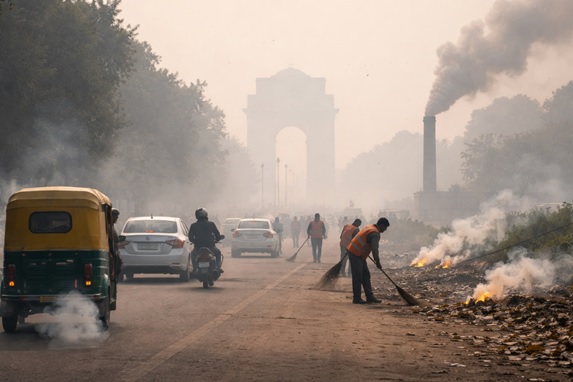
Delhi and the NCR experience severe air pollution every winter due to a complex interplay of:
Over the years, numerous scientific studies have attempted to apportion pollution sources. However, differences in data sets, methodologies, and time frames led to conflicting estimates, making it difficult to design targeted interventions.
To bridge this gap, the CAQM undertook a meta-analysis of existing peer-reviewed studies, producing a consolidated and evidence-based assessment of pollution sources affecting Delhi during the winter months.
The report provides a source-wise contribution to Delhi’s winter air pollution:
Importantly, the report notes that:
Unlike primary pollutants that are directly emitted, secondary particulate matter forms in the atmosphere through chemical reactions involving:
These react to form sulphates and nitrates, which together constitute nearly 25–60% of PM2.5 concentrations during winter.
Why this matters:
Ammonia plays a critical enabling role in the formation of secondary particulate matter.
These compounds significantly increase PM2.5 levels during winter, highlighting the rural–urban linkage in Delhi’s air pollution problem and the need to integrate agricultural practices into air quality governance.
1. Transport Emissions (23%)
2. Biomass Burning (20%)
3. Dust Pollution (15%)
The CAQM report has far-reaching implications for air quality management:
FAQs1. What is the CAQM synthesis report? It is a consolidated scientific assessment by the Commission for Air Quality Management that harmonises multiple studies to identify the major contributors to Delhi’s winter air pollution. 2. Which pollutant contributes the most to Delhi’s winter air pollution? Secondary particulate matter, contributing about 27%, is the largest single contributor. 3. Why is ammonia important in air pollution formation? Ammonia reacts with SO₂ and NOx to form sulphates and nitrates, which significantly increase PM2.5 levels, especially during winter. 4. How significant are transport and biomass burning compared to secondary particles? Transport contributes 23%, biomass burning 20%, while secondary particles remain the largest at 27%. 5. Why is the CAQM report significant for policymaking? It provides a unified scientific basis for targeted, multi-sectoral interventions and strengthens forecasting and governance mechanisms for air quality management. |



Our support team will be happy to assist you!

 Contact Us
  New Batch : 9555124124/ 7428085757
  Tech Support : 9555124124/ 7428085757