Prelims: (Polity & Governance + CA)
Mains: (GS 3 – Infrastructure, Energy, Climate Change, Economic Development, Governance) |
Why in News?
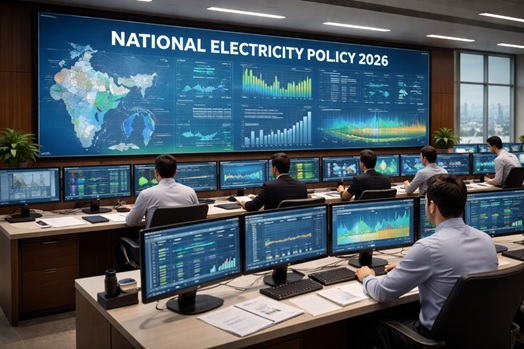
The Ministry of Power has released the Draft National Electricity Policy (NEP) 2026, outlining a comprehensive roadmap to overhaul India’s power sector in line with the vision of Viksit Bharat @2047.
Once finalised, the policy will replace the National Electricity Policy, 2005, reflecting two decades of transformation in energy demand, technology, market structures, and climate priorities.
From Shortages to Scale: How the Power Sector Has Evolved
Early Challenges (Pre-2005)
- The 2005 NEP focused on:
- Chronic power shortages,
- Limited electricity access,
- Weak generation and transmission infrastructure.
Transformation Since 2005
- Installed generation capacity has grown nearly fourfold, driven by strong private sector participation.
- Universal electrification was achieved by March 2021.
- A unified national grid became operational in 2013, enabling seamless power transfers across regions.
- Per capita electricity consumption rose to 1,460 kWh in 2024–25.
- The emergence of power markets and exchanges improved procurement efficiency, flexibility, and price discovery.
Persistent Stress Points
Despite progress, structural issues remain, particularly in the distribution segment:
- High accumulated losses,
- Mounting debt of DISCOMs,
- Non–cost-reflective tariffs,
- Heavy cross-subsidisation, raising industrial tariffs and hurting global competitiveness.
Draft NEP 2026: Ambitious Consumption and Climate Goals
The Draft NEP 2026 sets forward-looking national targets:
- Per capita electricity consumption:
- 2,000 kWh by 2030,
- Over 4,000 kWh by 2047.
- Climate alignment:
- 45% reduction in emissions intensity from 2005 levels by 2030,
- Net-zero emissions by 2070.
These goals signal a decisive shift toward a low-carbon, reliable, and resilient power system.
Draft National Electricity Policy 2026: Key Interventions at a Glance
The Draft NEP 2026 proposes wide-ranging reforms across planning, tariffs, markets, generation, grids, and technology.
1. Resource Adequacy Planning
- Decentralised planning:
- DISCOMs and State Load Despatch Centres (SLDCs) to prepare utility- and state-level Resource Adequacy (RA) plans under State Commission regulations.
- National coordination:
- Central Electricity Authority (CEA) to prepare a national RA plan to ensure countrywide capacity adequacy.
2. Financial Viability and Economic Competitiveness
- Automatic tariff revision: Linking tariffs to a suitable index for annual revision if State Commissions fail to issue tariff orders.
- Cost-reflective tariffs: Progressive recovery of fixed costs through demand charges to reduce cross-subsidisation.
- Cross-subsidy exemptions: Removal of cross-subsidies and surcharges for manufacturing, railways, and metro railways to lower logistics costs and improve industrial competitiveness.
- Large consumers: Possible exemption of distribution licensees from Universal Service Obligation for consumers with contracted load of 1 MW and above.
- Faster dispute resolution: Strengthening mechanisms to reduce regulatory burden and lower costs.
3. Renewable Energy Generation and Storage
- Market-based capacity addition:
- Greater reliance on markets and captive power plants for renewable expansion.
- Distributed Renewable Energy (DRE):
- DISCOM-led storage for small consumers to achieve economies of scale.
- Bulk consumers to install their own storage systems.
- Energy trading:
- Peer-to-peer (P2P) trading of surplus DRE and stored energy, directly or via aggregators.
- Scheduling parity:
- Equal treatment of renewable and conventional power in scheduling and deviation mechanisms by 2030.
- Market deployment of storage:
- Promotion of Battery Energy Storage Systems (BESS),
- Domestic manufacturing of cells and components,
- Incentives such as Viability Gap Funding (VGF) for BESS and pumped storage.
4. Thermal Power: Supporting the Energy Transition
- Grid support role:
- Integration of storage and repurposing of older thermal units to support grid stability and renewable integration.
- Efficiency gains:
- Exploring direct use of steam from thermal plants for district cooling and industrial processes.
5. Nuclear Energy Expansion
- Advanced technologies:
- Adoption of advanced nuclear technologies, modular reactors, and small reactors in line with the SHANTI Act, 2025.
- Long-term target:
- Scaling nuclear capacity to 100 GW by 2047, including use by commercial and industrial consumers.
6. Hydropower Development
- Storage-based hydro:
- Fast-tracking storage hydro projects for:
- Flood moderation,
- Irrigation,
- Water security,
- Energy security.
7. Power Markets and Competition
- Market oversight:
- Strong regulatory framework for monitoring and surveillance to prevent:
- Collusion,
- Gaming,
- Market dominance.
8. Transmission Reforms
- Right of Way (RoW):
- Use of advanced technologies and appropriate land-use compensation to address RoW challenges.
- Tariff parity:
- Equal transmission tariff treatment for renewable and conventional power by 2030.
- Efficient access:
- Utilisation-based allocation of transmission connectivity to prevent speculative hoarding.
9. Distribution System Reforms
- Loss reduction:
- Targeting single-digit Aggregate Technical and Commercial (AT&C) losses.
- Network sharing:
- Shared distribution networks to enhance competition and avoid duplication of infrastructure.
- Distribution System Operator (DSO):
- Establishment of DSOs to integrate distributed renewables, storage, and Vehicle-to-Grid (V2G) systems.
- Urban reliability:
- N-1 redundancy at distribution transformer level in cities with population above 10 lakh by 2032.
- Undergrounding of networks in congested urban areas.
10. Grid Operations and Governance
- Institutional reform:
- Functional unbundling of State Transmission Utilities.
- Creation of independent entities for SLDC operations and transmission planning.
- Regulatory alignment:
- Harmonisation of State Grid Codes with the Indian Electricity Grid Code issued by CERC.
11. Cybersecurity and Data Sovereignty
- Cyber resilience:
- Establishment of a robust cybersecurity framework for the power sector.
- Data localisation:
- Mandatory storage of power sector data within India to ensure sovereignty and system security.
12. Data Sharing and Visibility
- Transparent data framework:
- Sharing of operational and market data under a central government-prescribed framework.
- Real-time monitoring:
- Ensuring real-time visibility of Distributed Energy Resources for DISCOMs and SLDCs.
13. Technology and Skill Development
- Indigenous systems:
- Transition to domestically developed SCADA systems by 2030.
- Software self-reliance:
- Development of Indian software solutions for all critical power system applications.
FAQs
1.What is the Draft National Electricity Policy 2026?
It is a comprehensive policy framework released by the Ministry of Power to guide the transformation of India’s power sector in line with long-term growth and climate goals.
2. What policy will it replace?
It will replace the National Electricity Policy, 2005.
3. What are the consumption targets under the Draft NEP 2026?
Per capita electricity consumption is targeted at 2,000 kWh by 2030 and over 4,000 kWh by 2047.
4. How does the policy support renewable energy and storage?
Through market-based capacity addition, promotion of BESS and pumped storage, peer-to-peer energy trading, and incentives like Viability Gap Funding.
5. Why is the Draft NEP 2026 significant?
It integrates energy security, financial sustainability, market competition, and climate commitments into a unified roadmap for India’s power sector transformation.
|






 Contact Us
  New Batch : 9555124124/ 7428085757
  Tech Support : 9555124124/ 7428085757