Prelims: (Polity + CA)
Mains: (GS 2 – Constitutional Bodies, Governance) |
Why in the News ?
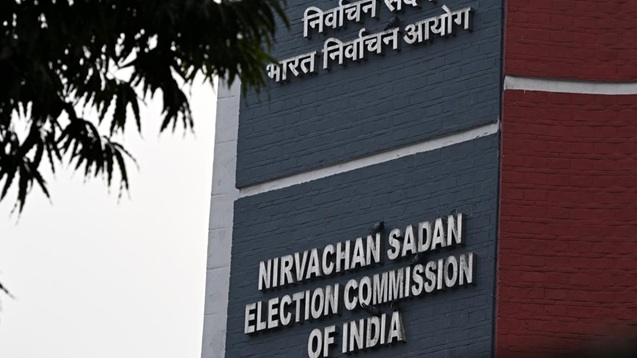
The Election Commission of India (ECI) has informed the Supreme Court that the Union Government’s role in citizenship matters is limited and does not override the Commission’s constitutional power to verify citizenship for electoral roll maintenance. The clarification comes amid Opposition challenges to the Special Intensive Revision (SIR) exercise carried out in multiple states.
Centre’s Citizenship Powers: Background to the Dispute
Opposition Objections
- Opposition parties in Tamil Nadu, Kerala, and West Bengal claim the ECI is conducting a quasi–NRC exercise through SIR.
- They argue that only the Union Government may determine citizenship under the Constitution and the Citizenship Act, 1955.
- These concerns were presented in legal challenges before the Supreme Court.
ECI’s Response (184-page Affidavit)
- Refutes allegations of an NRC-like screening.
- States that the dispute arises from a misunderstanding regarding the interface between:
- Citizenship Act, 1955, and
- Representation of the People Act (ROPA), 1950,
especially concerning voter eligibility under Article 326.
ECI on Limits of Central Authority
Section 9 of Citizenship Act — A Narrow Mandate
- Section 9 deals with termination of citizenship when an Indian acquires foreign citizenship voluntarily.
- According to the ECI:
- The Centre may determine how/when foreign citizenship was obtained.
- Its role is confined to this limited enquiry.
Key Point
This does not prevent other authorities—including the ECI—from examining citizenship status for voter roll purposes.
ECI’s Constitutional Mandate to Assess Citizenship
Powers Under Articles 324 & 326
- Article 324: Grants the ECI plenary powers of superintendence, direction, and control over elections.
- Article 326: Requires Indian citizenship as a precondition for voting.
- These collectively authorise the ECI to verify citizenship for maintaining clean electoral rolls.
ROPA, 1950: Statutory Duties
- Section 16: Disqualifies non-citizens from inclusion in electoral rolls.
- Section 19: Requires electors to be ordinarily resident in the constituency.
- Hence, the ECI must determine whether a person:
- is a citizen, and
- resides in the constituency claimed.
ECI’s Stand
Even Parliament’s power to make laws under Article 327 cannot dilute the Commission’s constitutional mandate.
Understanding the Special Intensive Revision (SIR)
Purpose & Legal Basis
- Conducted under Section 21(3), ROPA, allowing an “intense” revision when required.
- Initiated to address concerns of inaccurate, inflated, or outdated voter lists.
- The ECI emphasises that SIR is not a citizenship determination exercise, but a voter roll purification measure essential for free and fair elections—a Basic Feature of the Constitution.
Process of Verification
- Booth Level Officers deliver pre-filled Enumeration Forms (EFs) to electors’ homes.
- Voters are required only to sign/confirm the details.
- The ECI asserts that:
- No additional burden is placed on voters.
- The process helps locate voters missing from previous revisions (e.g., 2002 SIR).
ECI’s Rationale Behind SIR
To ensure electoral roll accuracy, the Commission seeks to remove:
- Deceased persons
- Voters who have permanently shifted
- Non-citizens
- Untraceable electors
Accurate rolls are crucial for both enrolment integrity and smooth voting at polling stations.
Opposition’s Concerns & ECI’s Clarification
Concerns Raised
- SIR is unconstitutional
- It duplicates the Union Government’s functions under the Citizenship Act
- Signature/verification requirements are burdensome
- It resembles an NRC-like citizenship screening
ECI’s Position
- SIR is constitutional, routine, and necessary.
- Documentation sought is minimal and directly linked to voter eligibility.
- It is not an NRC-style screening, nor does it determine citizenship beyond electoral purposes.
- The objective is limited to maintaining accurate, lawful, and updated voter lists.
FAQs
1. What triggered the ECI’s clarification to the Supreme Court ?
Challenges alleging that SIR was a citizenship-screening exercise similar to NRC.
2. What does Section 9 of the Citizenship Act empower the Centre to do ?
Determine how and when foreign citizenship was acquired—only for termination of Indian citizenship.
3. Under which constitutional articles does ECI claim the authority to verify citizenship ?
Articles 324 and 326.
4. What is the purpose of the Special Intensive Revision (SIR) ?
To correct, update, and purify electoral rolls—not to determine citizenship independently.
5. Does the SIR exercise require extensive documentation ?
No. Voters only need to sign pre-filled forms delivered to their homes.
|






 Contact Us
  New Batch : 9555124124/ 7428085757
  Tech Support : 9555124124/ 7428085757