
- UPSC Exam
- State PCS
- One Day Exam
- Current Affairs
- PT Quiz
- Downlaods
- About Coaching
- Blog
- Videos

| Prelims: (Polity + CA) Mains: (GS 2: Governance, Constitutional Rights, Judicial Interpretation; GS 3: Internal Security, Terrorism, Role of Anti-Terror Laws) |
The Supreme Court of India granted bail to five accused in the 2020 Northeast Delhi riots case but denied bail to Umar Khalid and Sharjeel Imam, holding that all accused did not stand on equal footing despite facing similar charges under the Unlawful Activities (Prevention) Act (UAPA).
The ruling is significant not only for its bail outcome but for its expansive interpretation of “terrorist act” under UAPA, the creation of a hierarchy of culpability, and its clarification on the limits of prolonged pre-trial incarceration under anti-terror laws.
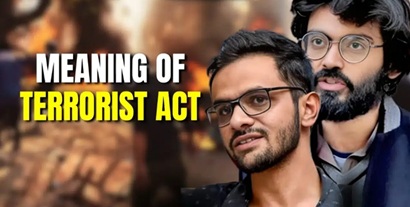
The Supreme Court rejected a blanket approach to culpability and emphasised that each accused must be assessed based on their role within the alleged conspiracy.
The Court introduced a graded or hierarchical framework of responsibility, distinguishing between:
In the case of Umar Khalid and Sharjeel Imam, the Court accepted the prosecution’s claim that they occupied a central and directive role.
They were described as:
The Court held that they allegedly planned coordinated disruptions, including chakka jams, intended to paralyse civic life and escalate protests into mass disorder.
The five accused granted bail were characterised as:
Their roles were deemed derivative, lacking autonomy or strategic control over the alleged conspiracy.
Since the investigation was complete and trial delays were substantial, continued incarceration of such accused was considered disproportionate and punitive.
Section 15 of the UAPA defines a terrorist act as one committed with intent to:
It lists specific violent means (explosives, firearms, etc.) and includes a broad residual clause — “or any other means.”
The prosecution argued that planned, synchronised road blockades choking arterial roads could fall under “any other means”, even without conventional weapons, because of their intended impact, scale, and consequences.
The defence argued that:
The Court rejected a narrow reading and held that:
This marks a broadened judicial understanding of terrorism, extending beyond traditional violence to include calibrated mass disruption.
Section 43D(5) bars bail if accusations appear prima facie true.
For the co-accused with limited roles, the bar was held not to operate with equal force.
All accused highlighted:
They relied on Union of India v. K.A. Najeeb (2021), where the Supreme Court held that constitutional courts may grant bail under UAPA to prevent violation of Article 21 if trials are indefinitely delayed.
The Court clarified that:
Given:
The delay could not be attributed solely to the prosecution.
Balancing Liberty and Security
Thus, bail was granted selectively.
FAQsQ1. What is the significance of this Supreme Court ruling ? It broadens the interpretation of “terrorist act” and clarifies bail standards under UAPA. Q2. Did the Court equate protest with terrorism ? No, but it held that coordinated, disruptive acts with strategic intent may qualify as terrorism. Q3. What is Section 43D(5) of UAPA ? It restricts bail if accusations appear prima facie true. Q4. How does this affect Article 21 rights ? The Court balanced liberty against national security, limiting automatic bail due to delay. Q5. Why is this judgment important for future cases ? It shapes how courts assess conspiracy, intent, and proportionality under anti-terror laws. |



Our support team will be happy to assist you!

 Contact Us
  New Batch : 9555124124/ 7428085757
  Tech Support : 9555124124/ 7428085757