Why in News?
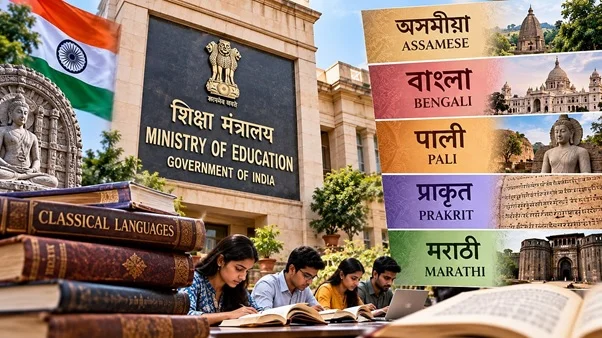
- The Ministry of Education has approved the establishment of five Centres of Excellence (CoEs) for studies in Classical Languages.
- The Centres will focus on Classical Assamese, Classical Bengali, Classical Marathi, Classical Pali and Classical Prakrit.
What are Classical Languages?
- Classical Languages are languages recognised for their high antiquity, rich ancient literary heritage and significant historical and cultural contribution.
- India currently has 11 recognised Classical Languages.
- Tamil was the first Indian language to receive Classical Language status in 2004.
- In 2024, five languages - Marathi, Pali, Prakrit, Assamese and Bengali were granted Classical Language status, taking the total number to 11.
India’s 11 Classical Languages
|
S. No.
|
Language
|
Year
|
|
1
|
Tamil
|
2004
|
|
2
|
Sanskrit
|
2005
|
|
3
|
Telugu
|
2008
|
|
4
|
Kannada
|
2008
|
|
5
|
Malayalam
|
2013
|
|
6
|
Odia
|
2014
|
|
7
|
Marathi
|
2024
|
|
8
|
Pali
|
2024
|
|
9
|
Prakrit
|
2024
|
|
10
|
Assamese
|
2024
|
|
11
|
Bengali
|
2024
|
Key Features
- Number of Centres: 5
- Classical Languages Covered: Assamese, Bengali, Marathi, Pali and Prakrit
- Assamese: Tezpur University, Assam
- Bengali: Visva-Bharati University, West Bengal
- Marathi: Deccan College Post-Graduate and Research Institute, Pune, Maharashtra
- Pali: Central University of Odisha, Odisha
- Prakrit: Central University of Gujarat, Gujarat
- Major Focus: Research, preservation, documentation, digitisation and dissemination
- Geographical Coverage: Five States
- Implementing Institutions: Designated Higher Educational Institutions
Centres of Excellence for Classical Languages
1. Classical Assamese
- The Tezpur University, Assam will house the Centre of Excellence for Classical Assamese.
- The Centre will provide institutional support for research and scholarship related to Assamese linguistic and literary traditions.
- It will also contribute to the documentation, preservation and digitisation of relevant linguistic and literary resources.
2. Classical Bengali
- The Visva-Bharati University, West Bengal will house the Centre of Excellence for Classical Bengali.
- The Centre will support advanced academic research into Bengali language and literary traditions.
- It will also facilitate wider dissemination of knowledge associated with the language.
3. Classical Marathi
- The Deccan College Post-Graduate and Research Institute, Pune, Maharashtra will house the Centre of Excellence for Classical Marathi.
- The Centre will strengthen research and scholarly engagement in Marathi’s linguistic and literary heritage.
- It will support the preservation and digitisation of important linguistic and textual resources.
4. Classical Pali
- The Central University of Odisha, Odisha will house the Centre of Excellence for Classical Pali.
- The Centre will provide an institutional platform for advanced research and scholarship related to Pali language and literature.
- It will contribute to documentation, preservation and wider dissemination of Pali knowledge traditions.
5. Classical Prakrit
- The Central University of Gujarat, Gujarat will house the Centre of Excellence for Classical Prakrit.
- The Centre will strengthen academic research into Prakrit language and its literary traditions.
- It will also support the preservation and digitisation of Prakrit linguistic resources.
How will the Centres of Excellence Promote Classical Languages?
The initiative will strengthen Classical Language studies through four broad areas:
1. Advanced Academic Research
- The Centres will provide dedicated platforms for advanced research, scholarly work and academic engagement.
- They will encourage systematic study of language, literature and associated knowledge traditions.
2. Documentation and Preservation
- The Centres will support the documentation and preservation of linguistic and literary resources.
- This will contribute to the long-term conservation of India’s rich textual and linguistic heritage.
3. Digitisation
- Digitisation will help preserve manuscripts, texts and other linguistic resources in digital formats.
- It can also improve access to these resources for students, researchers and academic institutions.
4. Wider Dissemination
- The Centres will facilitate wider access to linguistic, literary and knowledge traditions.
- This can expand academic engagement with Classical Languages beyond specialised research communities.
Why are the Centres of Excellence Important?
- India possesses a vast and diverse linguistic and literary heritage.
- Classical Languages preserve important traditions of literature, philosophy, history, religion and knowledge.
- Dedicated institutional platforms can strengthen specialised research and scholarship.
- Digitisation can protect valuable textual resources from physical deterioration and improve accessibility.
- The initiative can also strengthen Higher Educational Institutions as centres of research and knowledge preservation.
Classical Languages and India’s Cultural Heritage
- The Classical Languages of India represent an important part of the country’s civilisational, linguistic and literary heritage.
- Their literature and knowledge traditions provide valuable sources for understanding India’s intellectual and cultural development.
- The establishment of dedicated Centres of Excellence can help connect this heritage with modern research, higher education and digital technologies.
Institutional Framework
The initiative will involve multiple stakeholders, including:
- Ministry of Education
- Designated Higher Educational Institutions
- Universities and academic researchers
- Language and literature scholars
- Research and preservation institutions
The five designated institutions will act as specialised academic centres for their respective Classical Languages.
Significance
- Preservation of linguistic heritage: The initiative will strengthen institutional mechanisms for preserving India’s linguistic traditions.
- Promotion of research: Dedicated Centres will create opportunities for advanced academic research.
- Digitisation of resources: Digital preservation can improve the long-term accessibility of manuscripts and literary materials.
- Strengthening higher education: Universities will gain a greater role in specialised language research and scholarship.
- Regional academic development: The Centres across five States can strengthen regional ecosystems for linguistic research.
- Wider dissemination: The initiative can make Classical Language resources more accessible to students and researchers.
Challenges
- Shortage of specialised scholars: Classical Language research requires experts in linguistics, literature, manuscripts and related disciplines.
- Manuscript preservation: Ancient manuscripts often require specialised conservation infrastructure and expertise.
- Digitisation challenges: Scanning alone is insufficient; accurate transcription, translation, cataloguing and metadata creation are also required.
- Limited youth engagement: Classical Language studies need to be connected with contemporary academic and research opportunities.
- Need for interdisciplinary research: Greater integration with history, archaeology, philosophy, anthropology and digital humanities is required.
Way Forward
- Develop comprehensive programmes for digitisation and cataloguing of Classical Language resources.
- Promote interdisciplinary research linking languages with history, archaeology, philosophy and digital humanities.
- Use emerging technologies such as Artificial Intelligence, OCR and language technologies for research and preservation, with expert validation.
- Provide scholarships and fellowships to encourage young researchers.
- Strengthen collaboration among universities, archives, museums and research institutions.
- Create accessible digital repositories for students, scholars and researchers.
Conclusion
- The establishment of five Centres of Excellence marks an important step towards strengthening the institutional ecosystem for the study and preservation of India’s Classical Languages.
- With 11 languages now recognised as Classical Languages, dedicated research institutions can play an important role in preserving manuscripts, advancing scholarship, digitising linguistic resources and disseminating traditional knowledge.
- The initiative can help connect India’s rich linguistic and literary heritage with modern higher education, research and technology, ensuring its preservation for future generations.
Prelims Practice Question
Q. With reference to the Centres of Excellence for Classical Languages recently approved by the Ministry of Education, consider the following pairs:
- Classical Assamese — Tezpur University
- Classical Bengali — Visva-Bharati University
- Classical Marathi — Deccan College, Pune
- Classical Pali — Central University of Gujarat
Which of the pairs given above are correctly matched?
A. 1, 2 and 3 only
B. 1, 2 and 4 only
C. 1, 3 and 4 only
D. 1, 2, 3 and 4
Mains Practice Question
Q. India’s Classical Languages represent an important component of its linguistic and literary heritage. Discuss the significance of establishing Centres of Excellence for their preservation, research and digitisation.
|
FAQs
Q1. How many Classical Languages are recognised in India?
India currently has 11 recognised Classical Languages.
Q2. Which languages were recognised as Classical Languages in 2024?
Marathi, Pali, Prakrit, Assamese and Bengali were recognised as Classical Languages in 2024.
Q3. Which institution will host the Centre of Excellence for Classical Assamese?
The Centre for Classical Assamese will be established at Tezpur University, Assam.
Q4. Which institution will host the Centre of Excellence for Classical Bengali?
The Centre for Classical Bengali will be established at Visva-Bharati University, West Bengal.
Q5. Which institution will host the Centre of Excellence for Classical Marathi?
The Centre for Classical Marathi will be established at Deccan College Post-Graduate and Research Institute, Pune, Maharashtra.
|






 Contact Us
  New Batch : 9555124124/ 7428085757
  Tech Support : 9555124124/ 7428085757