Why in News?
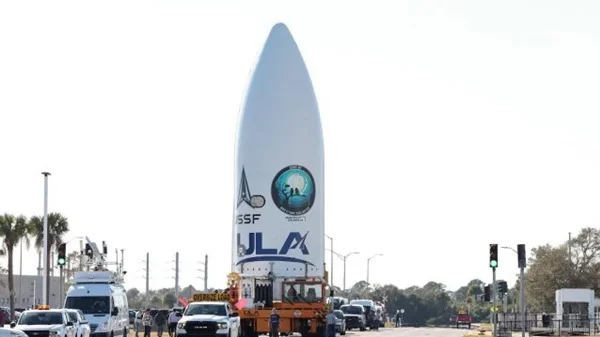
- On November 15, 2026, United Launch Alliance’s (ULA) Vulcan rocket suffered a technical malfunction approximately 10 minutes after its launch from Cape Canaveral Space Force Station in Florida, USA.
- The failure resulted in the loss of all 40 Amazon Leo satellites intended to provide satellite-based broadband internet services. It also marked the first complete mission failure in ULA’s history since its establishment in 2006.
Key Highlights of the Mission
|
Particulars
|
Details
|
|
Mission
|
Vulcan Leo 1 (LV-01)
|
|
Launch date
|
November 15, 2026
|
|
Launch vehicle
|
Vulcan Centaur
|
|
Launch operator
|
United Launch Alliance
|
|
Launch site
|
Cape Canaveral, Florida, USA
|
|
Payload
|
40 Amazon Leo satellites
|
|
Target orbit
|
Low Earth Orbit (LEO)
|
|
Mission status
|
Failed
|
|
Cause of failure
|
Under investigation
|
What Caused the Vulcan Rocket Failure?
- The rocket initially lifted off successfully, and its six solid rocket boosters separated during the early phase of flight.
- Preliminary observations suggest that the malfunction occurred during the operation of the Centaur upper stage.
- The rocket failed to achieve the required orbital conditions to deploy the satellites.
- ULA has launched an investigation to determine the exact technical cause of the failure.
The precise cause of the accident has not yet been officially established.
About Vulcan Centaur Rocket
Vulcan Centaur is a two-stage heavy-lift launch vehicle developed by United Launch Alliance (ULA) to carry commercial, scientific and national security payloads into space.
- Developer: United Launch Alliance (USA).
- Maiden flight: January 8, 2024.
- Height: Approximately 65 metres.
- First-stage engines: Two BE-4 engines developed by Blue Origin.
- First-stage fuel: Liquefied natural gas and liquid oxygen as oxidiser.
- Upper stage: Centaur V, powered by two RL10 engines.
- Upper-stage propellant: Liquid hydrogen and liquid oxygen.
- Purpose: To replace the Atlas V and Delta IV rocket families.
About United Launch Alliance (ULA)
- ULA is an American aerospace launch service provider established in 2006.
- It is a joint venture between Boeing and Lockheed Martin.
- It provides satellite launch services for commercial companies, NASA and US national security agencies.
- Its major launch vehicles include Atlas V, Delta IV and Vulcan Centaur.
What is Amazon Leo?
Amazon Leo, formerly known as Project Kuiper, is a satellite-based broadband internet initiative of Amazon. It aims to provide high-speed internet connectivity through a large network of satellites in Low Earth Orbit.
- Project Kuiper was renamed Amazon Leo on November 13, 2025.
- The initial constellation is designed to comprise more than 3,200 satellites.
- It aims to provide internet connectivity in remote and underserved regions.
- It is a major competitor to SpaceX’s Starlink and Eutelsat OneWeb.
- Amazon has contracted 38 Vulcan launches to deploy more than 1,500 satellites.
What is Low Earth Orbit (LEO)?
Low Earth Orbit refers to the region of space extending approximately 160 to 2,000 km above Earth's surface.
- Satellites in LEO orbit relatively close to Earth.
- They generally offer lower communication delays than geostationary satellites.
- They are widely used for Earth observation, communication, scientific research and internet services.
- The International Space Station (ISS) also operates in LEO.
Major Satellite Internet Projects
|
Project
|
Company
|
Country/Region
|
|
Starlink
|
SpaceX
|
USA
|
|
Amazon Leo
|
Amazon
|
USA
|
|
OneWeb
|
Eutelsat Group
|
Europe
|
|
Guowang
|
China SatNet
|
China
|
|
Telesat Lightspeed
|
Telesat
|
Canada
|
Significance of Satellite-Based Internet
- Digital inclusion: Provides internet access in remote and rural areas.
- Disaster management: Maintains communication when terrestrial networks are damaged.
- National security: Supports communication in geographically inaccessible regions.
- Maritime and aviation connectivity: Enables internet services for ships and aircraft.
- Economic development: Supports digital education, telemedicine and online businesses.
- Space economy: Creates opportunities in satellite manufacturing, launch services and ground infrastructure.
Impact of the Vulcan Rocket Failure
- Financial losses: The failure has resulted in the loss of 40 expensive communication satellites.
- Delay in deployment: It could affect Amazon’s satellite constellation expansion plans.
- Launch market disruption: Vulcan missions may face delays pending the investigation.
- Competitive disadvantage: The incident could strengthen Starlink’s position in the satellite broadband market.
- National security concerns: Delays in Vulcan launches could also affect future US government missions.
Relevance for India
- Commercial launch opportunities: India can expand its role in the global satellite launch market through cost-effective and reliable launch services.
- LVM3 capabilities: ISRO successfully launched 72 OneWeb satellites through two LVM3 missions in October 2022 and March 2023.
- Private sector participation: Indian space startups can contribute to satellite manufacturing and launch vehicle development.
- Digital connectivity: Satellite internet can improve connectivity in Himalayan regions, islands and remote villages.
- Strategic autonomy: Indigenous launch technology can reduce dependence on foreign launch service providers.
Challenges Associated with Satellite Constellations
- High satellite manufacturing and launch costs.
- Risk of rocket failures and satellite losses.
- Increasing congestion and space debris in Low Earth Orbit.
- Potential interference with astronomical observations.
- Spectrum allocation and regulatory challenges.
- Limited operational lifespan of LEO satellites.
Way Forward
- Strengthen launch vehicle testing and quality assurance.
- Diversify satellite launch service providers.
- Promote reusable launch vehicle technologies to reduce costs.
- Develop effective space debris management mechanisms.
- Encourage international cooperation in space traffic management.
- Promote public-private partnerships in the space sector.
Conclusion
The Vulcan rocket failure highlights the technological complexities and financial risks associated with commercial space missions. Despite such setbacks, satellite-based internet remains an important technology for global digital connectivity. For India, the growing commercial space market presents opportunities to strengthen its launch capabilities and emerge as a reliable global space partner.
Prelims Practice Question
Q. With reference to the Vulcan Centaur rocket, consider the following statements:
- It has been developed by United Launch Alliance.
- Its first-stage engines use liquefied natural gas and liquid oxygen.
- Amazon Leo satellites are designed to operate in geostationary orbit.
Which of the statements given above are correct?
(a) 1 and 2 only
(b) 2 and 3 only
(c) 1 and 3 only
(d) 1, 2 and 3
Mains Practice Question
Q. Discuss the significance of Low Earth Orbit satellite constellations in improving global digital connectivity. Examine the associated technological challenges and opportunities for India.
|
FAQs
Q1. What is the Vulcan Centaur rocket?
It is a heavy-lift rocket developed by ULA.
Q2. How many Amazon Leo satellites were lost?
All 40 satellites aboard the rocket were lost.
Q3. What was Amazon Leo previously known as?
It was previously known as Amazon's Project Kuiper.
Q4. Which engines power the Vulcan rocket’s first stage?
Two BE-4 engines developed by Blue Origin.
Q5. Why did the Vulcan rocket fail?
The exact technical cause is still under investigation.
|