For Prelims: India–Egypt Joint Trade Committee (JTC), Suez Canal, Preferential Trade Agreement (PTA), Free Trade Agreement (FTA), BRICS, Suez Canal Economic Zone.
For Mains: GS Paper II – International Relations; India–Egypt bilateral relations, India's engagement with Africa and West Asia.
Keywords: India–Egypt Trade Relations, Strategic Partnership, Bilateral Trade, Economic Cooperation, Piyush Goyal, Market Access. |
Why in News?
Union Minister of Commerce and Industry Piyush Goyal visited Egypt from 15–16 November 2026 to strengthen bilateral trade, investment and industrial cooperation.
- The seventh session of the India–Egypt Joint Trade Committee (JTC) was held at the ministerial level for the first time.
- Both countries agreed to establish a Joint Working Group to explore a potential Preferential Trade Agreement (PTA) or Free Trade Agreement (FTA).
- India and Egypt reaffirmed their commitment to achieving a bilateral trade target of USD 12 billion.
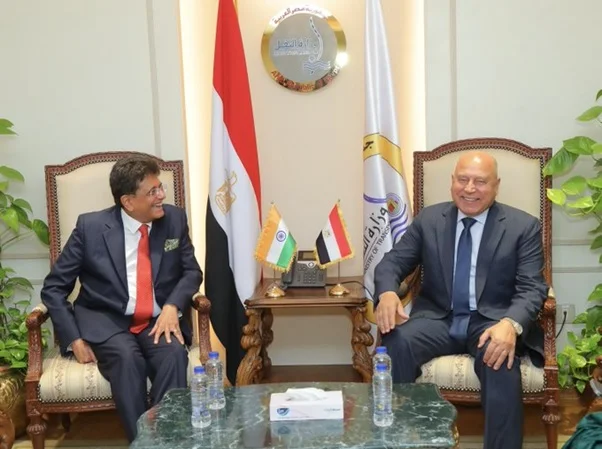
Key Highlights of the 7th Joint Trade Committee Meeting
- Venue: New Administrative Capital, Egypt.
- Co-chairpersons: India's Commerce and Industry Minister Piyush Goyal and Egypt's Minister of Investment and Foreign Trade Mohamed Farid Saleh.
- Trade Agreement: Establishment of a Joint Working Group to examine the framework for a potential bilateral trade agreement.
- Market Access: Reduction of non-tariff barriers, simplification of customs procedures and improvement of regulatory cooperation.
- Business Cooperation: More than 300 Indian and Egyptian companies participated in the India–Egypt Business Forum.
- Next Meeting: The eighth JTC meeting will be held in New Delhi in 2028 or earlier, as mutually agreed.
What is the Joint Trade Committee (JTC)?
The Joint Trade Committee is an institutional mechanism established between two countries to strengthen bilateral trade and economic cooperation.
Its major objectives include:
- Reviewing bilateral trade and investment relations.
- Resolving trade-related disputes and regulatory challenges.
- Identifying new opportunities for economic cooperation.
- Facilitating market access and business partnerships.
- Promoting industrial and technological collaboration.
India–Egypt Relations
- 1947: India and Egypt established diplomatic relations on 18 August.
- 1955: Both countries signed a Treaty of Friendship.
- 1961: India and Egypt became founding members of the Non-Aligned Movement (NAM).
- 1978: The India–Egypt Bilateral Trade Agreement came into operation.
- 2023: Bilateral relations were elevated to a Strategic Partnership.
- 2027: Both countries will celebrate 80 years of diplomatic relations.
India–Egypt Bilateral Trade
|
Indicator
|
Trade Value
|
|
Bilateral trade (FY 2025–26)
|
USD 6.5 billion
|
|
Annual trade growth (FY 2025–26)
|
35%
|
|
Indian exports (FY 2025–26)
|
USD 3.87 billion
|
|
Indian imports (FY 2025–26)
|
USD 2.60 billion
|
|
Bilateral trade (April–September 2026)
|
USD 5.04 billion
|
|
Indian investment in Egypt
|
Over USD 5.5 billion
|
|
Bilateral trade target
|
USD 12 billion
|
Major Export and Import Items
|
India's Exports to Egypt
|
India's Imports from Egypt
|
|
Petroleum products
|
Crude petroleum
|
|
Meat and poultry products
|
Fertilisers
|
|
Organic chemicals
|
Mineral products
|
|
Machinery
|
Cotton
|
Major Areas of India–Egypt Cooperation
- Pharmaceuticals and Healthcare: India can support Egypt through affordable medicines, vaccines, medical equipment and healthcare technologies.
- Defence and Security: Both countries share interests in military cooperation, joint exercises, defence manufacturing, maritime security and counterterrorism.
- Agriculture and Food Security: Cooperation in agricultural products, fertilisers, irrigation technologies and food processing can strengthen food security.
- Energy Cooperation: Both countries have significant opportunities in solar energy, green hydrogen, petroleum and renewable energy technologies.
- Digital and Financial Cooperation: India and Egypt are exploring opportunities in digital payments, UPI connectivity, local currency trade and digital public infrastructure.
- Infrastructure and Connectivity: Cooperation in railways, highways, ports and logistics can strengthen industrial development and regional connectivity.
Difference Between PTA and FTA
|
Preferential Trade Agreement (PTA)
|
Free Trade Agreement (FTA)
|
|
Reduces tariffs on selected products.
|
Eliminates or reduces tariffs on most traded goods.
|
|
Limited trade coverage.
|
Wider trade coverage.
|
|
Provides selective trade benefits.
|
Promotes deeper economic integration.
|
|
Example: India–MERCOSUR PTA.
|
Example: India–Australia ECTA.
|
Why is Egypt Important for India?
- Strategic Location: Egypt connects Africa, Asia and Europe, making it an important centre for international trade.
- Suez Canal: Egypt controls a major maritime route connecting the Mediterranean Sea with the Red Sea.
- Gateway to Africa: Egypt provides Indian companies opportunities to expand into African and Arab markets.
- Energy Security: Cooperation in petroleum, natural gas and fertilisers can strengthen India's energy and agricultural security.
- Defence Cooperation: Egypt is an important partner in maintaining regional stability and maritime security.
- Global South Cooperation: Both countries can strengthen developing countries' representation through platforms such as BRICS and NAM.
About Egypt
|
Particular
|
Details
|
|
Official name
|
Arab Republic of Egypt
|
|
Location
|
Northeastern Africa and Sinai Peninsula in Asia
|
|
Capital
|
Cairo
|
|
Currency
|
Egyptian Pound
|
|
Major river
|
Nile River
|
|
Bordering countries
|
Libya, Sudan and Israel
|
|
Other land boundary
|
Gaza Strip
|
|
Major water bodies
|
Mediterranean Sea and Red Sea
|
|
BRICS membership
|
January 2024
|
About the Suez Canal
- The Suez Canal is an artificial waterway located in Egypt.
- It was officially opened in 1869.
- It connects the Mediterranean Sea with the Red Sea.
- It provides a shorter maritime route between Asia and Europe by avoiding the Cape of Good Hope.
- Egypt nationalised the canal in 1956.
- It is strategically important for global energy supplies, maritime transport and international trade.
Significance of the India–Egypt Joint Trade Committee Meeting
- Export Promotion: Greater market access can increase Indian exports.
- Trade Diversification: Egypt can help India reduce dependence on traditional export destinations.
- Investment Opportunities: Industrial partnerships can generate employment and attract investment.
- Resilient Supply Chains: Joint manufacturing can strengthen regional and global supply chains.
- Strategic Partnership: Economic cooperation can further strengthen India's relations with Africa and West Asia.
Challenges in India–Egypt Relations
- Non-Tariff Barriers: Complex regulations and certification requirements affect bilateral trade.
- Currency Instability: Exchange rate fluctuations can increase business risks.
- Regional Instability: Conflicts in West Asia and the Red Sea can disrupt maritime trade.
- Limited Trade Diversification: Bilateral trade remains concentrated in certain sectors.
- Administrative Barriers: Customs procedures, visa restrictions and product registration requirements can discourage investment.
Way Forward
- Accelerate discussions on the proposed bilateral trade agreement.
- Promote Indian investment in the Suez Canal Economic Zone.
- Encourage bilateral trade settlement in local currencies.
- Simplify customs procedures and regulatory requirements.
- Strengthen cooperation in defence, healthcare, renewable energy and emerging technologies.
- Promote regular interaction between businesses and government institutions.
Conclusion
The seventh India–Egypt Joint Trade Committee meeting marks an important step towards strengthening bilateral economic relations. A potential trade agreement, greater industrial cooperation and improved market access can help achieve the USD 12 billion trade target while strengthening India's strategic engagement with Africa and West Asia.
Prelims Practice Questions
Q. With reference to the seventh India–Egypt Joint Trade Committee meeting, consider the following statements:
- It was held at the ministerial level for the first time.
- India and Egypt have signed a Free Trade Agreement.
- Both countries have set a bilateral trade target of USD 12 billion.
Which of the statements given above are correct?
(a) 1 and 2 only
(b) 2 and 3 only
(c) 1 and 3 only
(d) 1, 2 and 3
Mains Practice Question
Q. Discuss the economic and strategic significance of Egypt for India. How can the proposed India–Egypt trade agreement strengthen India's engagement with Africa and West Asia?
|
FAQs
Q1. What is the India–Egypt Joint Trade Committee?
It is a mechanism for promoting bilateral trade.
Q2. What is the India–Egypt bilateral trade target?
Both countries aim to achieve USD 12 billion.
Q3. When did India and Egypt establish diplomatic relations?
Both countries established diplomatic relations in August 1947.
Q4. When did Egypt become a BRICS member?
Egypt officially joined BRICS on 1 January 2024.
Q5. Which seas are connected by the Suez Canal?
It connects the Mediterranean Sea and Red Sea.
|