Prelims: Environment & Ecology, Biodiversity, Amphibians, Western Ghats, New Species
Mains: GS Paper III: Biodiversity, Environment and Conservation
Keywords: Gegeneophis chandgadi, Caecilian, Amphibian, Gymnophiona, Apoda, Western Ghats, Maharashtra, Annuli, Fossorial Species, Biodiversity, Endemism |
Why in News?
- Scientists have discovered a new species of legless, worm-like amphibian named Gegeneophis chandgadi from Maharashtra.
- The species belongs to the group of amphibians known as caecilians, which spend most of their lives underground.
About Gegeneophis chandgadi
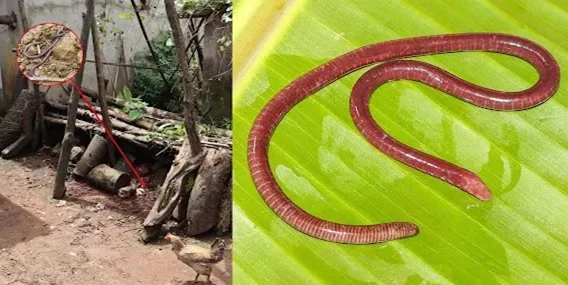
- Gegeneophis chandgadi is a newly identified species of caecilian.
- It was discovered in a rural region of Maharashtra.
- It is a legless, worm-like amphibian adapted to an underground lifestyle.
- The species has a slender, flesh-coloured body.
- Its body is surrounded by characteristic ring-like folds known as annuli.
- Primary annuli occur along its body, while secondary annuli are concentrated mainly on the posterior half.
Why is it Named ‘chandgadi’?
- The species name chandgadi has been given as a tribute to the local culture of the region where it was discovered.
- It derives from Chandgadi, a distinct local dialect of Marathi spoken by communities in the area.
- Thus, the scientific naming of the species also recognises the region's linguistic and cultural identity.
- The species has been reported from Maharashtra.
- Researchers have highlighted the northern Western Ghats as an important hotspot for caecilian diversity.
- The Western Ghats are globally recognised for their high levels of biodiversity and endemism.
What are Caecilians?
- Caecilians are a group of legless amphibians that superficially resemble large earthworms or small snakes.
- Despite their appearance, they are neither worms nor reptiles.
- They belong to the class Amphibia and are generally classified under the order Gymnophiona, also known as Apoda.
- Most caecilians are highly adapted to a burrowing or fossorial lifestyle.
Key Features of Caecilians
- They have no arms or legs.
- Their bodies are elongated and cylindrical.
- Their shiny skin contains ring-like folds called annuli.
- Most species spend much of their lives underground.
- Their skull is hard, thick and adapted for digging through soil.
- They are generally associated with moist tropical environments.
- Their underground lifestyle makes them difficult to observe and study.
Habitat
Most caecilians occur in moist tropical and subtropical regions.
They are mainly distributed across:
- South and Central America
- Sub-Saharan Africa
- South Asia
- Southeast Asia
Most caecilians are terrestrial and live underground, although some species are associated with aquatic environments.
Western Ghats and Biodiversity
- The discovery of Gegeneophis chandgadi once again highlights the ecological importance of the Western Ghats.
- The Western Ghats are one of the world's major biodiversity-rich regions and contain a large number of endemic plants and animals.
- The region's combination of high rainfall, forests, moist soil and geographical isolation has contributed to the evolution of several unique amphibian species.
Significance of the Discovery
- Biodiversity Documentation: The discovery adds a new species to India's documented amphibian diversity.
- Western Ghats Biodiversity: It strengthens the understanding of the Western Ghats as an important centre of amphibian diversity and endemism.
- Hidden Biodiversity: Since caecilians spend most of their lives underground, many species may remain scientifically undocumented.
- Conservation Importance: The discovery underlines the need to conserve soil ecosystems, forests and other microhabitats that support fossorial species.
- Local Cultural Recognition: Naming the species after the Chandgadi dialect links biodiversity documentation with local cultural heritage.
Challenges to Caecilian Conservation
Caecilians are particularly difficult to conserve because their underground lifestyle means that their population size and distribution are often poorly understood.
Major potential threats include:
- Habitat destruction
- Deforestation
- Changes in soil moisture
- Agricultural expansion
- Infrastructure development
- Pollution and pesticide use
- Climate change
Loss of healthy soil ecosystems can directly affect these underground amphibians.
India Relevance
- India is home to significant amphibian diversity, particularly in biodiversity-rich regions such as the Western Ghats and Northeast India.
- New species discoveries demonstrate that India's biodiversity is still not completely documented.
- Such discoveries can help scientists identify previously unknown habitats and improve conservation planning.
- They also reinforce the importance of protecting biodiversity hotspots from habitat fragmentation and unsustainable development.
Way Forward
- Conduct systematic surveys of underground biodiversity.
- Strengthen research on India's amphibian species.
- Protect important habitats in the Western Ghats.
- Promote conservation of soil and forest ecosystems.
- Involve local communities in biodiversity conservation.
- Document species before habitat degradation leads to their disappearance.
- Strengthen long-term monitoring of newly discovered species.
Conclusion
- The discovery of Gegeneophis chandgadi demonstrates that India's biodiversity, particularly in the Western Ghats, continues to hold species that remain unknown to science. Since caecilians live predominantly underground and are difficult to detect, their study can provide valuable insights into India's hidden biodiversity.
- Protecting their habitats and strengthening scientific surveys will be important for conserving these lesser-known components of India's natural heritage.
Prelims MCQs
Q. Gegeneophis chandgadi has been discovered in which Indian state?
A. Kerala
B. Karnataka
C. Maharashtra
D. Tamil Nadu
Mains Question
The discovery of new amphibian species in the Western Ghats highlights both India's rich biodiversity and gaps in its scientific documentation. Discuss the ecological significance of such discoveries and the challenges associated with conserving lesser-known species.
|
FAQs
What is Gegeneophis chandgadi?
It is a newly identified species of legless, worm-like amphibian belonging to the caecilian group and discovered in Maharashtra.
Is Gegeneophis chandgadi a snake?
No. Although it may resemble a small snake or large earthworm, it is an amphibian.
What are caecilians?
Caecilians are elongated, limbless amphibians, most of which are adapted to living underground.
What are annuli?
Annuli are ring-like skin folds that encircle the bodies of caecilians.
Why was the species named chandgadi?
The name honours the Chandgadi dialect of Marathi spoken by people in the region where the species was discovered.
Why is this discovery important for UPSC?
It is relevant to biodiversity, Western Ghats, endemic species, amphibians, biodiversity hotspots and species conservation, making it important particularly for Prelims and GS Paper III.
|







 Contact Us
  New Batch : 9555124124/ 7428085757
  Tech Support : 9555124124/ 7428085757