Why in News?
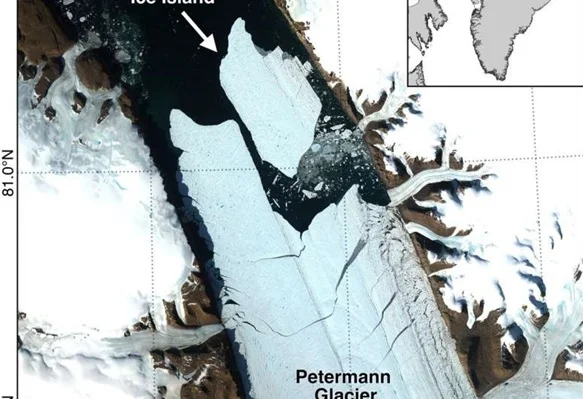
Recently, Petermann Glacier in northwest Greenland calved a 76.4 km² ice island, marking its largest ice loss since 2012 and the largest Arctic calving event since 2020. The event was identified through satellite monitoring by an international team of researchers led in part by the University of Ottawa.
What is Glacier Calving?
Glacier calving is the natural process in which large blocks of ice break away from the edge of a glacier or ice shelf, forming icebergs or ice islands.
Major Causes
- Rising air and ocean temperatures
- Melting of glacier ice
- Expansion of cracks (rifts)
- Ocean waves and tidal forces
About Petermann Glacier
- Petermann Glacier is located in northwestern Greenland, near the Nares Strait, which lies between Greenland and Canada's Ellesmere Island.
- It is one of Greenland's largest glaciers and connects the Greenland Ice Sheet to the Arctic Ocean.
- The glacier is named after German cartographer August Heinrich Petermann.
- It regularly calves large icebergs into the ocean.
- Melting of Greenland's glaciers is a major contributor to global sea-level rise.
- Scientists estimate that the complete collapse of Petermann Glacier could raise global sea levels by
Why is this Event Important?
Climate Change Indicator
- Large glacier calving events indicate changes in the Arctic climate and provide evidence of the impact of global warming on polar ice.
Scientific Importance
- Scientists will study the new ice island to understand:
- Glacier retreat
- Ice shelf stability
- Ocean circulation
- Polar climate processes
- Future sea-level changes
Impact on Arctic Navigation
- Large ice islands can drift for years before breaking into smaller icebergs.
- These floating ice masses can:
- Obstruct shipping routes
- Threaten offshore infrastructure
- Increase risks for Arctic navigation
- Canada's Environment and Climate Change Department is continuously tracking the movement of the new ice island.
Future Outlook
- Researchers expect two more large ice islands to break away from Petermann Glacier in the coming years.
- If all projected calving events occur:
- Around 254 km² of the glacier's floating ice tongue will be lost.
- This would reduce the ice tongue by nearly 22%.
Why is Greenland Important?
- Greenland contains the second-largest ice sheet in the world after Antarctica.
- Its ice sheet stores enough freshwater to significantly affect global sea levels if large-scale melting continues.
- It plays a crucial role in regulating the Earth's climate system.
Difference Between Iceberg and Ice Island
|
Iceberg
|
Ice Island
|
|
Usually smaller and irregular
|
Very large, flat (tabular) block of ice
|
|
Common in Antarctica
|
Rare in the Arctic
|
|
Formed by glacier or ice shelf calving
|
Formed from large floating ice shelves or glacier tongues
|
Prelims Question
Q1. With reference to the Petermann Glacier, consider the following statements:
- It is located in northwestern Greenland.
- It connects the Greenland Ice Sheet with the Arctic Ocean.
- It is situated near the Nares Strait.
Which of the statements given above is/are correct?
-
1 only
-
1 and 2 only
-
2 and 3 only
-
1, 2 and 3
Mains Question
Q. What is glacier calving? Explain the geographical significance of glacier calving in the Arctic region.
|
FAQs:
1. Why is Petermann Glacier in the news?
Recently, Petermann Glacier in northwestern Greenland calved a 76.4 km² ice island, marking its largest ice loss since 2012 and the largest Arctic calving event since 2020.
2. What is Petermann Glacier?
Petermann Glacier is one of the largest glaciers in Greenland, connecting the Greenland Ice Sheet to the Arctic Ocean.
3. What is glacier calving?
Glacier calving is the process in which large blocks of ice break away from a glacier or ice shelf, forming icebergs or ice islands.
4. What is an ice island?
An ice island is a large, flat (tabular) block of floating ice that breaks away from a glacier or ice shelf. It is much larger than a typical iceberg.
5. Where is the Nares Strait located?
The Nares Strait is a narrow waterway located between Greenland and Canada's Ellesmere Island in the Arctic.
|






 Contact Us
  New Batch : 9555124124/ 7428085757
  Tech Support : 9555124124/ 7428085757